


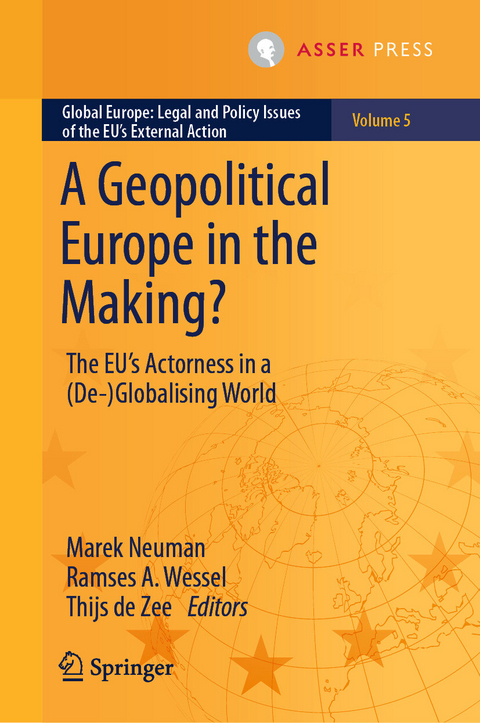
This edited book investigates whether - and if so, to what extent - the European Union began to turn its recently uttered ambition of becoming a geopolitical Union into practice. It does so by bringing a range of scholars from various institutions and disciplines - among others, political science, European law, European studies - together, asking them whether in their specific field, they can observe a geopolitical turn in the European Union's policy-making. The result of this intellectual endeavour can be found in this book; a book that makes a first attempt at empirically testing the Union's ability to effectively respond to ever- and rapidly-changing conditions for conducting international politics in a rule-based system. The volume is divided into two separate, yet mutually informing, parts. Part I consists of a series of empirical chapters assessing the EU's actorness vis-à-vis other regional powers, regional and international organisations. This is followed by several empirical snapshots looking into specific policy areas in Part II. As we combine the insights from both parts, we attempt to contribute to the debate on the changing nature of the European Union in challenging times. Our approach, then, is primarily an empirical one. And yet, building upon these conclusions, we are able to also draw conceptual conclusions about the EU's increasing geopolitical nature, or the lack thereof. These conclusions make this a relevant read not only for academics, but also for practitioners of European law and European integration.
Marek Neuman is Assistant Professor in EU Foreign Policy and Jean Monnet Chair of European Politics and Governance at the Faculty of Arts of the University of Groningen, The Netherlands.
Ramses A. Wessel is Professor of European Law at the Faculty of Law of the University of Groningen, The Netherlands.
Thijs de Zee is a PhD Candidate at the Faculty Campus Fryslân of the University of Groningen, The Netherlands.
Chapter 3 is available open access under a Creative Commons Attribution 4.0 International License via link.springer.com.
This edited book investigates whether - and if so, to what extent - the European Union began to turn its recently uttered ambition of becoming a geopolitical Union into practice. It does so by bringing a range of scholars from various institutions and disciplines - among others, political science, European law, European studies - together, asking them whether in their specific field, they can observe a geopolitical turn in the European Union's policy-making. The result of this intellectual endeavour can be found in this book; a book that makes a first attempt at empirically testing the Union's ability to effectively respond to ever- and rapidly-changing conditions for conducting international politics in a rule-based system. The volume is divided into two separate, yet mutually informing, parts. Part I consists of a series of empirical chapters assessing the EU's actorness vis-a-vis other regional powers, regional and international organisations. This is followed by several empirical snapshots looking into specific policy areas in Part II. As we combine the insights from both parts, we attempt to contribute to the debate on the changing nature of the European Union in challenging times. Our approach, then, is primarily an empirical one. And yet, building upon these conclusions, we are able to also draw conceptual conclusions about the EU's increasing geopolitical nature, or the lack thereof. These conclusions make this a relevant read not only for academics, but also for practitioners of European law and European integration.Marek Neuman is Assistant Professor in EU Foreign Policy and Jean Monnet Chair of European Politics and Governance at the Faculty of Arts of the University of Groningen, The Netherlands.Ramses A. Wessel is Professor of European Law at the Faculty of Law of the University of Groningen, The Netherlands.Thijs de Zee is a PhD Candidate at the Faculty Campus Frysln of the University of Groningen, The Netherlands.Chapter 3 is available open access under a Creative Commons Attribution 4.0 International License via link.springer.com.
| Erscheint lt. Verlag | 1.7.2025 |
|---|---|
| Sprache | englisch |
| Themenwelt | Recht / Steuern ► EU / Internationales Recht |
| Sozialwissenschaften ► Politik / Verwaltung ► Europäische / Internationale Politik | |
| ISBN-10 | 94-6265-666-5 / 9462656665 |
| ISBN-13 | 978-94-6265-666-6 / 9789462656666 |
| Informationen gemäß Produktsicherheitsverordnung (GPSR) | |
| Haben Sie eine Frage zum Produkt? |
 PDF (Wasserzeichen)
Größe: 4,6 MB
DRM: Digitales Wasserzeichen
Dieses eBook enthält ein digitales Wasserzeichen und ist damit für Sie personalisiert. Bei einer missbräuchlichen Weitergabe des eBooks an Dritte ist eine Rückverfolgung an die Quelle möglich.
Dateiformat: PDF (Portable Document Format)
Mit einem festen Seitenlayout eignet sich die PDF besonders für Fachbücher mit Spalten, Tabellen und Abbildungen. Eine PDF kann auf fast allen Geräten angezeigt werden, ist aber für kleine Displays (Smartphone, eReader) nur eingeschränkt geeignet.
Systemvoraussetzungen:
PC/Mac: Mit einem PC oder Mac können Sie dieses eBook lesen. Sie benötigen dafür einen PDF-Viewer - z.B. den Adobe Reader oder Adobe Digital Editions.
eReader: Dieses eBook kann mit (fast) allen eBook-Readern gelesen werden. Mit dem amazon-Kindle ist es aber nicht kompatibel.
Smartphone/Tablet: Egal ob Apple oder Android, dieses eBook können Sie lesen. Sie benötigen dafür einen PDF-Viewer - z.B. die kostenlose Adobe Digital Editions-App.
Buying eBooks from abroad
For tax law reasons we can sell eBooks just within Germany and Switzerland. Regrettably we cannot fulfill eBook-orders from other countries.
 EPUB (Adobe DRM)
Kopierschutz: Adobe-DRM
Adobe-DRM ist ein Kopierschutz, der das eBook vor Mißbrauch schützen soll. Dabei wird das eBook bereits beim Download auf Ihre persönliche Adobe-ID autorisiert. Lesen können Sie das eBook dann nur auf den Geräten, welche ebenfalls auf Ihre Adobe-ID registriert sind.
Details zum Adobe-DRM
Dateiformat: EPUB (Electronic Publication)
EPUB ist ein offener Standard für eBooks und eignet sich besonders zur Darstellung von Belletristik und Sachbüchern. Der Fließtext wird dynamisch an die Display- und Schriftgröße angepasst. Auch für mobile Lesegeräte ist EPUB daher gut geeignet.
Systemvoraussetzungen:
PC/Mac: Mit einem PC oder Mac können Sie dieses eBook lesen. Sie benötigen eine
eReader: Dieses eBook kann mit (fast) allen eBook-Readern gelesen werden. Mit dem amazon-Kindle ist es aber nicht kompatibel.
Smartphone/Tablet: Egal ob Apple oder Android, dieses eBook können Sie lesen. Sie benötigen eine
Geräteliste und zusätzliche Hinweise
Buying eBooks from abroad
For tax law reasons we can sell eBooks just within Germany and Switzerland. Regrettably we cannot fulfill eBook-orders from other countries.


