


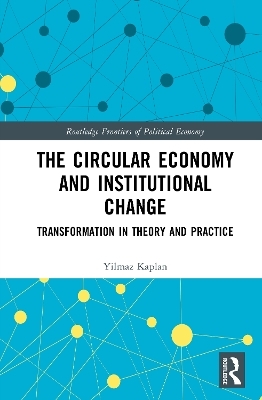
The Circular Economy and Institutional Change
Transformation in Theory and Practice
Seiten
2025
Routledge (Verlag)
978-1-032-78909-5 (ISBN)
Routledge (Verlag)
978-1-032-78909-5 (ISBN)
The climate crisis has emerged as a consequence of the linear economic system that developed in the aftermath of the industrial revolution. In recent years, global actors have recognised the need for institutional change from the linear economy to a more sustainable alternative: the circular economy.
The climate crisis has emerged as a consequence of the linear economic system that developed in the aftermath of the Industrial Revolution. In recent years, global actors have recognised the need for institutional change from the linear economy to a more sustainable alternative: The circular economy.
This book analyses the potential for transformative institutional change to a circular economy, both in theory and in practice. At the theoretical level, the book evaluates the feasibility of transitioning from a linear economy system to a circular economy by drawing on the principles of New Institutionalism. It thoroughly examines the key parameters of institutional change, focusing on the role of actors and new ideas within the institutional change process. Building upon this theoretical framework, the book then delves into the practical implementations of key actors. It first explores the role of the state and the market as crucial institutional actors, referencing the historical debate between these two entities. Additionally, the book critically assesses the agenda-setting power of influential international organisations, specifically the United Nations and the World Trade Organization, in driving a circular institutional change. Furthermore, it analyses the circular economy policies of influential global actors such as the European Union, China, Japan, and the USA. Aligned with these analyses, the book also examines the potential of a circular institutional change to bring about a paradigm shift from the prevailing industrial and consumer-centric society to an ecologically oriented society.
This book is invaluable for readers interested in the circular economy, new institutionalism, the impacts of climate change, and alternative economic policy.
The climate crisis has emerged as a consequence of the linear economic system that developed in the aftermath of the Industrial Revolution. In recent years, global actors have recognised the need for institutional change from the linear economy to a more sustainable alternative: The circular economy.
This book analyses the potential for transformative institutional change to a circular economy, both in theory and in practice. At the theoretical level, the book evaluates the feasibility of transitioning from a linear economy system to a circular economy by drawing on the principles of New Institutionalism. It thoroughly examines the key parameters of institutional change, focusing on the role of actors and new ideas within the institutional change process. Building upon this theoretical framework, the book then delves into the practical implementations of key actors. It first explores the role of the state and the market as crucial institutional actors, referencing the historical debate between these two entities. Additionally, the book critically assesses the agenda-setting power of influential international organisations, specifically the United Nations and the World Trade Organization, in driving a circular institutional change. Furthermore, it analyses the circular economy policies of influential global actors such as the European Union, China, Japan, and the USA. Aligned with these analyses, the book also examines the potential of a circular institutional change to bring about a paradigm shift from the prevailing industrial and consumer-centric society to an ecologically oriented society.
This book is invaluable for readers interested in the circular economy, new institutionalism, the impacts of climate change, and alternative economic policy.
Yılmaz Kaplan received his PhD from the Department of Politics at the University of York, UK. His research interests include international political economy, the circular economy, environmental governance, globalisation, and new institutionalism.
1: Introduction: The Circular Economy as a Transformative Idea 2: Ideas, Actors and System Change: An Institutionalist Analysis 3: The State versus the Market: How to Govern an Institutional Change 4: Analysing the Leading Actors: China, Japan, the EU, and the USA 5: International Organizations and the Circular Economy: the UN, the Bretton Woods Institutions and the WTO 6: Conclusion
| Erscheinungsdatum | 17.10.2025 |
|---|---|
| Reihe/Serie | Routledge Frontiers of Political Economy |
| Verlagsort | London |
| Sprache | englisch |
| Maße | 156 x 234 mm |
| Gewicht | 460 g |
| Themenwelt | Naturwissenschaften ► Biologie ► Ökologie / Naturschutz |
| Sozialwissenschaften ► Politik / Verwaltung | |
| Wirtschaft ► Volkswirtschaftslehre ► Wirtschaftspolitik | |
| ISBN-10 | 1-032-78909-3 / 1032789093 |
| ISBN-13 | 978-1-032-78909-5 / 9781032789095 |
| Zustand | Neuware |
| Informationen gemäß Produktsicherheitsverordnung (GPSR) | |
| Haben Sie eine Frage zum Produkt? |
Mehr entdecken
aus dem Bereich

aus dem Bereich
Gewinnung - Aufbereitung - Speicherung - Verteilung
Buch | Softcover (2022)
Springer Vieweg (Verlag)
CHF 55,95
Methoden – Lösungen – Anwendungen
Buch | Hardcover (2025)
Hanser (Verlag)
CHF 69,95


