


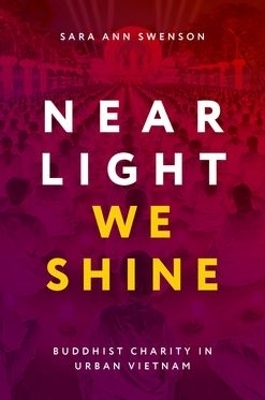
Near Light We Shine
Buddhist Charity in Urban Vietnam
Seiten
2026
Oxford University Press Inc (Verlag)
978-0-19-781186-3 (ISBN)
Oxford University Press Inc (Verlag)
978-0-19-781186-3 (ISBN)
- Lieferbar (Termin unbekannt)
- Versandkostenfrei
- Auch auf Rechnung
- Artikel merken
Near Light We Shine explores the growth of grassroots charity movements in Vietnam. Volunteers promote altruism by citing the Buddhist proverb, "What is near ink, darkens; what is near light, shines", and this book traces how Buddhism directly affects and inspires these widespread yet relatively small-scale grassroots charity movements.
Buddhists in Vietnam are meeting humanitarian needs by popularizing charity. Vietnam's rapid urbanization has intensified social service demands while straining public infrastructure. In response, charity volunteers are building roads, subsidizing medicine, and giving away food. Near Light We Shine draws on two years of ethnographic research conducted in Ho Chi Minh City to analyse why and how people join these grassroots movements.
Volunteers adapt practices from Vietnam's dominant religion--Buddhism--to attract donors and advocate for different programming styles. However, there can also be clashes over the ultimate purpose of philanthropy. Volunteers approach both Buddhism and altruism in different ways depending on their personal values and demographic communities. These communities include low-income day laborers, elderly women, Buddhist nuns, urban migrants, college students, and queer men. Volunteers promote altruism by citing the proverb, "What is near ink, darkens; what is near light, shines." They use this axiom to distinguish themselves as good people "with heart" [co tam], whose charities are more caring and ethical than other organizations. Disputes over who practices true charity are rooted in different phenomenological and ontological experiences of how altruism influences the world. Volunteers promote distinct Buddhist cosmologies that are traditional, pro-socialist, sceptical, queer, modern, scientific, magical, and often at odds with one another. Altogether, people draw on Buddhism as an adaptable resource to build moral communities and transform the world. Near Light We Shine provides unprecedented insights into how Buddhism functions as a highly adaptable tool for people to build moral communities in Southeast Asia.
Buddhists in Vietnam are meeting humanitarian needs by popularizing charity. Vietnam's rapid urbanization has intensified social service demands while straining public infrastructure. In response, charity volunteers are building roads, subsidizing medicine, and giving away food. Near Light We Shine draws on two years of ethnographic research conducted in Ho Chi Minh City to analyse why and how people join these grassroots movements.
Volunteers adapt practices from Vietnam's dominant religion--Buddhism--to attract donors and advocate for different programming styles. However, there can also be clashes over the ultimate purpose of philanthropy. Volunteers approach both Buddhism and altruism in different ways depending on their personal values and demographic communities. These communities include low-income day laborers, elderly women, Buddhist nuns, urban migrants, college students, and queer men. Volunteers promote altruism by citing the proverb, "What is near ink, darkens; what is near light, shines." They use this axiom to distinguish themselves as good people "with heart" [co tam], whose charities are more caring and ethical than other organizations. Disputes over who practices true charity are rooted in different phenomenological and ontological experiences of how altruism influences the world. Volunteers promote distinct Buddhist cosmologies that are traditional, pro-socialist, sceptical, queer, modern, scientific, magical, and often at odds with one another. Altogether, people draw on Buddhism as an adaptable resource to build moral communities and transform the world. Near Light We Shine provides unprecedented insights into how Buddhism functions as a highly adaptable tool for people to build moral communities in Southeast Asia.
Sara Ann Swenson is an Assistant Professor in Religion at Dartmouth College. She researches contemporary Buddhism in Vietnam. She holds a PhD and MPhil in Religion from Syracuse University, an MA in Comparative Religion from Iliff School of Theology, and a BA in English from the University of Minnesota Duluth.
Introduction: Many Buddhisms, Many Vietnams
1: Good People and Dangerous Strangers
2: Belonging, Precarious, and Queer
3: Charity Event-Networks
4: An Alternate Youth Culture
5: Fraud at the Children's Festival
6: Building a Socialist-Buddhist Nation
7: Taking a Stance through Grassroots Social Work
Conclusion: The Affective Politics of Giving
Appendix 1: Charity Groups (in Order of Appearance)
Appendix 2: People (By Group)
| Erscheinungsdatum | 06.12.2025 |
|---|---|
| Reihe/Serie | AAR Academy Series |
| Verlagsort | New York |
| Sprache | englisch |
| Maße | 165 x 242 mm |
| Gewicht | 503 g |
| Themenwelt | Geisteswissenschaften ► Religion / Theologie ► Buddhismus |
| Sozialwissenschaften ► Pädagogik ► Sozialpädagogik | |
| Sozialwissenschaften ► Soziologie | |
| ISBN-10 | 0-19-781186-8 / 0197811868 |
| ISBN-13 | 978-0-19-781186-3 / 9780197811863 |
| Zustand | Neuware |
| Informationen gemäß Produktsicherheitsverordnung (GPSR) | |
| Haben Sie eine Frage zum Produkt? |
Mehr entdecken
aus dem Bereich


aus dem Bereich
Philosophische Betrachtungen
Buch | Softcover (2024)
Aufbau TB (Verlag)
CHF 20,95
das Leben darf leicht sein : 99 Impulse eines Zen-Mönchs
Buch | Hardcover (2025)
Lotos (Verlag)
CHF 29,90


