


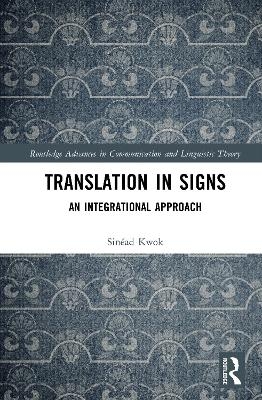
Translation in Signs
An Integrational Approach
Seiten
2026
Routledge (Verlag)
978-1-032-96986-2 (ISBN)
Routledge (Verlag)
978-1-032-96986-2 (ISBN)
- Noch nicht erschienen (ca. Februar 2026)
- Versandkostenfrei
- Auch auf Rechnung
- Artikel merken
What is translation? What is a sign? This book answers these questions and gives a critical review of how the West has been theorizing translation, in terms of theorizing the sign, a ‘unit’ of our communication.
What is translation? What is a sign? This book answers these questions and gives a critical review of how the West has been theorising translation, in terms of theorising the sign, a ‘unit’ of our communication.
From the promotion of servitude to the craving for creativity, the suspicious conceit of ‘equivalence’ to the new-fangled notion of ‘untranslatability’, the concept of translation as a one-off, specialised process that takes place between human languages to one of translation as a ceaseless happening which goes beyond languages and humans –this book dives into these popular discourses on translation, one by one, and unveils the underlying assumptions about the sign. What should a sign mean? Does the sign stand in for something in reality, something in our mind, or does it not stand for anything at all? How do we identify and share the same form of signs? How do we communicate via signs? These are the questions everyone has to answer, whether they know it or not, when they conceptualise translation. This book also proffers a refreshing take on translation, stemming from the integrational theory of the sign, as founded by Roy Harris.
This book provides a theory of translation based on a theory of the personal, integrational sign that will hopefully illuminate readers’ own experience with translation and with sign-making. It is a book for students of linguistics, semiotics and translation, as well as lay sign-makers and translators alike.
What is translation? What is a sign? This book answers these questions and gives a critical review of how the West has been theorising translation, in terms of theorising the sign, a ‘unit’ of our communication.
From the promotion of servitude to the craving for creativity, the suspicious conceit of ‘equivalence’ to the new-fangled notion of ‘untranslatability’, the concept of translation as a one-off, specialised process that takes place between human languages to one of translation as a ceaseless happening which goes beyond languages and humans –this book dives into these popular discourses on translation, one by one, and unveils the underlying assumptions about the sign. What should a sign mean? Does the sign stand in for something in reality, something in our mind, or does it not stand for anything at all? How do we identify and share the same form of signs? How do we communicate via signs? These are the questions everyone has to answer, whether they know it or not, when they conceptualise translation. This book also proffers a refreshing take on translation, stemming from the integrational theory of the sign, as founded by Roy Harris.
This book provides a theory of translation based on a theory of the personal, integrational sign that will hopefully illuminate readers’ own experience with translation and with sign-making. It is a book for students of linguistics, semiotics and translation, as well as lay sign-makers and translators alike.
Sinéad Kwok is an adjunct assistant professor at the University of Hong Kong. Her research interests lie in semiology and semiotics, translation, linguistics, language and communication, language philosophy and textual studies. Sinead has published in multiple book series and journals, including Language Sciences and Language and Communication.
Prolegomenon
1 The Origin of the Translation Myth: On Disowning and Purifying Signs
2 (Un)translatability as a Structuralist Cacophony?
3 Hermeneutics and Semiotics: Translating Life towards the Ultimate (Speech) Sign
4 Missing in Action: The Lay Translating Sign‑Maker?
| Erscheint lt. Verlag | 11.2.2026 |
|---|---|
| Reihe/Serie | Routledge Advances in Communication and Linguistic Theory |
| Verlagsort | London |
| Sprache | englisch |
| Maße | 156 x 234 mm |
| Gewicht | 453 g |
| Themenwelt | Geisteswissenschaften ► Philosophie ► Erkenntnistheorie / Wissenschaftstheorie |
| Geisteswissenschaften ► Sprach- / Literaturwissenschaft ► Sprachwissenschaft | |
| Sozialwissenschaften | |
| ISBN-10 | 1-032-96986-5 / 1032969865 |
| ISBN-13 | 978-1-032-96986-2 / 9781032969862 |
| Zustand | Neuware |
| Informationen gemäß Produktsicherheitsverordnung (GPSR) | |
| Haben Sie eine Frage zum Produkt? |
Mehr entdecken
aus dem Bereich

aus dem Bereich
Buch | Softcover (2023)
Reclam, Philipp (Verlag)
CHF 9,80
die Evolution des Geistes
Buch | Softcover (2025)
Suhrkamp (Verlag)
CHF 41,95


