


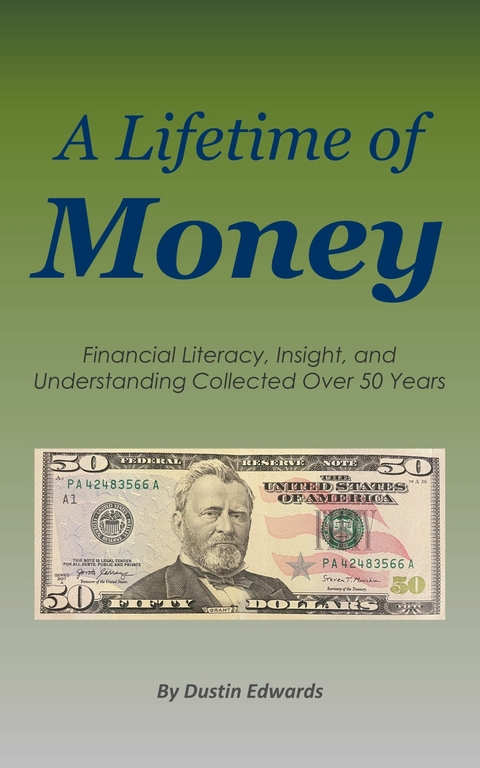
A Lifetime of Money (eBook)
105 Seiten
Publishdrive (Verlag)
9780000957573 (ISBN)
A Financial Literacy primer for those who are just starting out on their financial journey from someone who has spent time over the course of 50 years learning the basics of personal finance one small step at a time.
2. Your relationship with money and things
Once, when I was a kid, probably 11 years old or so, I went to the State Fair in the state where I lived and had some unsupervised time on my own there for a few hours. I had taken some of my own money with me and had a great time riding rides and playing games. I ended up spending all of the money I brought with me. Afterward, I felt terrible. I had a tremendous sense of guilt over having wasted all of my money on the frivolity of the State Fair. I really was beside myself, practically in tears, and got some comfort from one of my older sisters who reassured me that I hadn’t done anything terrible. The emotion of that moment helped lodge the memory in me to a degree that I have never forgotten. How much money had I managed to waste? $10 or what today might be worth about $70, not a trivial amount but maybe not enough to be upset about either.
Each of us, by the ways we were raised and taught, has developed ways in which we think about, or relate to, money. My own parents were both raised with a Great Depression era mindset, definitely of frugality, but not necessarily of minimalism. Living through the Depression as children in the early 1930s made them somewhat fearful of scarcity. That experience and perspective helped to make both of them hoarders, each in their own way, and it also shaped their own relationships with money, some of which, naturally, was passed along to me.
You may love money, or hate it. Money may excite you or frighten you. It may confuse you or empower you. Coming into some money suddenly may trigger you to spend it in ways that you previously could or would not. Maybe you feel soothed by a spending spree online or at the mall. Maybe you feel good when you see your bank or investment account balances going up, and not so good when they go down. Or maybe, like I did, you feel guilty when you feel like you’ve spent too much.
In my experience, there are many times and situations in life where it helps to keep one’s emotions in check, to actively manage and control one’s feelings to preclude impulsive actions from ruling the day. Examples include when choosing a job, when choosing a life partner, when getting a loan, or when making a large purchase or investment.
Money, generally speaking, is certainly one of those things that is best handled objectively. Love, hate, excitement, fear, confusion, empowerment, feeling good, guilty, depressed or bad, and engaging in fantastical thinking all land on the emotional side of the fence and have no place at the table when it comes to financial matters. Ideally, all of the ways that you handle money and all of the ways that you make financial decisions would be done using a rational, objective, approach that’s not driven by emotions.
Emotions tend to be blinding. They easily prevent us from seeing all the angles and all of the facts. They do this by drawing all of our attention to the emotion, be it a fear or a fantasy. When you’re making a financial decision, have you considered all of the alternatives? What about taxes and the time-value of money or the depreciation of an asset, that is, the tendency for anything that you buy to lose its value over time, or even lose its value immediately after buying, like buying a new car and driving it off the lot.
Making matters worse, advertisers are more than well aware of the lure of the shiny, new and fantastical. They say: “wouldn’t your life be wonderful if only…” or “you will be so happy if…” They are also aware of FOMO, the Fear Of Missing Out, peddling the notion that you will be miserable if you’re the last one in your neighborhood to… In short, they are trying to play to your emotions. To make purchases, small or large, based on these kinds of emotional factors is a fool’s errand. I recommend that you try hard to save yourself from this kind of fate.
How can one make financial decisions objectively and rationally?
First, realize that money is an object. As an object, money does not have any inherent power. Test it. Lay a $20 on the table in front of you to see what it does. You can stare at it all day and it won’t do a thing. The only power that can be associated with money is when it is used by someone to make something happen. Consequently, it is OK to think about money objectively. When you realize that money can’t hurt you and it can’t make you happy either you may be able to start seeing the world a little differently.
When you’re faced with making a decision about spending some money, start by asking yourself: “Do I need this or do I just want it?” Every expenditure fits into at least one of those two categories and sometimes both. The expenditure under consideration might be small such as: “I need breakfast. I want coffee.” Or, it might be large like: “I need a car. I want a vacation.”
If the answer is “yes, I really need it”, you should then ask yourself other questions like: “do I need it above all else?”, “do I need it right now”, “is my need temporary such that a rental might make more sense than a purchase?”, “do I need a new one or could I get a good deal on a used one?”, or “do I need one with all the bells and whistles or would a basic one meet my needs just as well?”
For example, if you’re considering a car purchase, if the car fits into the “need” category then there is a strong chance that you should go conservative and look for a solid used, reliable car brand that doesn’t have too many miles on it. However, if the car you’re considering fits into the “want” category then you very well may want something less practical like a stretch pickup with a hot tub in the back.
There will definitely be things that you need in life and sometimes, when you are acquiring something that you will use for many years, it is best to get one that has enough quality to last. You should not feel guilty about spending money to get something you need and you should not feel bad about getting good quality stuff or something that will have enduring value to you even if it is in the experiential realm, like a trip to Europe for example. Remember, money is an object that you are simply trading for other objects or experiences. Keep the emotions like guilt out of the equation.
OK, so what if I don’t actually need it?
There is, of course, nothing inherently wrong with wanting to buy things you don’t need. But, actually deciding when to buy something you want, but don’t need, can be more difficult because wants are more likely to be associated with emotions. There are a few approaches you can take or questions you can ask yourself before you spend money on a want.
The first is timing. Is now the right time or can it wait? Sometimes, waiting is all it takes to make a want go away and disappear completely forever. Persistent or recurring wants warrant more scrutiny. Also, consider the timing relative to the last time you satisfied a want. If you are spending money to satisfy wants frequently, that’s a big red flag that you’re wasting money. What happened to the thing that you wanted yesterday? Are you already finished playing with it? Did you get your money’s worth out of it? Is it now settled on a shelf or at the back of the closet collecting dust?
Next is the reason or the answer to the question: “why do I want it?” The more the answer to this points to external factors, the less reasonable or rational it likely is. If I want it just because someone else already has it or maybe because no one else has it yet, it is, by definition, a bad idea. It is far better to buy something you want because it brings you joy than because you’re trying to impress someone else. If someone expects you to conform to some material standard, or will only admire you if you are participating in or leading the fashion trend, they’re probably toxic for you. Effectively, they’re influencing you to make bad or untimely financial decisions. Just put your wallet back in your pocket and walk away.
Another external factor is the comfort of stuff. Are you a hoarder? Do you simply feel better with more stuff around? There are numerous reasons for wanting stuff. Some stuff you gather and keep just because you might eventually be able to use it someday, somehow. Other stuff gives you warm fuzzies, usually visually. Maybe it’s a collection proudly displayed on a shelf or wall in your home or your garage. Sometimes you just like spending money. It may give you a sense of power or control over your life or environment. You might not even know why but it might help to try to figure it out.
The best reasons for you to want something over and beyond your basic needs are internal. Ideally, all your purchases will align with your personal values, however, it is challenging to objectively assess your own reasons for wanting something. Once you have gone through the process of asking all the questions above and ruled out external influences and emotional factors you may find that you still want to buy this thing that you’re considering. However, remain aware that the most frugal, and sometimes the most wealthy, people in the world own little or even nothing for no other reason than that it was simply wanted at one time. If you find yourself not being able to figure out why you want to purchase something, maybe that’s enough reason to avoid getting it.
So far we’ve only really talked about over-spending. Can under-spending be a problem too?
Good point! I have run across this a few times, though I’ve seen far more people have a problem being spendthrifts than being misers. Still, cheapness can be a problem in at least a couple different ways.
First, when you do need to make a purchase, you frequently get...
| Erscheint lt. Verlag | 13.1.2025 |
|---|---|
| Sprache | englisch |
| Themenwelt | Sozialwissenschaften ► Pädagogik |
| ISBN-13 | 9780000957573 / 9780000957573 |
| Informationen gemäß Produktsicherheitsverordnung (GPSR) | |
| Haben Sie eine Frage zum Produkt? |
 EPUB (Adobe DRM)
Kopierschutz: Adobe-DRM
Adobe-DRM ist ein Kopierschutz, der das eBook vor Mißbrauch schützen soll. Dabei wird das eBook bereits beim Download auf Ihre persönliche Adobe-ID autorisiert. Lesen können Sie das eBook dann nur auf den Geräten, welche ebenfalls auf Ihre Adobe-ID registriert sind.
Details zum Adobe-DRM
Dateiformat: EPUB (Electronic Publication)
EPUB ist ein offener Standard für eBooks und eignet sich besonders zur Darstellung von Belletristik und Sachbüchern. Der Fließtext wird dynamisch an die Display- und Schriftgröße angepasst. Auch für mobile Lesegeräte ist EPUB daher gut geeignet.
Systemvoraussetzungen:
PC/Mac: Mit einem PC oder Mac können Sie dieses eBook lesen. Sie benötigen eine
eReader: Dieses eBook kann mit (fast) allen eBook-Readern gelesen werden. Mit dem amazon-Kindle ist es aber nicht kompatibel.
Smartphone/Tablet: Egal ob Apple oder Android, dieses eBook können Sie lesen. Sie benötigen eine
Geräteliste und zusätzliche Hinweise
Buying eBooks from abroad
For tax law reasons we can sell eBooks just within Germany and Switzerland. Regrettably we cannot fulfill eBook-orders from other countries.
aus dem Bereich


