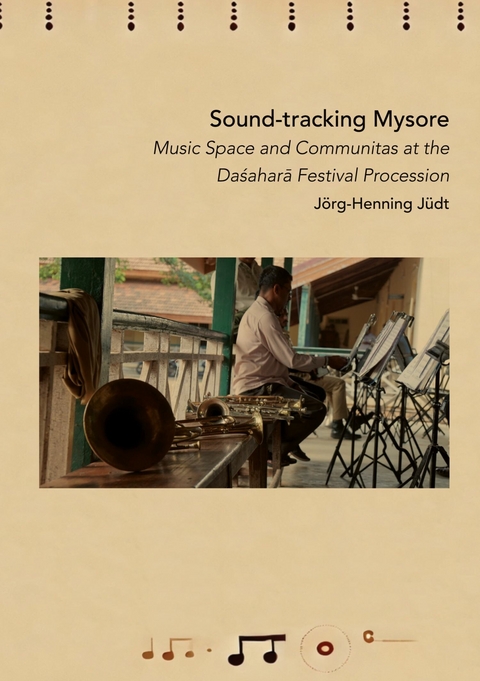
Sound-tracking Mysore (eBook)
112 Seiten
Books on Demand (Verlag)
978-3-8192-5797-1 (ISBN)
Dr. Jörg-Henning Jüdt is a musicologist specialising in ethnomusicology. His research focuses on the relationship between sound, space and community, particularly in musical processions, festive practices and ritual soundscapes, examining how music, movement and space construct religious, social and political meanings. Employing ethnographic fieldwork he also examined social hierarchies and status changes in the Cologne techno scene between 2010 and 2015 as an active Scene Member. In addition to his academic research and teaching at the university, he has worked as a dramaturge, designing and managing concert programmes and giving introductory lectures for symphony concerts.
1
INTRODUCTION
Processions are among the most striking visual displays of a religion. They reveal important aspects of religions. They are rituals but they are also much more. They display many of the dimensions of religion at the same time: art, sacred narratives, social hierarchies and competition, communities and identities. They are signals of social change. They are preservers of the past. They are continuously reinvented and may reflect strategies for groups to become visible in order to protect their place in the hierarchy or to compete for resources. (Jacobsen 2008: 9-10)
In this ethnographic study, my intention is to examine dynamic processes within a particular type of mobile music: the procession. The focus is on the Jumbo Savari Procession taking place during the Daśaharā Festival in the city of Mysore, located in the state of Karnataka in southern India. On Vijayādasamī, the 10th day of the festival, which is celebrated during the Hindu month of Ashvin (23 September to 22 October), people worship their local deity Chamundeshwari by attending and participating in the Jumbo Savari Procession, which simultaneously serves as a commemoration of past kings and an event to worship their living descendants.
1.1 Objectives and Research Questions
Two central aspects of this procession will be the main focus of my study. The first concerns its historical, social and participatory scale. Events such as processions require a variety of engagements and responsibilities with participants belonging to different groups. These groups include musicians who walk the prescribed procession route, those who do so without playing music, residents who live along the procession route, and various other spectators. They also include individuals engaged in the organisation during the actual event as well as during the preparation period or are generally associated with the procession. Based on their social agendas, imagination of history, and music played in the procession, they all have their respective conceptions of the significance of the procession. In light of this, my aim is to examine the role of music in the Jumbo Savari Procession in relation to the corresponding social order, hierarchy, and related power dynamics. The second concerns the spatiality. During musical processions, the spatial relationship between the participants and music can vary. The music moves mainly with the musicians, so from their point of view it stays with them. In contrast, spectators along the procession route experience the music as first approaching them, then staying with them for a while, and finally moving away from them. Both perspectives highlight the dynamic relationship between music, space, and participants. In this regard, I intend to explore the contribution of the music played during the Jumbo Savari Procession to the creation of space and its potential as a structuring element. More specifically, the Jumbo Savari Procession in Mysore serves as an example to explore the interplay between a) spatiotemporal aspects that affect how participants perceive music as mobile or stationary, b) space-constituting conditions for which music may be determinant, and c) associated social interactions and engagements that may occur during musical processions. To address these key issues, my research is guided by the following main research questions:
- What patterns of social interaction are part of the Daśaharā Festival and how do they shape processional musical practices? And how does the festival context constitute the social engagement of procession participants?
- ◦ How does music, as a central aspect of the Jumbo Savari Procession, affect the physical dimensions of the procession, taking into account its potential to shape spatial arrangements, create dynamic spatial experiences, and structure participation within the procession?
To further refine these questions regarding the relationship between music, space, and social interaction, the following questions are relevant. How does the act of rehearsing music connect with the sharing of ideas through social interaction? Are there musical markers associated with certain areas, places or moments along the processional route? Is the constitution of the processional space related to musical characteristics, such as style, instrumentation, singing, volume, etc.? Do these characteristics affect the interaction of the participants, for example, while the musicians in the procession stand still and continue to play in place, causing the audience on the side of the procession to experience the music as a rather stationary performance?
As described by Hagedorn (2002) and Sallnow (1981), the constitution of space is a collective process with a community-building effect. In this sense, and in relation to the concept of space theory developed by Michel de Certeau (2011), I understand musical processions as collective activities with socio-spatial relationships. Following de Certeau’s perception, social spaces serve as a basis for local community-building processes. They are initially constituted by individual actors and their subjective experiences of space. In processions, space constitution is experienced as a collective activity. Collectively constituted spaces, again, are a prerequisite for local community-building processes (Giddens 1996; Stokes 1994) for different social groups and the identities of the associated members marked by, for example, class, caste, gender, language, profession, or ritual roles. In processions, these processes may be temporal, for example, for tourists or other groups of spectators who come together spontaneously to watch the procession. Alternatively, they may be time-spanning, as for musicians in music groups who meet for preparation and musical rehearsals on a regular basis to represent religious and ritual contexts during the procession. Some groups are formally constituted, including military bands, police bands, and political parties, which may participate in parades for specific purposes such as hierarchical order or demonstration of authority. In short, this Dissertation will present an ethnographic study that provides a consolidated understanding of the cultural practices and the role music plays in the course of the Jumbo Savari Procession.
1.2 Overview of Chapters
Following the above introduction of my research questions and the aims of this study, in Chapter 2, I will expand my understanding of the concept of procession by first providing a detailed specification of the term, followed by clarification of the various names associated with the procession and the surrounding Daśaharā Festival. To provide a contextual understanding of the thesis topic, I offer an overview of the relevant literature concerning processions in general and the Jumbo Savari Procession in particular as well as a comprehensive analysis of its historical and cultural context and a description of the Jumbo Savari Procession itself. This leads to Chapter 3, where I provide a description of the research field in India and the qualitative research methodology adopted to explore the mobile, spatial, and social dynamics of the Jumbo Savari Procession in Mysore, including participant observation, audiovisual recordings, and interviews. I also discuss the key aspects of conducting this fieldwork, such as ethical considerations and limitations, offering insights into my researcher’s role and approach in the field. Chapter 4 is dedicated to my key research partners who played a crucial role in facilitating the historical, social, and spatial dimensions of the procession. It serves as an analysis and interpretation of my findings based on a combination of my field observations and interviews. I examine the musical contributions and social significance of the Police Band, while also analysing the layered meanings embedded in the spatial and musical order of the procession. Building on the interwoven layers of historical context and mythological constructs, spatial organisation, musical performance, and social dynamics, I will explore the concept of communitas as an integrating experience through the example of the Police Band. Accordingly, Chapter 5 examines how the participation of the Police Band as key performers in the Jumbo Savari Procession, guided by Victor Turner’s concept of normative communitas, provides a compelling example of how liminoid phenomena can generate meaningful communal expressions within organised contexts, thereby enhancing the event and fostering a stronger sense of community and belonging among participants. Chapter 6 provides a summary of my study on the Jumbo Savari Procession, recapitulating its historical, social, and spatial aspects. This concluding narrative not only summarises the findings of this ethnographic study but also lays the foundation for future research on public rituals and events, such as processions, ultimately contributing to the enrichment of scholarly discourse on the diverse terrain of Indian society.
1.3 Communitas
In order to provide a theoretical framework for the term “communitas” used in the title of this dissertation, Victor Turner’s1 groundwork on ritual and his related concept of communitas provide a valuable conceptual foundation. His empirical work on ritual has profoundly shaped anthropological views of cultural practices, such as community building and associated values, and it serves as a promising concept for this work. In the following section, I condense Turner’s ritual theory. In doing so, I will not only introduce terms that will...
| Erscheint lt. Verlag | 3.7.2025 |
|---|---|
| Sprache | englisch |
| Themenwelt | Sozialwissenschaften ► Politik / Verwaltung |
| ISBN-10 | 3-8192-5797-7 / 3819257977 |
| ISBN-13 | 978-3-8192-5797-1 / 9783819257971 |
| Informationen gemäß Produktsicherheitsverordnung (GPSR) | |
| Haben Sie eine Frage zum Produkt? |
 EPUB (Wasserzeichen)
DRM: Digitales Wasserzeichen
Dieses eBook enthält ein digitales Wasserzeichen und ist damit für Sie personalisiert. Bei einer missbräuchlichen Weitergabe des eBooks an Dritte ist eine Rückverfolgung an die Quelle möglich.
Dateiformat: EPUB (Electronic Publication)
EPUB ist ein offener Standard für eBooks und eignet sich besonders zur Darstellung von Belletristik und Sachbüchern. Der Fließtext wird dynamisch an die Display- und Schriftgröße angepasst. Auch für mobile Lesegeräte ist EPUB daher gut geeignet.
Systemvoraussetzungen:
PC/Mac: Mit einem PC oder Mac können Sie dieses eBook lesen. Sie benötigen dafür die kostenlose Software Adobe Digital Editions.
eReader: Dieses eBook kann mit (fast) allen eBook-Readern gelesen werden. Mit dem amazon-Kindle ist es aber nicht kompatibel.
Smartphone/Tablet: Egal ob Apple oder Android, dieses eBook können Sie lesen. Sie benötigen dafür eine kostenlose App.
Geräteliste und zusätzliche Hinweise
Buying eBooks from abroad
For tax law reasons we can sell eBooks just within Germany and Switzerland. Regrettably we cannot fulfill eBook-orders from other countries.
aus dem Bereich