


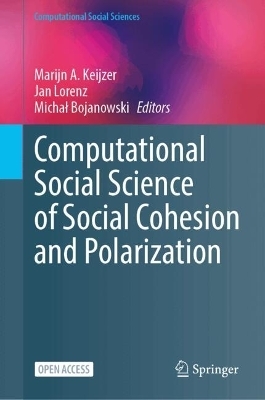
Computational Social Science of Social Cohesion and Polarization
Springer International Publishing (Verlag)
978-3-032-01372-9 (ISBN)
- Noch nicht erschienen - erscheint am 26.02.2026
- Versandkostenfrei
- Auch auf Rechnung
- Artikel merken
This is an open access book. What holds societies together and what drives them apart? As worry over political polarization and social cohesion intensifies across the globe, this volume explores timely and vital questions of social cohesion and polarization through the lens of Computational Social Science. It brings together leading and junior scholars who harness the power of computational methods to analyze, model, and understand discourse, social relationships, and beliefs. Drawing on tools such as agent-based modeling, social network analysis, and natural language processing, the book offers a range of innovative approaches to study how belief systems form, attitudes polarize, and communities fragment.
Aimed at researchers, students, and practitioners across disciplines, this volume is both an introduction to the field and a showcase of its most promising applications. It is an introduction into CSS of social cohesion and polarization, and an invitation to rethink how we study and perhaps even how we can repair the social fabric.
Marijn Keijzer is a research fellow at the Institute for Advanced Study in Toulouse and the Toulouse School of Economics. His research focuses on opinion dynamics and polarization, using a diverse set of methodologies from computational social science such as agent-based modeling, analysis of digital trace data and online (macro-)experiments. Marijn holds a PhD in Sociology (2022, ICS / University of Groningen).
Jan Lorenz is an assistant professor of social data science at Constructor University Bremen and faculty member at the Bremen International Graduate School of Social Sciences. He holds a Ph.D. in mathematics (2007, University Bremen) and a habilitation in computational social science at Constructr University. His research topics are models of opinion dynamics, social segregation, and other complex socio-economic systems. He did empirical research on the wisdom of crowds, measuring social cohesion, and polarization.
Michal Bojanowski is an assistant professor at the Chair of Quantitative Methods and Information Technology at Kozminski University and a post-doctoral researcher at the COALESCE Lab at the Autonomous University of Barcelona. He holds a PhD in sociology (2012, ICS / Utrecht University) and his research focuses on modeling social network data, especially collected with non-sociocentric designs as well as on assembling complex social network datasets from non-obvious sources (such as historical archives) often using technically-advanced procedures. Michal is an R developer with over 20 years of experience in writing packages and providing training in academic and business contexts. He is a member of Statnet Development Team -- the creators of a suite of R packages for statistical network analysis.
Computational Social Science of Social Cohesion and Polarization.- Social Cohesion and its Development in Germany before, during, and after COVID-19: The Bertelsmann Social Cohesion Radar.- Part I. Networks, Simulating an Empirically Informed Population Network of Core Discussion Ties.- The Anatomy of Rabbit Holes: Studying Information Segregation in YouTube s Recommendation Graph.- ResIN: A New Method to Analyze Socio-Political Attitude Systems.- Part II. Text-based methods, Elites and Polarisation: A Text and Sentiment Analytical Approach on the Dynamics of Polarized Political Discourses During Times of Crises.- Linguistic Polarization in Minority Representation: Analyzing Parliamentary Speeches in Germany and the UK (1980-2021).- Convergence in Framing: A Semantic Network Analysis of News Coverage of the LGBTQ Movement in the United States (1960s 2010s).- Part III. Agent-based modelling, Understanding Mutual Social Influence When People Prefer Coherent Beliefs.- An Investigation into the Causal Mechanism of Political Opinion Dynamics: A Model of Hierarchical Coarse-Graining with Community-Bounded Social Influence.- Modeling Social Cohesion: The Influence of Memory and Learning.- Epilogue, From Summer Schools to Research Incubators in Computational Social Science and Beyond.
| Erscheinungsdatum | 24.07.2025 |
|---|---|
| Reihe/Serie | Computational Social Sciences |
| Zusatzinfo | XV, 281 p. 74 illus., 58 illus. in color. |
| Verlagsort | Cham |
| Sprache | englisch |
| Maße | 155 x 235 mm |
| Themenwelt | Sozialwissenschaften ► Politik / Verwaltung ► Politische Theorie |
| Sozialwissenschaften ► Soziologie ► Makrosoziologie | |
| Schlagworte | communication science • Complexity Science • Computer Science • network science • open access • Opinion Dynamics • polarization and segregation • Political Science • Social Dynamics |
| ISBN-10 | 3-032-01372-0 / 3032013720 |
| ISBN-13 | 978-3-032-01372-9 / 9783032013729 |
| Zustand | Neuware |
| Informationen gemäß Produktsicherheitsverordnung (GPSR) | |
| Haben Sie eine Frage zum Produkt? |
aus dem Bereich


