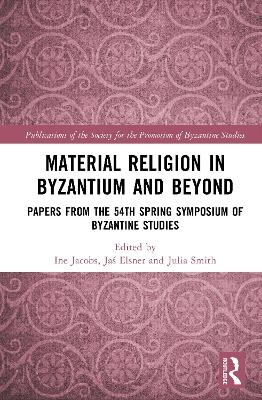
Material Religion in Byzantium and Beyond
Routledge (Verlag)
978-1-032-79171-5 (ISBN)
The theoretical framework known as Material Religion has emerged as a vibrant and profoundly influential approach within religious studies over the past two decades. Originating in the first decade of the 21st century from currents within cultural anthropology, Material Religion challenges a foundational assumption of much modern Western thought: that matter and spirit — materiality and religion — are fundamentally opposed. Rather than conceiving religion primarily as a system of ideas, doctrines, and beliefs, this framework accords equal significance to behaviours, practices, and objects. It reorients the study of religion towards the physical world, while simultaneously highlighting the capacity of tangible environments to mediate between humans and extraordinary powers.
This volume introduces the insights of Material Religion to the field of Byzantine Studies. It presents Material Religion as a new theoretical lens to Byzantinists, who have long explored religious life through behaviours, practices, and material culture, and who have long recognized their significance. A series of case studies — encompassing individual sites, urban spaces, landscape features, and categories of objects — illustrates the relevance and analytical power of the framework across the full span of byzantine material culture, from Late Antiquity to the Fall of Constantinople, including instances of cultural exchange within and beyond the Empire’s heartland.
Material Religion in Byzantium and Beyond will appeal to a broad audience, from students of Byzantium to established scholars who may be unfamiliar with the Material Religion framework.
Ine Jacobs is Stavros Niarchos Foundation Associate Professor of Byzantine Archaeology and Visual Culture at the University of Oxford. She works on Roman and byzantine architecture and urbanism, the experience and perception of built environments and their ornamentation, the longue durée of display and reception of sites, statuary and artefacts, as well as Material Religion. She has undertaken archaeological fieldwork in Belgium, Italy, North Macedonia, and Turkey, and has been the Field Director of the Aphrodisias Excavations since 2016. Jaś Elsner is Professor of Late Antique Art at Oxford and Visiting Professor of Art and Religion at the University of Chicago. He has worked all his life on Greco-Roman, early Christian and byzantine art in the context of changing religious culture and its material phenomena, such as pilgrimage. He has more recently extended his range of expertise in the same themes across Eurasia to look at similar issues in early Buddhist art. Julia M. H. Smith retired from the Chichele Professorship of Medieval History at the University of Oxford in 2025, before which she held the Edwards Chair of Medieval History at the University of Glasgow. Her research explores the instrumental use of small material objects in late antique and early medieval Christian practice from a variety of perspectives and offers a new analysis of the origin and growth of relic cults. She also works with palaeographers and materials scientists to explore the practices of writing, wrapping, and labelling associated with the curation of relics in the medieval Latin West.
1 Material Religion in Byzantium and Beyond
Ine Jacobs, Jaś Elsner, Julia Smith
PART I
Movement of People: Space and Sites Arranged for Performative Human Mobility
2 Materializing Motion in the Early Byzantine Church: The Case of the Hama Cathedral
Sean Leatherbury
3 Meeting God in Seventh-Century Armenia: The Role of Monumental Painting in Lmbat and Talin in Liturgy and Beyond
Veronika Džugan Hermanová, Ivan Foletti
4 Movement in the Late Antique Religious Landscape of Alahan
Troels Myrup Kristensen
PART II
Movement of Objects: The Mobility of Artefacts Within their Worlds and to New Contexts
5 Non-Indigeneity and the Materiality of “Enclosure”: Relics, Statues and Icons in Constantinople
Paroma Chatterjee.
6 Beyond the Borders, Outside the Frame: Translating Presence from Byzantium to the West after 1204
Anne Lester
7 Sacred Space Social-Time Machines: Accumulation Value and Material Affordances
Ann Marie Yasin
PART III
Objects and People: Reactions, Sensations and Bodies
8 Placed Coins in Late Antiquity, or how Archaeology can Uncover Small-Scale Religious Transactions
Ine Jacobs
9 Putting on the Lord: The Bosom as a Locus for Private Devotion (seventh–ninth centuries)
Francesca Dell’Acqua
10 Assemblage Icons: Composite Forms of Materiality in Byzantium and Beyond
Dorota Zaprzalska
11 Interactions with the Divine: Material Channels of Power and Social Cohesion through Metalwork in Justinian’s Empire
Brigitte Pitarakis
PART IV
The Natural World
12 Cavernous Landscapes in the Byzantine Aegean. Materialities of Cult and Sensorial Topologies
Myrto Veikou
13 Intangible Materialities: Clouds and Paradox in Byzantine Spiritual Culture
Veronica Della Dora
14 Weather Control and Manuscript Margins in the Early Medieval West
Ildar Garipzanov
Coda
15 Catching up: Byzantine Reverberations in the Material Study of Religion
Birgit Meyer
| Erscheinungsdatum | 22.11.2025 |
|---|---|
| Reihe/Serie | Publications of the Society for the Promotion of Byzantine Studies |
| Zusatzinfo | 107 Halftones, color; 107 Illustrations, color |
| Verlagsort | London |
| Sprache | englisch |
| Maße | 156 x 234 mm |
| Gewicht | 890 g |
| Themenwelt | Geschichte ► Allgemeine Geschichte ► Mittelalter |
| Geschichte ► Teilgebiete der Geschichte ► Kulturgeschichte | |
| Geschichte ► Teilgebiete der Geschichte ► Religionsgeschichte | |
| Sozialwissenschaften | |
| ISBN-10 | 1-032-79171-3 / 1032791713 |
| ISBN-13 | 978-1-032-79171-5 / 9781032791715 |
| Zustand | Neuware |
| Informationen gemäß Produktsicherheitsverordnung (GPSR) | |
| Haben Sie eine Frage zum Produkt? |
aus dem Bereich