


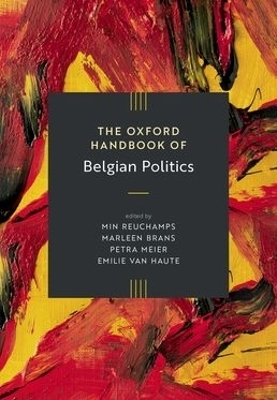
The Oxford Handbook of Belgian Politics
Oxford University Press (Verlag)
9780198914754 (ISBN)
- Noch nicht erschienen (ca. Februar 2026)
- Versandkostenfrei
- Auch auf Rechnung
- Artikel merken
Belgium is a paradoxical case: a country that some argue should not exist, yet one that has been a model of both democratic innovation and political fragmentation. The Oxford Handbook of Belgian Politics dissects Belgium's unique institutional architecture, its complex linguistic and community divides, and its evolving federal structure. Despite its small size and historically precarious existence, Belgium has played an outsized role in both political practice and political science scholarship. This volume brings together leading Belgian and international scholars to provide a comprehensive examination of Belgian politics, offering insights that extend far beyond its borders.
Structured into five thematic sections, the Handbook explores key dimensions of Belgian polity, politics, and policies. In forty meticulously crafted chapters, contributors analyze how Belgian politics serves as both an inspiration and a cautionary tale. The country has pioneered electoral reforms, social policies, and LGBTQI+ rights, positioning itself as a laboratory of democratic experimentation. At the same time, it has experienced extreme governmental instability, record-breaking coalition negotiations, and a deeply entrenched partitocracy. Whether viewed as a beacon of democratic resilience or an emblem of institutional gridlock, Belgium remains a compelling case for understanding the broader dynamics of governance in divided and multilingual societies worldwide.
Marleen Brans holds a PhD in Political Science from the European University Institute in Florence. As Professor at the KU Leuven Public Governance Institute, she conducts research on the production and consumption of policy advice by various actors inside and outside government. She co-founded the International Public Policy Association (IPPA). Petra Meier is Professor in Political Science, and co-chair of A*, the Antwerp Gender & Sexuality Studies Network, at the University of Antwerp (UAntwerpen). Her research focuses on the (re)presentation of gender and other social markers in politics and policies. She investigates how (in)formal institutions (re)produce inequality, dynamics of exclusion in political spaces and how this shapes power relations among social groups, and what contributes to fostering equality in a sustainable way. Min Reuchamps is Professor of Political Science at UCLouvain. He graduated from the Université de Liège (ULiège) and from Boston University. His teaching and research interests include federalism and multi-level governance, democracy and its transformations and innovations, participatory and deliberative methods, as well as relations between language(s) and politics and in particular the role of metaphors in political discourse. Emilie van Haute is Professor of Political Science at the Université libre de Bruxelles (ULB). Her research focuses on political parties, elections and voting behaviour, political participation and representation, and democracy. She is the co-editor of the European Journal of Political Research. Her work has appeared in Electoral Studies, Party Politics, Representation, European Journal of Political Research, or Regional Studies, Regional Science.
Acknowledgements
About the Volume Editors
Contributors
1: Min Reuchamps, Marleen Brans, Petra Meier, and Emilie van Haute: Introduction: A Journey Through Belgian Polity, Politics and Policies
Part 1: Historic Background and Core Features
2: Catherine Lanneau and Sebastian Dubois: Short History of the Belgian State Formation
3: Edith Drieskens: Belgium and the United Nations
4: Bambi Ceuppens and Scott Brenton: Decolonizing Belgium
5: Pascal Delwit: Cleavages and Party Systems in Belgium
6: Matthijs Bogaards: Consociationalism in Belgium
7: Lieven De Winter: Partitocracy in Belgium
8: Ive Marx and Ninke Mussche: Corporatism and Welfare State in Belgium
9: Patricia Popelier and Christoph Niessen: Federalism
10: Silvia Erzeel, Eline Severs, and Petra Meier: Democracy in Belgium
Part 2: Institutions
11: Frédéric Bouhon and Yseult Marique: Constitution and Courts in Belgium
12: Anne-Emmanuelle Bourgaux and Jean-Benoit Pilet: Electoral System and Elections in Belgium
13: Robin Devroe and Wouter Wolfs: Parliaments in Belgium
14: Régis Dandoy and Patrick Dumont: Governments in Belgium
15: Christian de Visscher, Catherine Fallon, Damien Piron, Frankie Schram: Civil Service and Public Administrations in Belgium
16: Sofie Hennau and Kristof Steyvers: Local Governments in Belgium
Part 3: Actors
17: Kenza Amara-Hammou, Scott Brenton, Lise Frehen, and Laura Uyttendaele: Citizens and Non-citizens in Belgium
18: Louise Knops and Nicolas Bocquet: Social Movements in Belgium
19: Bert Fraussen and Evelien Willems: Interest Groups in Belgium
20: Jean Faniel and Kurt Vandaele: Trade Unions in Belgium
21: Thomas Legein, Emilie van Haute, Bram Wauters: Political Parties in Belgium
22: Gert-Jan Put, Audrey Vandeleene, and Jérémy Dodeigne: Political Elites in Belgium
23: Marie Goransson, Arthur Meert, Tom Bellens, and Marleen Brans: Ministerial Cabinets and Advisers in Belgium
24: Laura Jacobs and Cato Waeterloos: Media and Social Media in Belgium
Part 4: Political and Social Challenges
25: Catherine Xhardez and Ilke Adam: Immigration and Integration in Belgium
26: Ann-Mireille Sautter, Coline Rondiat, Bart Meuleman, Pierre Baudewyns: (Sub)national Identification and Identities in Belgium
27: Karen Celis and David Paternotte: Gender and LGBTQI+ Politics in Belgium
28: Samira Azabar, Sami Zemni, Corinne Torrekens: Religion and Politics in Belgium
29: Donatien Dibwe and Valérie Rosoux: Dealing with Belgium's Colonial Past
30: Ruth Dassonneville: Polarization in Belgium
31: David Aubin, Marleen Brans, Ellen Fobé, Stéphane Jacobzone, and Valérie Pattyn: Policy Advisory Systems and the Science-Policy Nexus in Belgium
32: Didier Caluwaerts, Vincent Jacquet, Elisa Minsart, and Trui Steen: Democratic Innovations and Co-creation in Belgium
Part 5: Public Policies
33: Damien Pennetreau, Claire Dupuy, Virginie Van Ingelgom: Multi-level Governance and Public Policies in Belgium
34: Benoit Bayenet and Willem Sas: Financing the Belgian Federation
35: Bea Cantillon, Yannick Vanderborght, and Daniel Dumont: Social Policy in Belgium
36: Aurore Fransolet and Anaïs Augé: Climate Governance in Belgium
37: Cathy Macharis, Dirk Lauwers, Imre Keseru: Mobility Policy in Belgium
38: Mathias Sabbe, Sacha Frenay, Céline Parotte: Energy Policy in Belgium
39: Fanny Hockers and Tanguy de Wilde d Estmael: Foreign Policy in Belgium
40: Alexander Mattelaer: Defence Policy in Belgium
41: Emmanuel Klimis, Elisabeth Paul, Dimitri Renmans: Development Policy in Belgium
| Erscheint lt. Verlag | 5.2.2026 |
|---|---|
| Reihe/Serie | Oxford Handbooks |
| Zusatzinfo | 29 |
| Verlagsort | Oxford |
| Sprache | englisch |
| Maße | 171 x 246 mm |
| Themenwelt | Sozialwissenschaften ► Politik / Verwaltung ► Politische Systeme |
| Sozialwissenschaften ► Politik / Verwaltung ► Staat / Verwaltung | |
| Sozialwissenschaften ► Politik / Verwaltung ► Vergleichende Politikwissenschaften | |
| ISBN-13 | 9780198914754 / 9780198914754 |
| Zustand | Neuware |
| Informationen gemäß Produktsicherheitsverordnung (GPSR) | |
| Haben Sie eine Frage zum Produkt? |
aus dem Bereich


