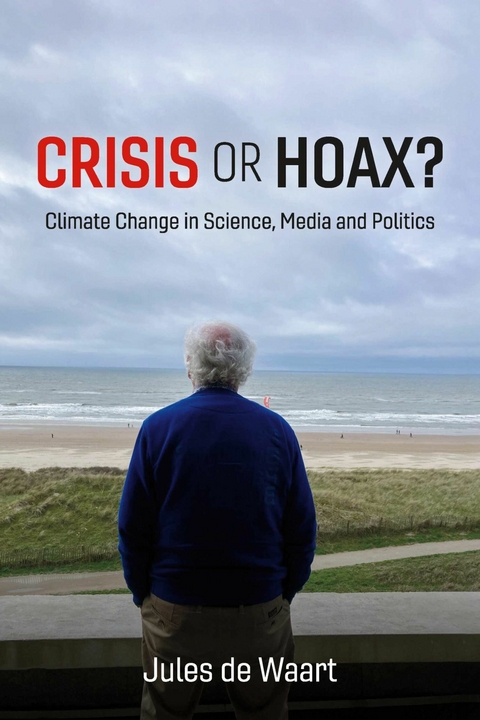
Crisis or Hoax? (eBook)
372 Seiten
Bookbaby (Verlag)
979-8-3178-0377-3 (ISBN)
Jules de Waart studied physical geography and climatology at the University of Amsterdam, where he obtained his PhD. He worked for several years as an exploration geologist in Uganda and Congo (Kinshasa). After returning to the Netherlands he began a new career as a civil servant at the Ministry of Health and the Environment. Jules de Waart later became active in politics and served his party as a member of the Provincial States of North Holland and the National Parliament. He became the spokesman for environmental issues, climate and defense. He also served as Secretary of the Military Committee of the NATO Assembly. After his retirement he began studying political sciences which led him to revisit his earlier interest in physical geography and climatology. He identified a discernable global warming trend over the past 150 years and sought to understand its causes. He questioned the recent conclusions of the Intergovernmental Panel on Climate Change (IPCC) which attributed most global warming to human emissions of greenhouse gases. He aims to provide an unbiased view of climate change, shed light on the fierce debate between alarmists and skeptics and offer suggestions for climate policy that remains effective without harming the economy. His book is intended for readers with a strong interest in climate change and environmental protection, but who question mainstream media narratives and prefer to draw their own conclusions.
"e;Crisis or Hoax"e; is intended for readers with a strong interest in climate change and environmental protection, but who do not accept everything published by the media at face value. Many recent publications stress that climate science is not "e;settled"e; and that experimental proof remains insufficient. Scientists grapple with a "e; double ethical bind"e;, a concept that appears to defend and promote alarmist misinformation. The author identifies a discernable anthropogenic global warming trend over the last 150 years - known as the Modern Warm Period - but questions the recent conclusions of the Intergovernmental Panel On Climate Change (IPCC) which attributes most global warming to human emission of greenhouse gases. Most of the trillions of dollars spent on the mitigation of CO2 might be wasted; adaptation to climate change - warming as well as cooling - is a better option. The book offers an unbiased perspective on climate science, explains the intensive conflicts between alarmists and skeptics and presents suggestions for climate policy that can be effective without harming the economy. The book is intended for readers with a strong interest in climate change but who question mainstream media narrative and prefer to draw their own conclusions. The author studied physical geography and climatology and was a Member of Parliament in the Netherlands.
Overview1
“On the one hand, as scientists we are ethically bound to the scientific method. On the other hand we are not just scientists but human beings as well. And like most people, we’d like to see the world a better place, which in this context translates into our working to reduce the risk of potentially disastrous climatic change. To do that we need to get some broad-based support to capture the public imagination. That, of course, means getting loads of media coverage. So we have to offer up scary scenarios, make simplified dramatic statements, and make little mention of any doubt we might have. This “double ethical bind” we find ourselves in cannot be solved by any formula. Each of us has to decide what the right balance is between being effective and being honest. I hope that means being both.”( Stephen Schneider, 19892)
It is, of course, a relevant question: ‘What motivates someone to write yet another book on climate change?’ Hasn’t the subject already been covered exhaustively enough in the many reports of the globally authoritative IPCC, the Intergovernmental Panel on Climate Change?3 In the exhaustive coverage of the UNFCCC conferences in Paris, Glasgow, and Dubai?4 In the tens of thousands of articles published each year in the scientific journals? Haven’t enough skeptical books already been written challenging the consensus on the IPCC reports? And given the recent problems of war, security, public health, environmental pollution, and energy supply, is climate change really the most important problem facing us?
The answer to all these questions is “no.” But climate change and climate policy are still among the most important issues of the coming decades. The secretary-general of the United Nations has repeatedly warned of an imminent climate catastrophe. He has said, “The air is unbreathable. The oceans are boiling.” A growing portion of the population is experiencing climate anxiety. People, often including a very high percentage of young people, see “the climate” as a major threat to themselves, their children, and the Earth itself. They are willing to make great sacrifices for it. But there is still scientific doubt about the underlying assumptions, and the debate about it just does not get off the ground. Proponents and opponents of the “IPCC consensus” do not communicate, do not read each other’s publications, do not understand each other, and threaten to drift further and further apart. And there is a great lack of basic knowledge. Not in terms of the specializations of the many researchers but for climate science as a whole and for the political and social context in which that knowledge is used. Despite the hundreds of thousands of scientific publications and despite the many claims to the contrary, the science is far from “settled.”5, 6 Many recent publications point to the great uncertainty about the impact of CO2 on the climate.7 Nobel Prize winners speak of a myth, a bad joke, a hoax, and even fraud.8
A thorough underpinning of the skeptical views can be found in “Settled?,” a 2021 book by Steven Koonin, professor of theoretical physics at New York University and former deputy secretary of energy in the Obama administration.
Good science takes the “royal road” through publications in peer-reviewed scientific journals and the books and reports based on them. There are probably more than a thousand books on climate change by now, and many tens of thousands of articles now appear each year in peer-reviewed scientific journals. The majority of authors write about man-made global warming as a direct result of greenhouse gas emissions, with CO2 being the most important. They fear that massive climate disasters await humanity and sound the alarm. We would usually call these authors “alarmists.” They claim an almost complete consensus on their views and have convinced many. Almost everything you read or see on TV is alarmist. Everything taught in schools and universities is alarmist. Virtually all governments in the world support an alarmist agenda. Virtually all international organizations—such as the IPCC, UNFCCC, WHO, WMO, EU, and WEF—do.
In contrast, there is a group of scientists who, for various reasons, do not share this alarmist consensus. We usually call them “skeptics.” They play only a minor role in the climate debate but they are still quite numerous. Tens of thousands of scientists—many of them full professors, whether emeritus or not—are skeptics. At least seventy Nobel laureates signed the skeptical Heidelberg Appeal of 1992.9 Several (tens of) thousands of scientists signed subsequent appeals, declarations, and open letters. These skeptics do not deny recent global warming. They differ with the alarmists on the causes of that warming and its immediate and future consequences. Skeptics are generally more optimistic about the consequences of increasing greenhouse gas concentrations than the alarmists. Many skeptics deny the important role that alarmists attribute to the greenhouse gas CO2. They fear that the current climate policies, which are primarily aimed at rapid reduction of CO2 emissions, are largely a waste of money: thousands of billions of dollars.
Some see mainly positive sides to the addition of CO2 to the atmosphere. More CO2 stimulates plant growth and leads to higher agricultural yields. Not unimportant at a time when the world population is rapidly increasing.
In all those hundreds of books, thousands of articles and the many appeals, petitions, declarations, and open letters published in recent years, the arguments and conclusions of both the alarmists and the skeptics are expressed, usually in a rational and responsible manner. But no one listens to each other. Scientific doubt, the foundation of all modern rational science, is now called “sowing doubt.” Skeptical scientists must fear for their careers; a number of them have been dismissed by their universities. Why the polarization? Those differences in opinion are often not that great.
This book attempts to describe that context and broaden the discussion and makes suggestions for different policies. It deals with climate change in the geological past, with the veracity of some basic studies, with the political motivations of some key players. Virtually all statements in this book, both skeptical and alarmist, are based on scientific articles in the major peer-reviewed professional journals. You can find these in Chapter 11.
Is the author the right person to write such a fundamental and controversial book? To comment on internationally authoritative sources such as the IPCC and the UNFCCC? I certainly do not stand alone, as tens of thousands important scientists have preceded me.10 But most skeptical publications have had little effect. Invariably, the discussion got bogged down. Invariably, relevant opinions “got lost.” More and more, the major problems of nature and the environment (soil degradation, biodiversity, and air and ocean pollution) were narrowed down to climate change and climate policy. More and more it was about greenhouse gases and reducing CO2. Important topics, but probably not the most important ones. Why this fascination with CO2? How did it come to be? To investigate this further, I searched in my memories, read the most relevant publications, and wrote this book. My way.
Do I understand the topic now? Over the course of writing, I have become increasingly convinced that climate science is gradually beginning to lose sight of the path of “real” science, of “good” science, of testing theories and falsifying hypotheses. The constant emphasis placed by alarmists on a (nonexistent and irrelevant) “consensus.” The exclusion of skeptical articles, books, and petitions in IPCC reports; the cancelling of skeptics; the censure of critical opinions. And the growing numbers of very critical papers in some of the leading scientific journals. But does this outweigh the many serious scientific articles written by alarmists?
Don’t believe everything that is written—”Nullius in Verba”—was and is the motto of the Royal Society of London for Improving Natural Knowledge. It was founded in 1660, with roots deep in the Enlightenment and with such eminent—and sometimes controversial—scientists as Boyle, Newton, Wren, Darwin, Einstein, Feynman, and Hawking as fellows. Let us not forget that independent thinking and independent science are among the foundations of our culture. The emphasis of current climate science on “consensus” and dismissing virtually all the opinions of dissenters (including well-known scientists and some Nobel Prize winners) as “nonsense” is difficult to justify in this context.
Many questions remain for me. These are mainly of a scientific nature, and I will deal with them more comprehensively later. But there are also smaller things that never cease to amaze me.
Why those absurdly large numbers of participants in those UN climate conferences organized by the UNFCCC? From 1992 until now, it has always been more than twenty thousand participants every year, even when there was nothing to decide. At the CoP in Glasgow, there were almost forty thousand! In Dubai, a hundred thousand!!! What role were these participants assigned?...
| Erscheint lt. Verlag | 30.6.2025 |
|---|---|
| Sprache | englisch |
| Themenwelt | Sozialwissenschaften ► Politik / Verwaltung |
| ISBN-13 | 979-8-3178-0377-3 / 9798317803773 |
| Informationen gemäß Produktsicherheitsverordnung (GPSR) | |
| Haben Sie eine Frage zum Produkt? |
 EPUB (Ohne DRM)
Digital Rights Management: ohne DRM
Dieses eBook enthält kein DRM oder Kopierschutz. Eine Weitergabe an Dritte ist jedoch rechtlich nicht zulässig, weil Sie beim Kauf nur die Rechte an der persönlichen Nutzung erwerben.
Dateiformat: EPUB (Electronic Publication)
EPUB ist ein offener Standard für eBooks und eignet sich besonders zur Darstellung von Belletristik und Sachbüchern. Der Fließtext wird dynamisch an die Display- und Schriftgröße angepasst. Auch für mobile Lesegeräte ist EPUB daher gut geeignet.
Systemvoraussetzungen:
PC/Mac: Mit einem PC oder Mac können Sie dieses eBook lesen. Sie benötigen dafür die kostenlose Software Adobe Digital Editions.
eReader: Dieses eBook kann mit (fast) allen eBook-Readern gelesen werden. Mit dem amazon-Kindle ist es aber nicht kompatibel.
Smartphone/Tablet: Egal ob Apple oder Android, dieses eBook können Sie lesen. Sie benötigen dafür eine kostenlose App.
Geräteliste und zusätzliche Hinweise
Buying eBooks from abroad
For tax law reasons we can sell eBooks just within Germany and Switzerland. Regrettably we cannot fulfill eBook-orders from other countries.
aus dem Bereich