


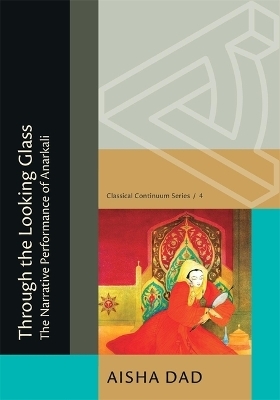
Through the Looking Glass
The Narrative Performance of Anarkali
Seiten
2026
Harvard University Press (Verlag)
978-0-674-30331-7 (ISBN)
Harvard University Press (Verlag)
978-0-674-30331-7 (ISBN)
- Noch nicht erschienen (ca. Februar 2026)
- Portofrei ab CHF 40
- Auch auf Rechnung
- Artikel merken
Informed by oral poetics, performance theory, and memory studies, Through the Looking Glass approaches Anarkali—the supposed lover of both the Mughal emperor Akbar and his son Jahangir— not as a historical enigma, but rather as a qissa, an oral narrative occupying a liminal and contentious space.
Anarkali, an Orientalized persona assigned to the harem of the Mughal Emperor Akbar, is also the lover of Akbar’s son, Salim, the future Mughal Emperor Jahangir. Her body and narrative occupy the liminal and contentious space between Akbar and Salim especially as construed under the male gaze of seventeenth-century European travelers. But while both Akbar and Salim are historically attested personalities, Anarkali is not. And yet, her narrative is pervasive in South Asia, appearing in everything from architecture to film. Up to this point studies of the enigma of Anarkali have centered on uncovering her historicity. But in the tragic performance of the poetics of the body, Anarkali embodies the ultimate conflation of the female body with narrative construction.
Informed by oral poetics, performance theory, and memory studies, Through the Looking Glass approaches Anarkali not as a historical enigma but rather as a qissa, an oral narrative. The so-called evidence of her historicity is the performance and reperformance of her qissa across different media: the Tomb of Anarkali in Lahore; early travel writings; Imtiaz Ali Taj’s seminal play Anarkali; and the Indian Cinema films Anarkali and Mughal-e-Azam. The poetics and performance of her body fundamentally signify the foreign and domestic anxieties at stake in the imperial personalities of Akbar and Salim.
Anarkali, an Orientalized persona assigned to the harem of the Mughal Emperor Akbar, is also the lover of Akbar’s son, Salim, the future Mughal Emperor Jahangir. Her body and narrative occupy the liminal and contentious space between Akbar and Salim especially as construed under the male gaze of seventeenth-century European travelers. But while both Akbar and Salim are historically attested personalities, Anarkali is not. And yet, her narrative is pervasive in South Asia, appearing in everything from architecture to film. Up to this point studies of the enigma of Anarkali have centered on uncovering her historicity. But in the tragic performance of the poetics of the body, Anarkali embodies the ultimate conflation of the female body with narrative construction.
Informed by oral poetics, performance theory, and memory studies, Through the Looking Glass approaches Anarkali not as a historical enigma but rather as a qissa, an oral narrative. The so-called evidence of her historicity is the performance and reperformance of her qissa across different media: the Tomb of Anarkali in Lahore; early travel writings; Imtiaz Ali Taj’s seminal play Anarkali; and the Indian Cinema films Anarkali and Mughal-e-Azam. The poetics and performance of her body fundamentally signify the foreign and domestic anxieties at stake in the imperial personalities of Akbar and Salim.
Aisha Dad is a Faculty Fellow at the Lloyd International Honors College at the University of North Carolina at Greensboro and a Research Affiliate at the Carolina Asia Center at the University of North Carolina at Chapel Hill as well as the Director of the Classics Gaming Collaborative.
| Erscheint lt. Verlag | 3.2.2026 |
|---|---|
| Reihe/Serie | Classical Continuum |
| Zusatzinfo | 4 photos/10 color photos |
| Verlagsort | Cambridge, Mass |
| Sprache | englisch |
| Maße | 146 x 210 mm |
| Themenwelt | Kunst / Musik / Theater ► Film / TV |
| Kunst / Musik / Theater ► Theater / Ballett | |
| Geisteswissenschaften ► Sprach- / Literaturwissenschaft ► Anglistik / Amerikanistik | |
| Geisteswissenschaften ► Sprach- / Literaturwissenschaft ► Literaturwissenschaft | |
| Sozialwissenschaften ► Pädagogik | |
| ISBN-10 | 0-674-30331-8 / 0674303318 |
| ISBN-13 | 978-0-674-30331-7 / 9780674303317 |
| Zustand | Neuware |
| Informationen gemäß Produktsicherheitsverordnung (GPSR) | |
| Haben Sie eine Frage zum Produkt? |
Mehr entdecken
aus dem Bereich


aus dem Bereich
Poetik eines sozialen Urteils
Buch | Hardcover (2023)
De Gruyter (Verlag)
CHF 83,90


