


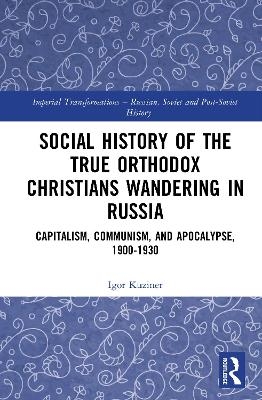
Social History of the True Orthodox Christians Wandering in Russia
Capitalism, Communism, and Apocalypse, 1900-1930
Seiten
2025
Routledge (Verlag)
978-1-041-10125-3 (ISBN)
Routledge (Verlag)
978-1-041-10125-3 (ISBN)
This book explores the social history of the radical religious community of Old Believer-Wanderers during the period of rapid late imperial, early Soviet and Stalinist modernization.
This book explores the social history of the radical religious community of Old Believer-Wanderers during the period of rapid Late Imperial, Early Soviet, and Stalinist modernization.
The self-titled True Orthodox Christians believed the 17th-century reforms of the Russian Orthodox Church ushered in the reign of an invisible Antichrist. Rejecting the corrupted world, they advocated extreme asceticism — renouncing property, marriage, and all contact with the state. Yet, despite their apocalyptic ideology, the Wanderers thrived in Late Imperial and Early Soviet society, engaging in capitalism, pioneering agricultural cooperatives, and even participating in Stalinist repression. Focusing on three key figures, this book examines how these seemingly isolated millenarians adapted to rapid modernization — from imperial capitalism to Soviet revolution and Stalinist terror. Their surprising integration challenges assumptions about radical religious groups, revealing both the adaptability of fringe communities and the unexpected flexibility of modernizing regimes. Through their stories, this book offers new insights into the relationship between marginalized beliefs and societal transformation.
This book offers a nuanced and realistic model of the social outcasts’ existence that recovers their agency and subjectivity from the layers of discursive projections by elite commentators. It is a significant contribution to the history of religion and popular religiosity in the Russian Empire and the early Soviet Union, and it presents a new and rare perspective on Russian modernity. It will be of interest to researchers in the fields of Russian history, Christianity, Orthodoxy, and the history of religion.
This book explores the social history of the radical religious community of Old Believer-Wanderers during the period of rapid Late Imperial, Early Soviet, and Stalinist modernization.
The self-titled True Orthodox Christians believed the 17th-century reforms of the Russian Orthodox Church ushered in the reign of an invisible Antichrist. Rejecting the corrupted world, they advocated extreme asceticism — renouncing property, marriage, and all contact with the state. Yet, despite their apocalyptic ideology, the Wanderers thrived in Late Imperial and Early Soviet society, engaging in capitalism, pioneering agricultural cooperatives, and even participating in Stalinist repression. Focusing on three key figures, this book examines how these seemingly isolated millenarians adapted to rapid modernization — from imperial capitalism to Soviet revolution and Stalinist terror. Their surprising integration challenges assumptions about radical religious groups, revealing both the adaptability of fringe communities and the unexpected flexibility of modernizing regimes. Through their stories, this book offers new insights into the relationship between marginalized beliefs and societal transformation.
This book offers a nuanced and realistic model of the social outcasts’ existence that recovers their agency and subjectivity from the layers of discursive projections by elite commentators. It is a significant contribution to the history of religion and popular religiosity in the Russian Empire and the early Soviet Union, and it presents a new and rare perspective on Russian modernity. It will be of interest to researchers in the fields of Russian history, Christianity, Orthodoxy, and the history of religion.
Igor Kuziner is a historian specializing in religious minorities, nationalisms, and social history in Russia. He holds a PhD in history and serves as an Associate Professor at the National Research University Higher School of Economics (St. Petersburg), where he leads the Research Group on Social Studies of Religion. His work explores Old Believers, church-state relations, and the intersection of religion and identity across the imperial, Soviet, and post-Soviet periods.
Introduction
Chapter 1. The Wanderers in the World of Antichrist
Chapter 2. The saints traded too
Chapter 3: Apocalypse in Vyatka
Chapter 4. Three lives of Maksim Zalesskii
Chapter 5. Wanderers in the labyrinth of Russian modernities
| Erscheinungsdatum | 17.10.2025 |
|---|---|
| Reihe/Serie | Imperial Transformations – Russian, Soviet and Post-Soviet History |
| Zusatzinfo | 5 Halftones, black and white; 5 Illustrations, black and white |
| Verlagsort | London |
| Sprache | englisch |
| Maße | 156 x 234 mm |
| Gewicht | 570 g |
| Themenwelt | Geisteswissenschaften ► Geschichte ► Allgemeine Geschichte |
| Geschichte ► Teilgebiete der Geschichte ► Kulturgeschichte | |
| Geschichte ► Teilgebiete der Geschichte ► Religionsgeschichte | |
| Geschichte ► Teilgebiete der Geschichte ► Sozialgeschichte | |
| Geisteswissenschaften ► Religion / Theologie ► Christentum | |
| Sozialwissenschaften ► Soziologie ► Spezielle Soziologien | |
| ISBN-10 | 1-041-10125-2 / 1041101252 |
| ISBN-13 | 978-1-041-10125-3 / 9781041101253 |
| Zustand | Neuware |
| Informationen gemäß Produktsicherheitsverordnung (GPSR) | |
| Haben Sie eine Frage zum Produkt? |
Mehr entdecken
aus dem Bereich

aus dem Bereich
Die Revolution des Gemeinen Mannes
Buch | Softcover (2024)
C.H.Beck (Verlag)
CHF 16,80
Eine Geschichte des Geschmacks
Buch | Hardcover (2025)
C.H.Beck (Verlag)
CHF 49,95
vom Mittelalter bis zur Gegenwart
Buch | Softcover (2024)
C.H.Beck (Verlag)
CHF 16,80


