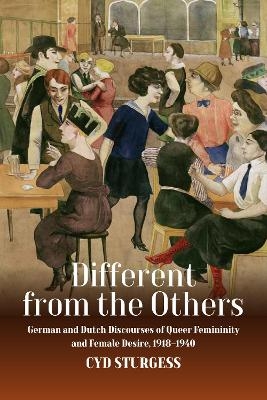
Different from the Others
Berghahn Books (Verlag)
978-1-83695-397-5 (ISBN)
- Noch nicht erschienen (ca. März 2026)
- Versandkostenfrei
- Auch auf Rechnung
- Artikel merken
For much of Europe, the interwar period was one of cultural expansion and diversion and increased visibility for lesbians. While historical research on Germany during the period immediately after the First World War has been extensively studied by historians through the lens of gender and sexuality—with an implicit emphasis on the “masculine” dimension of queer female sexuality—the Dutch context has been virtually ignored. Through careful and sensitive studies of medico‐social discourses, media representations, and literary depictions of queer femininity, Different from the Others recovers the submerged history of queer feminine women in both Germany and the Netherlands. Cyd Sturgess provides a theoretical analysis that makes key empirical contributions to the history of Dutch gays and lesbians while reframing our collective understanding of queer femininity more broadly.
Cyd Sturgess is a queer literary and cultural historian, who works as a Leverhulme postdoctoral researcher at Utrecht University. Lecturing on themes of gender and desire in the media, Cyd's latest research project concerns issues of identity and precarity in community-based film festivals and the queering of documentary and archival practices.
Acknowledgements
Abbreviations and Translations
Introduction
“Good” and “Bad” Femininities
Locating the “Fem(me)” in Histories of Sexuality
Labels and Names
Queer Historiographical Methods
Setting the Parameters for Historical Research
Part I: Socio-Medical Discourses
Chapter 1. Sex and the Cities – Locating Queer Feminine Desires
‘A Child of War’
A Conservative Modernity
Living Apart Together
The (Not So) Frivolous Flapper
‘Bubis’ and ‘Mädis’
Little Baskets and Cautionary Owls
Queer Activism in the City
Policing Same-Sex Desires
Conclusions
Chapter 2. Sexual Science – The Queer Feminine Mystique
The Emergence of a Scientia Sexualis
Ideal Women, Ideal Marriages
Queer Female Desire At the Margins: Early Theories of Same-Sex Desires
Somatic Signifiers: Questions of Queer Legitimac
Intermediary Forms: Spectrums and Hierarchies of Queer Desire
Femininity as a (Queer) Woman’s Right
Seductive Don Juans and Curable Queers
Conclusions
Part II: Community Discourses
Introduction
Chapter 3. Fashioning Femininities in the Weimar Periodicals The Girlfriend and Love of Women
The Girlfriend: ‘Journal for Ideal Friendship’
Women’s Love: ‘Friendship, Love and Sexual Emancipation’
Discursive Divisions within Berlin’s Queer Subculture
Defining the Parameters of the Feminine
Literary Discourses and Feminine Desire
Fashioning Femininities
Trans Femininities
Anti-Feminine Discourses
Conclusions
Chapter 4. Marys and Mollys: Finding the Queer Feminine on the Dutch Press Landscape
The Cult of Domesticity
Beatrice (1939–1967)
The Young Woman (1924–1938)
We (1932)
The Right to Live (1940–1946)
Conclusions
Part III: Fictional Discourses
Introduction
Chapter 5. A Mother’s Love: Eva Raedt-de Canter’s Internaat (1930) and Christa Winsloe’s Das Mädchen Manuela (1933)
Eva Raedt-de Canter
Christa Winsloe
Boarding School (1930)
The Girl Manuela (1933)
‘Alone in the World’: Dynamic Desires in Boarding School
‘I want to be a boy’: Queering Sexological Tropes in The Girl Manuela
A Mother’s Love
“Confessions” and “Comings-Out”: Queer Desires as Queer Identities?
Conclusions
Chapter 6. When Object Becomes Subject: Feminine Protagonists in Anne E. Weirauch’s The Scorpion (1919–1931) and Josine Reuling’s Back to the Island (1937)
Anna E. Weirauch
Josine Reuling
The Scorpion (1919–1931)
Back to the Island (1937)
Challenging Sexological Frameworks
Femininity in the Foreground
Hierarchies of Gender and Desire
Mother-Love and “Nonlesbian” Subjects
Conclusions
Conclusion
Bibliography
| Erscheint lt. Verlag | 1.3.2026 |
|---|---|
| Zusatzinfo | Bibliography; Index |
| Verlagsort | Oxford |
| Sprache | englisch |
| Themenwelt | Geschichte ► Allgemeine Geschichte ► Neuzeit (bis 1918) |
| Geschichte ► Allgemeine Geschichte ► 1918 bis 1945 | |
| Geschichte ► Teilgebiete der Geschichte ► Kulturgeschichte | |
| Sozialwissenschaften ► Soziologie ► Gender Studies | |
| ISBN-10 | 1-83695-397-6 / 1836953976 |
| ISBN-13 | 978-1-83695-397-5 / 9781836953975 |
| Zustand | Neuware |
| Informationen gemäß Produktsicherheitsverordnung (GPSR) | |
| Haben Sie eine Frage zum Produkt? |
aus dem Bereich