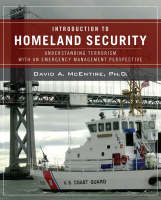
Wiley Pathways Introduction to Homeland Security
John Wiley & Sons Inc (Verlag)
978-0-470-12752-0 (ISBN)
- Titel erscheint in neuer Auflage
- Artikel merken
Dr. David McEntire is an Associate Professor in the Emergency Administration and Planning Program in the Department of Public Administration at the University of North Texas. He teaches emergency management courses in both the undergraduate EADP and MPA programs. His academic interests include emergency management theory, international disasters, community preparedness, response coordination, and vulnerability reduction. He has received several Quick Response Grants (funded by the National Science Foundation through the Natural Hazards Center at the University of Colorado) which allowed him to conduct research on disasters in Peru, the Dominican Republic, Texas, New York and California.
CHAPTER 1. UNDERSTANDING A NEW NATIONAL PRIORITY: 9/11, HOMELAND SECURITY, AND EMERGENCY MANAGEMENT 1
Introduction 2
1.1 9/11: A Wake-up Call 2
Self-Check 3
1.2 A Growing Threat 4
Self-Check 6
1.3 The Nature of Homeland Security 6
Self-Check 10
1.4 Disciplines Involved in Homeland Security and the Emergency Management Profession 11
1.4.1 The Role of Emergency Management 11
1.4.2 Important Terminology 15
Self-Check 17
Summary 17
Assess Your Understanding 18
Be a Homeland Security Professional 20
Key Terms 21
References 23
CHAPTER 2. IDENTIFYING TERRORISM: IDEOLOGICALLY MOTIVATED ACTS OF VIOLENCE 25
Introduction 26
2.1 Defining Terrorism 26
Self-Check 28
2.2 Common Characteristics of Terrorism 28
Self-Check 29
2.3 Types of Terrorism 29
Self-Check 32
2.4 Relation of Terrorism to Other Disasters 32
Self-Check 35
Summary 35
Assess Your Understanding 36
Be a Homeland Security Professional 38
Key Terms 39
References 40
CHAPTER 3. RECOGNIZING THE CAUSES OF TERRORISM: DIFFERING PERSPECTIVES AND THE ROLE OF IDEOLOGY 41
Introduction 42
3.1 Frequently Mentioned Causes 42
3.1.1 Historical Grievances 42
3.1.2 U.S. Foreign Policy 43
3.1.3 Poverty 45
Self-Check 45
3.2 Political Causes 46
3.2.1 Politics 46
3.2.2 Political Systems 47
3.2.3 Political Functions 48
3.2.4 Political Structure 48
Self-Check 50
3.3 Cultural and Religious Causes 50
3.3.1 Cultural Dimensions of Terrorism 50
3.3.2 The Role of Religion in Terrorism 51
Self-Check 53
3.4 Ideology 54
3.4.1 Understanding Ideologies 54
3.4.2 Ideological Dimensions and Terrorism 55
Self-Check 57
Summary 57
Assess Your Understanding 58
Be a Homeland Security Professional 59
Key Terms 60
References 62
CHAPTER 4. COMPREHENDING TERRORISTS AND THEIR BEHAVIOR: WHO THEY ARE AND WHAT THEY DO 63
Introduction 64
4.1 Terrorists and Terrorist Organizations 64
4.1.1 Classifying Terrorists 67
Self-Check 69
4.2 Personal Characteristics of Terrorists 69
4.2.1 Distinct Differences 70
Self-Check 72
4.3 The Behavior and Tactics of Terrorists 72
4.3.1 Propaganda 72
4.3.2 Recruiting 73
4.3.3 Financing 74
4.3.4 Training 75
4.3.5 False Documents, Travel, and Safe Haven 76
4.3.6 Code Words and Secret Communications 77
4.3.7 Planning 77
4.3.8 Obtaining Weapons 79
4.3.9 Initiating Acts of Civil Disorder or Terrorism 79
Self-Check 81
Summary 81
Assess Your Understanding 82
Be a Homeland Security Professional 84
Key Terms 84
References 86
CHAPTER 5. UNCOVERING THE DYNAMIC NATURE OF TERRORISM: HISTORY AND CHANGE OVER TIME 87
Introduction 88
5.1 The Appearance of Terrorism 88
Self-Check 90
5.2 The Evolution of Terrorism Abroad 90
Self-Check 93
5.3 Terrorism and the United States 94
Self-Check 97
5.4 Terrorism Today 97
Self-Check 101
Summary 101
Assess Your Understanding 102
Be a Homeland Security Professional 104
Key Terms 105
References 106
CHAPTER 6. EVALUATING A MAJOR DILEMMA: TERRORISM, THE MEDIA, AND CENSORSHIP 107
Introduction 108
6.1 Changes in the Media over Time 108
Self-Check 109
6.2 Terrorists and the Media 109
Self-Check 112
6.3 The Media and Terrorism 112
Self-Check 115
6.4 Government and the Media 115
Self-Check 116
6.5 Censorship and Self-Censorship 117
Self-Check 120
Summary 120
Assess Your Understanding 121
Be a Homeland Security Professional 122
Key Terms 123
References 124
CHAPTER 7. CONTEMPLATING A QUANDARY: TERRORISM, SECURITY, AND LIBERTY 125
Introduction 126
7.1 War, Terrorism, and Law 126
Self-Check 128
7.2 Security and Liberty 128
Self-Check 131
7.3 Cases and Considerations 131
Self-Check 136
Summary 136
Assess Your Understanding 137
Be a Homeland Security Professional 139
Key Terms 139
References 140
CHAPTER 8. PREVENTING TERRORIST ATTACKS: ROOT CAUSES, LAW, INTELLIGENCE, COUNTER TERRORISM, AND BORDER CONTROL 141
Introduction 142
8.1 Addressing Root Causes 142
Self-Check 144
8.2 Policy and Legislation 144
8.2.1 Laws Prior to 9/11 144
8.2.2 Legislation after 9/11 145
Self-Check 148
8.3 Intelligence 148
8.3.1 The Need for Intelligence 149
8.3.2 The Intelligence Cycle 150
8.3.3 Challenges Facing the Intelligence Community 151
8.3.4 Successes 154
Self-Check 155
8.4 Counter-terrorism 156
8.4.1 Risky Operations 157
8.4.2 Learning from Other Nations 158
8.4.3 Controversy Regarding Counter-terrorism 160
Self-Check 161
8.5 Border Control 162
8.5.1 What Is the Border? 162
8.5.2 Our Porous Border 162
8.5.3 Participants Involved in Border Control 164
8.5.4 Measures to Secure Borders 165
Self-Check 168
Summary 168
Assess Your Understanding 169
Be a Homeland Security Professional 171
Key Terms 172
References 175
CHAPTER 9. PROTECTING AGAINST POTENTIAL ATTACKS: THREAT ASSESSMENT AND SECURITY ENHANCEMENT 177
Introduction 178
9.1 Assessing Threats 178
9.1.1 Critical Infrastructure, Key Assets, and Soft Targets 178
9.1.2 Working with Others to Identify Threats 182
9.1.3 Points of Consideration 184
Self-Check 188
9.2 Structural and Non-Structural Mitigation 188
9.2.1 Architectural Design and Construction 189
9.2.2 Zoning and Set Back Regulations 190
9.2.3 Other Security Measures 191
Self-Check 195
Summary 195
Assess Your Understanding 196
Be a Homeland Security Professional 198
Key Terms 198
References 200
CHAPTER 10. PREPARING FOR THE UNTHINKABLE: READINESS FOR TERRORISM 201
Introduction 202
10.1 The Importance and Nature of Preparedness 202
10.1.1 Federal and State Initiatives 203
Self-Check 208
10.2 Setting the Foundation 208
10.2.1 Preparedness Councils 208
10.2.2 Ordinances 209
10.2.3 Budgets and Grants 210
10.2.4 EOC 212
Self-Check 213
10.3 Planning 214
Self-Check 216
10.4 Other Measures 216
10.4.1 Training 216
10.4.2 Exercises 217
10.4.3 Community Education 219
Self-Check 222
Summary 222
Assess Your Understanding 223
Be a Homeland Security Professional 225
Key Terms 226
References 228
CHAPTER 11. RESPONDING TO ATTACKS: IMPORTANT FUNCTIONS AND COORDINATION MECHANISMS 229
Introduction 230
11.1 Major Priorities 230
11.1.1 Safety and Security 231
11.1.2 Search and Rescue 233
11.1.3 Medical Care and Triage 233
11.1.4 Decontamination 234
11.1.5 Investigation 235
Self-Check 237
11.2 Other Crucial Functions 237
11.2.1 Warning, Intelligence, and Public Information 237
11.2.2 Evacuation and Sheltering 239
Self-Check 241
11.3 Coordination Mechanisms 242
11.3.1 The Incident Command System 243
11.3.2 Strengths and Weaknesses of ICS 245
11.3.3 Using Emergency Operations Centers 246
11.3.4 Managing EOCs 248
Self-Check 249
Summary 249
Assess Your Understanding 250
Be a Homeland Security Professional 252
Key Terms 253
References 255
CHAPTER 12. RECOVERING FROM IMPACTS: SHORT-TERM AND LONG-TERM MEASURES 257
Introduction 258
12.1 Initial Steps 258
12.1.1 Assessing Damages 258
12.1.2 Damage Assessment Concerns and Procedures 259
12.1.3 Declaring a Disaster and Seeking Help 260
Self-Check 262
12.2 Key Functions 262
12.2.1 Mass Fatality Management 262
12.2.2 Debris Management 264
12.2.3 Emotional Issues 265
Self-Check 267
12.3 The Importance of Disaster Assistance 267
12.3.1 Volunteer and Donation Management 268
12.3.2 Individual and Public Assistance 270
12.3.3 Novel Approaches 271
Self-Check 274
Summary 274
Assess Your Understanding 275
Be a Homeland Security Professional 277
Key Terms 277
References 279
CHAPTER 13. LOOKING TOWARD THE FUTURE: FORTHCOMING CHALLENGES AND OPPORTUNITIES 281
Introduction 282
13.1 The Future of Terrorism and WMD 282
Self-Check 286
13.2 Radiological Weapons 286
Self-Check 291
13.3 Nuclear Weapons 291
Self-Check 294
13.4 Biological Weapons 294
Self-Check 298
13.5 Chemical Weapons 299
Self-Check 303
13.6 Accountability and Policy in Homeland Security 303
Self-Check 307
Summary 308
Assess Your Understanding 309
Be a Homeland Security Professional 311
Key Terms 312
References 314
Glossary 315
Index 327
| Erscheint lt. Verlag | 6.5.2008 |
|---|---|
| Reihe/Serie | Delisted |
| Verlagsort | New York |
| Sprache | englisch |
| Maße | 183 x 226 mm |
| Gewicht | 635 g |
| Themenwelt | Sozialwissenschaften ► Politik / Verwaltung ► Europäische / Internationale Politik |
| ISBN-10 | 0-470-12752-X / 047012752X |
| ISBN-13 | 978-0-470-12752-0 / 9780470127520 |
| Zustand | Neuware |
| Informationen gemäß Produktsicherheitsverordnung (GPSR) | |
| Haben Sie eine Frage zum Produkt? |
aus dem Bereich