


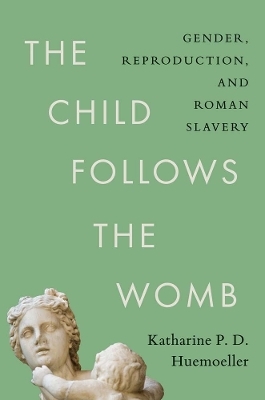
The Child Follows the Womb
Gender, Reproduction, and Roman Slavery
Seiten
2026
Yale University Press (Verlag)
978-0-300-28486-7 (ISBN)
Yale University Press (Verlag)
978-0-300-28486-7 (ISBN)
- Noch nicht erschienen (ca. März 2026)
- Versandkostenfrei
- Auch auf Rechnung
- Artikel merken
A new and incisive exploration of female slavery and reproduction in ancient Rome
One of ancient Rome’s most significant legacies is a legal framework for hereditary slavery. Under the Roman principle that would come to be known as partus sequitur ventrem (the offspring follows the womb), enslaved women bore enslaved children regardless of the identity of the child’s father. For centuries, across the globe, this legal doctrine was invoked to justify control over enslaved women’s reproductive labor.
This is the first book to examine the development and practice of the partus principle in its original Roman context, tracing the lives of five women subject to different forms of corporal control, from coerced reproduction to concubinage to forced marriage. These women’s stories—recovered from fragments of papyrus, stone monuments, wooden tablets, and more—reveal the diverse ways that slaveholders used the partus principle to their advantage. Offering an intimate, nuanced account of the sexual and reproductive dimensions of slavery across the vast Roman Empire, Katharine P. D. Huemoeller reveals the particularities of female enslavement in the Roman world and the long history of reproductive injustice.
One of ancient Rome’s most significant legacies is a legal framework for hereditary slavery. Under the Roman principle that would come to be known as partus sequitur ventrem (the offspring follows the womb), enslaved women bore enslaved children regardless of the identity of the child’s father. For centuries, across the globe, this legal doctrine was invoked to justify control over enslaved women’s reproductive labor.
This is the first book to examine the development and practice of the partus principle in its original Roman context, tracing the lives of five women subject to different forms of corporal control, from coerced reproduction to concubinage to forced marriage. These women’s stories—recovered from fragments of papyrus, stone monuments, wooden tablets, and more—reveal the diverse ways that slaveholders used the partus principle to their advantage. Offering an intimate, nuanced account of the sexual and reproductive dimensions of slavery across the vast Roman Empire, Katharine P. D. Huemoeller reveals the particularities of female enslavement in the Roman world and the long history of reproductive injustice.
Katharine P. D. Huemoeller is assistant professor of Roman history in the Department of Ancient Mediterranean and Near Eastern Studies at the University of British Columbia. She has previously worked as an advocate for gender equity and reproductive justice. She lives in Vancouver, British Columbia.
| Erscheint lt. Verlag | 24.3.2026 |
|---|---|
| Zusatzinfo | 20 b-w illus. |
| Sprache | englisch |
| Maße | 156 x 235 mm |
| Themenwelt | Geschichte ► Allgemeine Geschichte ► Vor- und Frühgeschichte |
| Geisteswissenschaften ► Geschichte ► Regional- / Ländergeschichte | |
| Sozialwissenschaften ► Soziologie ► Gender Studies | |
| ISBN-10 | 0-300-28486-1 / 0300284861 |
| ISBN-13 | 978-0-300-28486-7 / 9780300284867 |
| Zustand | Neuware |
| Informationen gemäß Produktsicherheitsverordnung (GPSR) | |
| Haben Sie eine Frage zum Produkt? |
Mehr entdecken
aus dem Bereich



aus dem Bereich
Konzepte – Methoden – Theorien
Buch | Softcover (2024)
UTB (Verlag)
CHF 55,85
auf den Spuren der frühen Zivilisationen
Buch | Hardcover (2023)
C.H.Beck (Verlag)
CHF 27,95


