


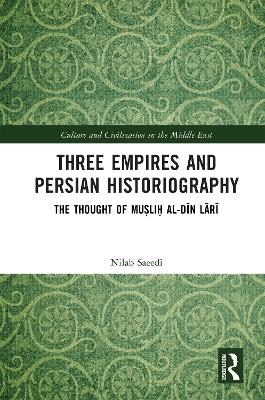
Three Empires and Persian Historiography
Routledge (Verlag)
978-1-041-11542-7 (ISBN)
- Lieferbar (Termin unbekannt)
- Versandkostenfrei
- Auch auf Rechnung
- Artikel merken
Three Empires and Persian Historiography: The Thought of Muṣliḥ al-dīn Lārī uncovers the underexplored historical vision of a sixteenth-century scholar whose work spanned the Safavid, Timurid, and Ottoman worlds.
Centering on Lārī’s universal chronicle [Mir’atu’l-Advār wa Mirḳātu’l-Aḫbār], The Mirror of Epochs and the Staircase of Historical Reports, this book explores how a figure in philosophy, theology, and the sciences used history to navigate shifting imperial landscapes. Written in Persian and completed upon Sultan Selīm II's accession to the throne, Lārī’s work offers a nuanced and often critical perspective on the Safavid dynasty, reverent accounts of the Timurid legacy, and a carefully constructed narrative of Ottoman rule. Through detailed textual analysis, the book demonstrates how Lārī positioned himself as both a cultural mediator and a political commentator, using historiography to reflect broader debates about legitimacy, identity, and intellectual authority in the early modern Islamic world.
A vital resource for scholars of Islamic historiography, Persianate studies, and Ottoman intellectual history, this book illuminates the enduring power of historical writing as a tool for negotiation, memory, and empire-making.
Nilab Saeedi is Research Associate at the Institute of Habsburg and Balkan Studies, Austrian Academy of Sciences. She received her PhD in history in 2025 at Ibn Haldun University in Istanbul, with a focus on Islamic intellectual history. Her dissertation was awarded the “Best Doctoral Thesis of the Year” at Ibn Haldun University. She also holds an MA in Turkish literature from Ondokuz Mayıs University and a BA in linguistics. Her research interests include early modern Ottoman history, Persian historiography, and Islamic intellectual history. She has taught courses on art and literature and worked as a translator in Turkish, English, and Persian. She is a contributing editor for the Journal of the History of Ideas, where she interviews scholars of intellectual history and reviews their work.
TABLE OF CONTENTS
List of Figures
List of TablesPreface
Acknowledgements
List of Symbols and Abbreviations
Chapter 1: Lārī’s World: Exile, Empire, and History
1.1 Introduction
Chapter 2: Muṣliḥ al-Dīn Lārī: Education, Travels, and Career
2.1. Origins and Early Scholarly Development
2.2. A Forced Migration
2.3. At the Mughal Court
2.4. Arriving at the Ottoman Court
Chapter 3: The Persianate Lens: Lārī's Literary Contributions and Historical Vision
3.1. Introduction
3.2. Mir’ātü’l-Advār wa Mirḳātü’l-Aḫbār: An In-Depth Analysis
3.3. Exploring Features of Mir’ātü’l-Advār wa Mirḳātü’l-Aḫbār
Chapter 4: Selective Silence: Lārī's Portrayal of the Safavids
4.1. Introduction
4.2. Lārī's Reversal of Safavid Historiography
4.2.1. Crafting the Safavid Universal History
4.2.2. Biographies
4.2.3. The Shah at the Core
4.2.4. Prefaces
4.2.5. The Ancient Stories
4.3. Safavid Rule in Question
4.4. Safavid Scholars in Lārī's Taẕkira4.5. Conclusion
Chapter 5: The Heroic Legacy: Tīmūr's Glorious Portrayal
5.1. Introduction
5.2. A Heroic Narrative
5.2.1. Tracing the Lineage of Tīmūr
5.2.2. The Leadership Triad: Strategy, Skills, and Character in Action
5.2.3. The Faithful Conqueror
5.2.4. The Patron of Knowledge
5.3. Lārī's Tīmūr: A Strategic Hero in the Battle of Ankara
5.4. Timurid Mindscapes: The Intellectuals of the Timurid Era in Mir’ātü’l-Advār 4.4.1. Mystics of the Naḳshbandīs
5.4.2. Mystics Beyond the Naḳshbandī Sufi Tradition
5.4.3. Scholars in the Era of Tīmūr
5.5. Conclusion
Chapter 6: Empire in Outline: Lārī's Portrayal of the Ottoman Dynasty
6.1. Introduction
6.2. Lārī's Lens: Early Ottoman Origins and the Shaping of Power
6.3. Osmān I: The Struggle for Legitimacy in the Early Ottoman Empire
6.4. Beneath Tīmūr's Shadow: Lārī's Account of the Ottoman Interregnum
6.5. Conquering the World: Lārī's Depiction of Meḥmed II
6.5.1. Conquering the World
6.6. Disclosing Hostility: Lārī's View on the Battle of Çaldıran6.7. Divine Majesty: Sultan Süleymān in Lārī's Narrative
6.8. Conclusion
Chapter 7: A Mirror Fading: Lārī’s Historiographical Legacy
7.1 Conclusion
Appendices
Index
| Erscheinungsdatum | 07.11.2025 |
|---|---|
| Reihe/Serie | Culture and Civilization in the Middle East |
| Zusatzinfo | 6 Tables, black and white; 1 Halftones, black and white; 1 Illustrations, black and white |
| Verlagsort | London |
| Sprache | englisch |
| Maße | 156 x 234 mm |
| Gewicht | 570 g |
| Themenwelt | Geisteswissenschaften ► Geschichte ► Regional- / Ländergeschichte |
| Sozialwissenschaften ► Soziologie ► Spezielle Soziologien | |
| ISBN-10 | 1-041-11542-3 / 1041115423 |
| ISBN-13 | 978-1-041-11542-7 / 9781041115427 |
| Zustand | Neuware |
| Informationen gemäß Produktsicherheitsverordnung (GPSR) | |
| Haben Sie eine Frage zum Produkt? |
aus dem Bereich


