


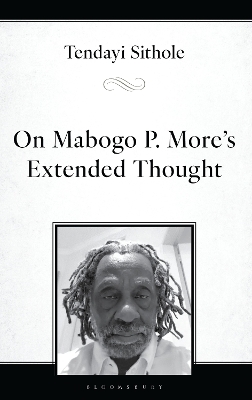
On Mabogo P. More’s Extended Thought
Seiten
2026
Rowman & Littlefield (Verlag)
978-1-6669-5956-7 (ISBN)
Rowman & Littlefield (Verlag)
978-1-6669-5956-7 (ISBN)
- Noch nicht erschienen (ca. April 2026)
- Versandkostenfrei
- Auch auf Rechnung
- Artikel merken
With a Black and decolonial intertextuality, this book explores ways in which Mabogo P. More viewed philosophy and philosophical anthropology not as an abstraction, but as a concrete and material project.
Mabogo P. More’s understanding of philosophical anthropology as the project that is concerned about the human question profoundly impacted how he accounted for the very idea of a black point of view. This book investigates how More’s extended thought generatively engages in themes like the name, principle, antiblackness, blackness, and Azania. With a Black and decolonial intertextuality, it explores ways in which More viewed philosophy not as an abstraction, but as a concrete and material project, one he sought to turn toward calls for justice, for challenging the antiblackness that pervaded post-1994 South Africa, and for a liberated Azania. Demonstrating just how much the South African experience can contribute to the often North-American-centered field of Black studies, the book shows how a politics centered on Black social interests must navigate between the temptations of Marxism and liberalism in order to find its own way towards liberation. At the long arc of the human question, which is at the core of philosophical anthropology, More’s extended thought makes a case for being-black-in-the-world as opposed to being-black-in-an-antiblack-world.
Mabogo P. More’s understanding of philosophical anthropology as the project that is concerned about the human question profoundly impacted how he accounted for the very idea of a black point of view. This book investigates how More’s extended thought generatively engages in themes like the name, principle, antiblackness, blackness, and Azania. With a Black and decolonial intertextuality, it explores ways in which More viewed philosophy not as an abstraction, but as a concrete and material project, one he sought to turn toward calls for justice, for challenging the antiblackness that pervaded post-1994 South Africa, and for a liberated Azania. Demonstrating just how much the South African experience can contribute to the often North-American-centered field of Black studies, the book shows how a politics centered on Black social interests must navigate between the temptations of Marxism and liberalism in order to find its own way towards liberation. At the long arc of the human question, which is at the core of philosophical anthropology, More’s extended thought makes a case for being-black-in-the-world as opposed to being-black-in-an-antiblack-world.
Tendayi Sithole is professor of political science at University of South Africa.
Introduction
Chapter 1: The Name
Chapter 2: Of Principle
Chapter 3: Against Antiblackness
Chapter 4: For Blackness
Chapter 5: In Azania
Postscript
| Erscheint lt. Verlag | 2.4.2026 |
|---|---|
| Reihe/Serie | African Philosophy: Critical Perspectives and Global Dialogue |
| Sprache | englisch |
| Maße | 152 x 229 mm |
| Themenwelt | Geisteswissenschaften ► Philosophie ► Philosophie der Neuzeit |
| Sozialwissenschaften ► Ethnologie | |
| Sozialwissenschaften ► Soziologie | |
| ISBN-10 | 1-6669-5956-1 / 1666959561 |
| ISBN-13 | 978-1-6669-5956-7 / 9781666959567 |
| Zustand | Neuware |
| Informationen gemäß Produktsicherheitsverordnung (GPSR) | |
| Haben Sie eine Frage zum Produkt? |
Mehr entdecken
aus dem Bereich


aus dem Bereich
ein Dialog mit Simone Weil
Buch | Softcover (2025)
Matthes & Seitz Berlin (Verlag)
CHF 19,55


