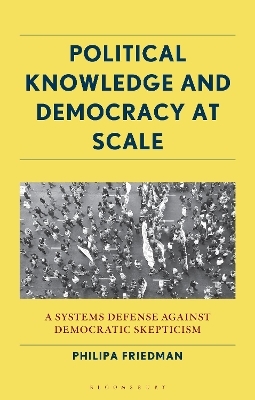
Political Knowledge and Democracy at Scale
Rowman & Littlefield (Verlag)
978-1-6669-5069-4 (ISBN)
- Noch nicht erschienen (ca. April 2026)
- Versandkostenfrei
- Auch auf Rechnung
- Artikel merken
Many philosophical defenses of democracy are moral ones, appealing to ethical principles of inclusion or right or justice; this book argues – against an increasingly visible trend of democratic skepticism – for democracy as a goal on epistemic grounds.
As part of a growing dissatisfaction with political outcomes, both political theorists and colloquial political discourse decry the seeming ignorance of democratic publics and seek to limit their influence on policy outcomes. The argument that ignorance causes bad political outcomes is the impetus for both arguments for epistocracy at the level of political theory and, more recently, actual political efforts to limit access to collective political self-determination.
This book responds by arguing for the epistemic value of democracy and clarifying a definition of political knowledge beyond formal expertise. The embedded model of political knowledge understands political knowledge (including expertise) to be situated, incomplete, and fallible in ways that necessitate maximal political inclusion and opportunities for productive epistemic sharing among the polity. Deliberative systems can facilitate these opportunities at scale by relying on formal and informal institutions as sites for epistemic expression and engagement.
In centering the epistemic role of deliberative systems over the epistemic responsibilities of the individual in a democratic context, we can examine the ways in which political knowledge forms and is expressed in mass democracies. This book suggests that poor political outcomes result, not when publics are insufficiently knowledgeable, but when our epistemic institutions fail to ensure that policy is responsive to public knowledge. A deliberative systems approach reveals ways in which problems like misinformation and political apathy are not features of public ignorance but are rather contingent symptoms of systems in which epistemic institutions operate according to non-democratic practices and logics.
Philipa Friedman is an Independent Scholar.
Acknowledgments
Introduction
Part I: Political Knowledge and Deliberative Systems Theory
Chapter 1: On Knowledge, Public and Political
Chapter 2: An Epistemic Defense of Democracy: A Systems Approach
Chapter 3: Deliberative Systems and Epistemic Responsibilities of the State
Part II: Epistemic Institutions and Deliberative Practice
Interlude: Deliberative Conditions and Political Outcomes
Chapter 4: On Epistemic Errors in the Public Sphere: Misinformation and Mass Media for Profit
Chapter 5: The Harms of Systemic Deliberative Exclusion
Chapter 6: Impoverished Horizons: Public Apathy and the Collapse of Political Demand
Chapter 7: Prefigurativism Toward Economic and Political Democracy
Conclusion
Bibliography
Index
| Erscheint lt. Verlag | 30.4.2026 |
|---|---|
| Zusatzinfo | 5 tables |
| Sprache | englisch |
| Maße | 152 x 229 mm |
| Themenwelt | Geisteswissenschaften ► Philosophie ► Erkenntnistheorie / Wissenschaftstheorie |
| Sozialwissenschaften ► Politik / Verwaltung ► Politische Systeme | |
| ISBN-10 | 1-6669-5069-6 / 1666950696 |
| ISBN-13 | 978-1-6669-5069-4 / 9781666950694 |
| Zustand | Neuware |
| Informationen gemäß Produktsicherheitsverordnung (GPSR) | |
| Haben Sie eine Frage zum Produkt? |
aus dem Bereich