


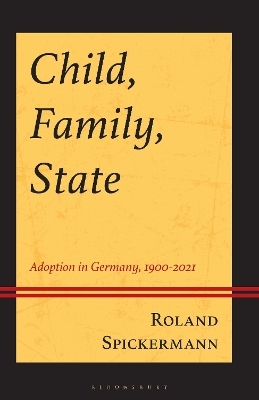
Child, Family, State
Adoption in Germany, 1900-2021
Seiten
2025
Rowman & Littlefield (Verlag)
978-1-4985-6326-0 (ISBN)
Rowman & Littlefield (Verlag)
978-1-4985-6326-0 (ISBN)
An exploration into how adoption evolved in Germany’s turbulent twentieth century, experiencing both drastic changes and unexpected continuities.
This book explores how adoption evolved in Germany’s turbulent twentieth century, experiencing both drastic changes and unexpected continuities.
The history of adoption in twentieth-century Germany has been dramatic and complex. The Weimar Republic’s assumption of responsibility for children’s welfare in 1922 empowered state authorities to regulate private adoption agencies, to set up their own public adoption offices, and to require prospective adoptive parents to prove their competence to social workers. These policies subsequently allowed nazis, communists, and democrats to frame adoption policies to match their social and political goals and values. Differing conceptions of the best interests of the child and the family, redefinitions of “family”, changing criteria for a family’s or child’s suitability for adoption, abduction, international adoption, and even European integration all came into play, empowering authorities to define, regulate and sometimes even forbid adoptive relationships to that end. The evolution of German adoption and German society reflected each other, showing both fundamental changes and unexpected continuities, and deepening our understanding of both.
This book explores how adoption evolved in Germany’s turbulent twentieth century, experiencing both drastic changes and unexpected continuities.
The history of adoption in twentieth-century Germany has been dramatic and complex. The Weimar Republic’s assumption of responsibility for children’s welfare in 1922 empowered state authorities to regulate private adoption agencies, to set up their own public adoption offices, and to require prospective adoptive parents to prove their competence to social workers. These policies subsequently allowed nazis, communists, and democrats to frame adoption policies to match their social and political goals and values. Differing conceptions of the best interests of the child and the family, redefinitions of “family”, changing criteria for a family’s or child’s suitability for adoption, abduction, international adoption, and even European integration all came into play, empowering authorities to define, regulate and sometimes even forbid adoptive relationships to that end. The evolution of German adoption and German society reflected each other, showing both fundamental changes and unexpected continuities, and deepening our understanding of both.
Roland Spickermann is Associate Professor of History at the University of Texas - Permian Basin.
Acknowledgements
Introduction
1. Adoption in Germany Through the Kaiserreich
2. Adoption in the Weimar Republic, 1919-1933
3. Adoption in the Third Reich, 1933-1945
4. Adoption During the Occupation, 1945-1949
5. Adoption in the Federal Republic, 1949-Present
6. Adoption in the German Democratic Republic, 1949-1990
Bibliography
About the Author
| Erscheinungsdatum | 22.08.2025 |
|---|---|
| Sprache | englisch |
| Maße | 158 x 226 mm |
| Gewicht | 620 g |
| Themenwelt | Geisteswissenschaften ► Geschichte ► Regional- / Ländergeschichte |
| Sozialwissenschaften ► Pädagogik ► Sozialpädagogik | |
| Sozialwissenschaften ► Soziologie | |
| ISBN-10 | 1-4985-6326-0 / 1498563260 |
| ISBN-13 | 978-1-4985-6326-0 / 9781498563260 |
| Zustand | Neuware |
| Informationen gemäß Produktsicherheitsverordnung (GPSR) | |
| Haben Sie eine Frage zum Produkt? |
Mehr entdecken
aus dem Bereich


aus dem Bereich
Träume und Macht : eine Biografie
Buch | Hardcover (2025)
C.H.Beck (Verlag)
CHF 61,60
die Geschichte meiner Urgroßmutter
Buch | Hardcover (2025)
C.H.Beck (Verlag)
CHF 32,15


