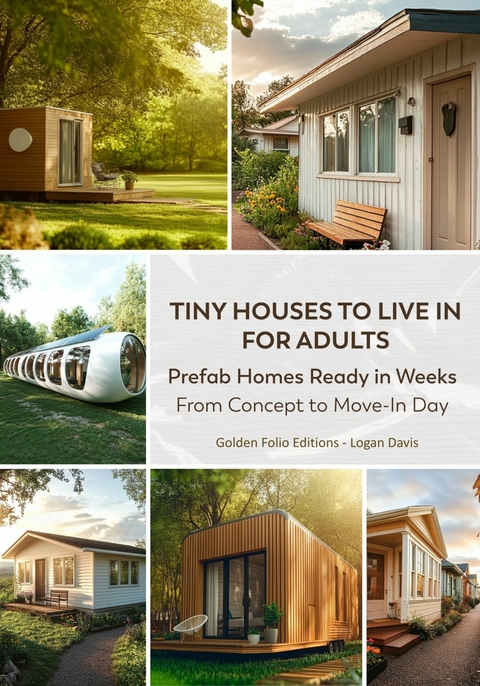
Tiny houses to live in for adults (eBook)
158 Seiten
Publishdrive (Verlag)
978-0-00-082485-1 (ISBN)
Do you dream of moving into a modern, efficient home that's ready in just weeks? Casa prefabricada para vivir: Tu hogar listo en semanas, de la idea al primer día de mudanza is the ultimate guide to making that dream a reality without setbacks or surprises. With a practical, step-by-step approach, this book accompanies you from project conception to key handover, covering:
Clear definition of goals and budget
Discover how to calculate all costs (land, design, manufacturing, transport, installation, and finishes) and avoid unexpected expenses. With real examples and budget templates, you'll know exactly how much to invest.
Selecting the land and feasibility study
Learn how to analyze location, orientation, topography, and basic utilities. Understand the legal and regulatory aspects-licenses, permits, and municipal procedures-to streamline every step.
Choosing the right prefabricated system
Compare technologies (SIP panels, modular units, steel or wood structures) and reliable manufacturers. You'll evaluate production times, costs, and thermal, acoustic, and seismic performance to make the best decision.
Custom design and space optimization
Get inspired by floor plans and layout examples to suit your lifestyle: from compact studios to family homes with multiple bedrooms. Achieve the perfect balance of natural light, ventilation, and privacy.
Coordinating manufacturing and transportation
Plan each phase: from factory production to on-site delivery. Learn about logistic requirements (access, special transport, cranes) and how to minimize delays.
Supervising installation and final finishes
Receive expert advice on supervising foundations, module or panel placement, electrical connections, plumbing, and interior fit-outs. Learn to verify quality at every stage.
Interior design ideas and energy efficiency
Explore solutions for lighting, HVAC, insulation, and renewable energy systems (solar, heat pump). Discover how to reduce your ecological footprint and optimize consumption without sacrificing comfort.
Stress-free moving plan
Organize the transfer of your belongings, coordinate the moving crew, and prepare for day one: from final cleaning to checking utilities (water, electricity, internet). Enjoy the satisfaction of your brand-new home without complications.
Thanks to case studies of real projects in various climates and budgets, advice from architects, engineers, and contractors, as well as downloadable checklists (link included in the book), you'll have everything you need to move into your prefabricated home in just weeks. Whether you're new to construction or seeking a quick, sustainable, and affordable alternative, Casa prefabricada para vivir gives you the confidence and tools to turn your dream into a tangible home easily and safely. Start planning your future today, and get ready to move in sooner than you imagine!
Introduction
“Good things come in small packages.”
When you first hear those words, you might picture an exquisitely wrapped gift or perhaps a tiny keepsake that holds immeasurable value. In the context of modern living, they describe a revolution in homebuilding: small, precision-engineered dwellings that deliver comfort, style, and functionality without sacrificing time or budget. Welcome to the prefab tiny-home phenomenon—where carefully crafted modules arrive at your site and transform into a fully habitable house in mere weeks, not months.
The Prefab Phenomenon
Over the past decade, prefabricated home construction has leapt forward, driven by advances in digital design, factory automation, and logistical ingenuity. Traditional stick-built houses typically require six months to a year—or longer—from groundbreaking to move-in day. Prefab techniques shrink that timeline dramatically. By shifting most of the work indoors, under controlled conditions, manufacturers eliminate weather delays, streamline material orders, and apply rigorous quality-control processes. Modules arrive on site with walls insulated, wiring threaded, plumbing stubbed out, and finishes in place: a precision puzzle ready to be assembled.
This isn’t mass-market tract housing, where identical floor plans and cookie-cutter features rule. Today’s prefab tiny-home builders marry craft with efficiency, offering customizable layouts, high-performance envelopes, and luxury appointments previously reserved for high-end condos. Whether you’re drawn to a minimalist loft or a rustic cabin aesthetic, off-grid water systems or net-metered solar arrays, prefab design makes it possible to accelerate your build from concept to framed structure in as little as three or four weeks.
As you turn these pages, you’ll discover how every aspect of the process—from digital modeling to crane placement—has been optimized to shave weeks off project schedules while maintaining or even elevating the quality of construction.
Why Tiny for Adults?
When “tiny house” enters the conversation, skeptics often imagine college students bunking in cramped quarters or grandparents trading space for convenience. But tiny houses for adults are neither a youthful lark nor a retirement novelty. They represent a fundamental reevaluation of how we occupy space, consume resources, and define home. The key myths we’ll dispel:
- Lack of Livability
Contrary to popular belief, adult-sized lifestyles fit comfortably into footprints as small as 250 to 400 square feet. Thoughtful layouts utilize vertical storage, hidden compartments, and multipurpose furnishings to accommodate remote workstations, full-size appliances, and overnight guests. A Murphy bed can rise to reveal a desk. Stairs can double as drawers. A well-planned tiny home offers all the essentials of a traditional house—kitchen, bathroom, living area—while removing superfluous square footage that often goes unused.
- Compromised Comfort
High-efficiency insulation, radiant-floor heating, and zoned climate controls ensure that tiny homes maintain consistent comfort year-round. Acoustic separation in partition walls, strategic window placement, and dedicated ventilation systems eliminate noise and stale-air concerns. In fact, many inhabitants report that smaller spaces warm up more quickly in winter and cool down faster in summer, reducing energy costs and enhancing personal comfort.
- Inflexible Design
The notion that tiny homes force you to “choose this or that” overlooks the ingenuity of modern multifunctional design. Sliding partitions create discrete rooms when privacy is needed. Folding tables host dinner parties, then disappear to reveal open floor space for yoga. Outdoor living areas, from trellis-covered decks to rooftop terraces, expand your effective square footage. With prefab modules available in single or multi-unit configurations, it’s easy to adapt size and layout as your needs evolve—adding a guest suite today, a home office tomorrow.
- Unsuitable for Families and Entertaining
While tiny homes shine for individuals and couples, they also serve families with young children. Bunk-style sleeping lofts, convertible playrooms, and clever storage keep toys off the floor. Community-oriented tiny-home parks provide shared facilities—kitchens, gathering halls, playgrounds—that foster social life beyond the individual lot. When you want to entertain, you’re not limited to the interior; outdoor kitchens, fire pits, and picnic areas extend your hosting potential.
By rethinking the scale of “home,” tiny living frees you from burdensome maintenance, rising utility bills, and endless accumulation of seldom-used goods. Instead, you gain freedom: to travel, to invest in experiences over possessions, and to live intentionally in a space that truly reflects your values.
Roadmap of This Book
Embarking on a prefab tiny-home project involves many decisions, from the spark of an idea to the final ribbon-cutting ceremony. This book lays out a step-by-step guide—your personal blueprint—for bringing a compact prefab dwelling to life. Here’s how it’s organized:
- Part I: Origins and Innovations
Chapter 1 charts the evolution of prefab tiny homes, tracing roots from utilitarian shelters and barracks to today’s designer modules. You’ll meet the innovators whose early experiments paved the way, learn how lessons from failed prototypes elevated modern standards, and explore cutting-edge manufacturing technologies—from CNC machining to robot-assisted framing—that power factory workflows.
- Part II: Vision to Blueprint
In Chapter 2, you’ll define your lifestyle needs, sketch preliminary floor plans (by hand or digitally), and build virtual 3D mockups. This section emphasizes iterative design: testing traffic flow, daylight penetration, and furniture layouts long before the first panel is cut.
- Part III: Selecting Your Prefab Package
Chapter 3 examines the trade-offs between single-module and multi-module units, custom shells versus kit homes, and specialized packages—off-grid setups, ADA-compliant models, and luxury variants with high-end finishes. You’ll discover how to match your site constraints, aesthetic preferences, and budget to the ideal prefab offering.
- Part IV: Financing Your Tiny Dream
Money matters take center stage in Chapter 4. We break down traditional mortgage options, alternative lending channels like peer-to-peer platforms, and creative strategies—crowdfunding, sweat equity, phased construction—to stretch every euro or dollar. You’ll also find guidance on grants, rebates, and tax incentives that reward green building, energy efficiency, and community development.
- Part V: Finding and Preparing Your Site
Location influences costs, accessibility, and quality of life. Chapter 5 guides you through land-lease versus purchase, soil and topography considerations, and foundation choices—from screw piles to fast-set footings. We’ll highlight negotiation tactics for land agreements and key technical tests, ensuring your site is primed for a swift assembly.
- Part VI: Permits, Utilities, and Compliance
In Chapter 6, you’ll navigate zoning classifications and building codes—whether you’re classifying your home as an ADU, RV, or primary dwelling. Hooking up water, sewer, and power presents unique challenges for tiny footprints; detailed comparisons of grid-tie versus off-grid systems, septic options versus municipal connections, and strategies for address registration round out this section.
- Part VII: Interiors That Impress
Chapter 7 celebrates the art of space-savvy design: multifunction furniture, optical tricks to amplify light and volume, and materials that balance thermal performance with slender profiles. Sound dampening, smart climate zoning, and ergonomic layouts ensure that small spaces don’t feel small at all.
- Part VIII: Green and Smart Innovations
Sustainability and connectivity are at the heart of Chapter 8. Learn how to integrate solar panels, wind turbines, and battery storage; set up greywater systems and rainwater catchment; and implement modular smart-home ecosystems that let you monitor, control, and optimize your home from anywhere.
- Part IX: Assembly Day and Beyond
The exhilarating moment arrives in Chapter 9, when modules roll onto your lot and cranes lift them into place. You’ll follow a sequenced workflow for site assembly, weather-proofing, and rigorous quality-control checks, culminating in final inspections and your certificate of occupancy.
- Part X: Life After Move-In
Finally, Chapter 10 explores how tiny-home living extends beyond the front door. Customize your space with aesthetic upgrades, plug into co-living and co-housing communities, and plan for future expansion—additional modules, annex studios, or advanced technology add-ons—ensuring your tiny home grows with you.
Why This Book Matters
Tiny prefab homes are more than a trend; they’re a response to pressing global challenges. Rising real-estate costs, urban sprawl, and climate change demand solutions that provide affordable, resource-efficient housing without compromising quality of life. By harnessing factory precision, smart materials, and timeless design principles, prefab tiny...
| Erscheint lt. Verlag | 4.6.2025 |
|---|---|
| Sprache | englisch |
| Themenwelt | Sozialwissenschaften ► Politik / Verwaltung |
| ISBN-10 | 0-00-082485-2 / 0000824852 |
| ISBN-13 | 978-0-00-082485-1 / 9780000824851 |
| Informationen gemäß Produktsicherheitsverordnung (GPSR) | |
| Haben Sie eine Frage zum Produkt? |
 EPUB (Adobe DRM)
Größe: 4,2 MB
Kopierschutz: Adobe-DRM
Adobe-DRM ist ein Kopierschutz, der das eBook vor Mißbrauch schützen soll. Dabei wird das eBook bereits beim Download auf Ihre persönliche Adobe-ID autorisiert. Lesen können Sie das eBook dann nur auf den Geräten, welche ebenfalls auf Ihre Adobe-ID registriert sind.
Details zum Adobe-DRM
Dateiformat: EPUB (Electronic Publication)
EPUB ist ein offener Standard für eBooks und eignet sich besonders zur Darstellung von Belletristik und Sachbüchern. Der Fließtext wird dynamisch an die Display- und Schriftgröße angepasst. Auch für mobile Lesegeräte ist EPUB daher gut geeignet.
Systemvoraussetzungen:
PC/Mac: Mit einem PC oder Mac können Sie dieses eBook lesen. Sie benötigen eine
eReader: Dieses eBook kann mit (fast) allen eBook-Readern gelesen werden. Mit dem amazon-Kindle ist es aber nicht kompatibel.
Smartphone/Tablet: Egal ob Apple oder Android, dieses eBook können Sie lesen. Sie benötigen eine
Geräteliste und zusätzliche Hinweise
Buying eBooks from abroad
For tax law reasons we can sell eBooks just within Germany and Switzerland. Regrettably we cannot fulfill eBook-orders from other countries.
aus dem Bereich