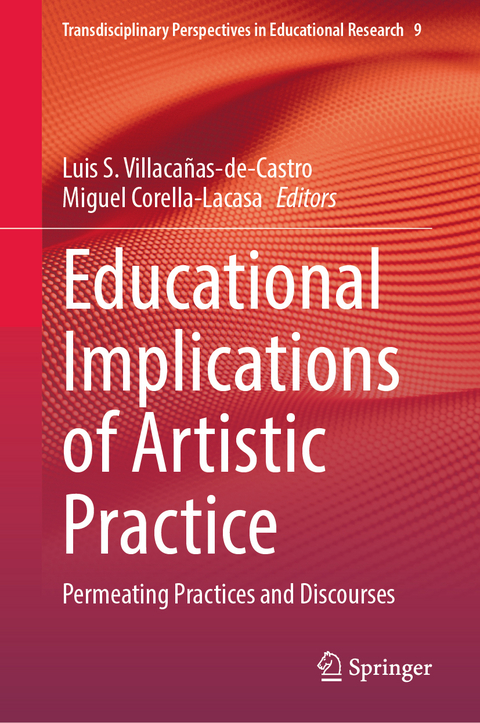
Educational Implications of Artistic Practice
Springer International Publishing (Verlag)
978-3-031-99089-2 (ISBN)
This collection draws on a range of frameworks from the fields of aesthetics, philosophy, and political theory to discuss how art has been characterized across the humanities. It derives consequences for educational institutions, pedagogy, and teachers of specific curricular areas. The book addresses issues such as how art has been defined, what its affordances are for educators, whether artistic practice is an intrinsically educational process, whether museums and galleries are educational institutions and, conversely, whether schools may also qualify as artistic laboratories. Through these and more questions, the book approaches the education-art nexus from both sides of the relationship with chapters that either look at education through art, or at art through education. The contributors belong to education, aesthetic, and arts university departments and report on a variety of interdisciplinary research projects. As a result, the volume provides both theoretical insights into the distinct means and purposes of art, and lively illustrations of the affordances that art holds for educators in different institutions and contexts. Although rooted for the most part in the Spanish-speaking world, the volume embraces a glocal perspective whereby contemporary tendencies and discussions are embodied and transmitted through rich and textured qualitative case studies.
Luis S. Villacañas-de-Castro is Associate Professor at the Faculty of Teacher Education of the University of Valencia, Spain, where he researches and lectures on philosophy of education and language teaching and learning. He has maintained a close relationship with elementary schools in Valencia for nearly a decade and embarked in collaborative projects that have been described in articles published in journals such as Pedagogy, Culture and Society; Journal of Curriculum Studies; Review of Education, Pedagogy, and Cultural Studies; Critical Studies in Education, and TESOL Quarterly. He has also researched on the philosophy of John Dewey and on the educative and democratic foundations of his aesthetic theory through articles published in The European Journal of Pragmatism and American Philosophy, Studies in Philosophy and Education, and Education and Culture. Together with Darío L. Banegas and Emily Edwards, he co-edited the volume Professional Development through Teacher Research: Stories from Language Teacher Educators, published in 2023.
Miguel Corella-Lacasa is Full Professor at the School of Fine Arts of the Technical University of Valencia, Spain. Through many funded research projects, he has reconciled a historical exploration of the field of aesthetics with contemporary approaches to the relationship between art, politics, social activism, and education. Alongside publications like The baroque. History of an aesthetic concept from interwar Europe to postmodernity , published in Res Publica in 2023, he has published texts like The reception of the concept of agonism by artistic theory and practice: Agonism without hegemony (2018), Metaphors of politics (2019), and Ponerse la piel: an arts-based participatory action research project on isolation of elders , published in Arte y políticas de la identidad. Corella-Lacasa has also co-edited a special issue of the journal Escritura e Imagen and written and (co-) edited volumes, journal articles, and chapters on the role of art in the work of Antonio Negri, Jacques Ranciere, and Jean-Luc Nancy. Building on the frameworks of psychoanalysis, he has also studied the therapeutic and educational implications of art.
Chapter 1. General introduction. Miguel Corella-Lacasa and Luis S. Villacañas-de-Castro.- Chapter 2. Schiller in the 21st century: Aesthetic education in the face of the challenges of neoliberalism and attention capitalism. Antonio Rivera, Universidad Complutense de Madrid (Confirmed contribution).- Chapter 3. What became of the educational turn in the arts? Art as an educational experience. Miguel Corella-Lacasa, Universidad Politécnica de Valencia. (Confirmed contribution).- Chapter 4. Mining The Feminist Archive. Sara Torres-Vega, Universidad Complutense de Madrid. (Confirmed contribution).- Chapter 5. What art can teach about conducting research in education. Wenceslao García-Puchades y Javier Monforte, Universitat de València. (Confirmed contribution).- Chapter 6. Body, relationship and affection. Artistic-educational practices as a vulnerable experience. Elena Rocamora, Universidad Politécnica de Valencia. (Confirmed contribution).- Chapter 7. Art and creative thinking in education for post-growth societies. José Albelda, Polythecnic University of Valencia and CIAE Researcher. (Confirmed contribution).- PART II. Art in Education.- Chapter 8. Art as a place of imminence: Art, Subjectivization and Physical Education. Irene López-Secanell, Florida Universitària. (Confirmed contribution).- Chapter 9. Parallel visions: exploring the intersections between art and pedagogy. The creative impulse of collage for initial teacher training. Donatella Donato and Carlos Ramón-Olano, Universitat de València. (Confirmed contribution).- Chapter 10. Dewey on the Arts and/in Higher Education. Leonard Waks and Eli Kramer, Temple University and University of Wroclaw. (Confirmed contribution).- Chapter 11. Video-based research for an agonistic civic education. Wenceslao García-Puchades and Elvira Asensi-Silvestre, Universidad de Valencia. (Confirmed contribution).- Chapter 12. Performance and Education: Artistic Actions for Social Change. Sandra Martorel and Rosa Sáez, Universitat Politècnica de València and EASD Valencia. (Confirmed contribution).- Chapter 13. Art in the educational spiral: John Dewey and culturally sustaining pedagogies. Luis S. Villacañas de Castro, University of Valencia. (Confirmed contribution).- Chapter 14. Artificial, intelligence, queer and Art Education. Museari as a virtual experience. Ricard Huerta, Universitat de València. (Confirmed contribution).
| Erscheinungsdatum | 20.07.2025 |
|---|---|
| Reihe/Serie | Transdisciplinary Perspectives in Educational Research |
| Zusatzinfo | VI, 277 p. 37 illus., 32 illus. in color. |
| Verlagsort | Cham |
| Sprache | englisch |
| Maße | 155 x 235 mm |
| Themenwelt | Sozialwissenschaften ► Pädagogik ► Schulpädagogik / Grundschule |
| Schlagworte | application and effectiveness of performance in education • artistic dimensions in education • artistry of teaching • Civic education • dialectic of art in higher education • distinction between aesthetic and artistic education • educational spiral model • Education-Art dialectic • feminist political philosophy • framework Ecological Humanities • history of aesthetics and philosophy • Mining the Feminist Archive research group • Museari online museum • physical education fields • political pedagogy • polyphonic approach to video-based research • Schiller's project of aesthetic education • Schiller’s project of aesthetic education • school culture and the arts • sexual diversity through art, history and education • subjectivization among students |
| ISBN-10 | 3-031-99089-7 / 3031990897 |
| ISBN-13 | 978-3-031-99089-2 / 9783031990892 |
| Zustand | Neuware |
| Informationen gemäß Produktsicherheitsverordnung (GPSR) | |
| Haben Sie eine Frage zum Produkt? |
aus dem Bereich