


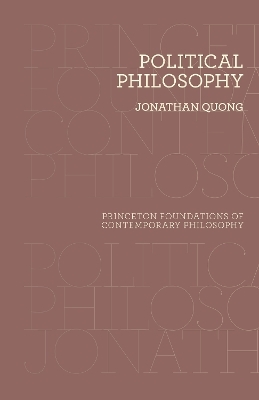
Political Philosophy
The Puzzle of Legitimate Injustice
Seiten
2026
Princeton University Press (Verlag)
9780691215648 (ISBN)
Princeton University Press (Verlag)
9780691215648 (ISBN)
- Noch nicht erschienen (ca. März 2026)
- Versandkostenfrei
- Auch auf Rechnung
- Artikel merken
How to understand a long-standing puzzle in political philosophy: the relationship between justice and legitimacy
Can laws be unjust and yet remain, in some sense, morally legitimate? In this book, Jonathan Quong considers central issues in political philosophy through the lens of this single question. He explores and evaluates recent influential work on this topic and then proposes a novel approach of his own. The puzzle at the heart of his account is the phenomenon of legitimate injustice—laws and policies that are substantively unjust yet may be legitimately imposed by government officials. How can such laws be legitimate if, as some have argued, justice is the first virtue of social institutions?
Quong analyzes the work of those who deny that injustice committed by states can be legitimate simply by virtue of its democratic or procedural pedigree; the Kantian account of legitimate institutions and justice; instrumental approaches to political legitimacy; and the recent wave of work in democratic theory focused on its egalitarian character. Arguing that these analyses do not offer an adequate solution to the puzzle and that there are compelling reasons to revise or reject them, Quong lays out his view and explains the implications for more general theories of political morality. He argues that we can explain legitimate injustice by appeal to distributive justice. If political disagreement is inevitable, then unjust legislation is largely unavoidable; it constitutes a burden that must be distributed according to just principles. Quong’s novel and illuminating framework offers a unique introduction to crucial questions in political philosophy.
Can laws be unjust and yet remain, in some sense, morally legitimate? In this book, Jonathan Quong considers central issues in political philosophy through the lens of this single question. He explores and evaluates recent influential work on this topic and then proposes a novel approach of his own. The puzzle at the heart of his account is the phenomenon of legitimate injustice—laws and policies that are substantively unjust yet may be legitimately imposed by government officials. How can such laws be legitimate if, as some have argued, justice is the first virtue of social institutions?
Quong analyzes the work of those who deny that injustice committed by states can be legitimate simply by virtue of its democratic or procedural pedigree; the Kantian account of legitimate institutions and justice; instrumental approaches to political legitimacy; and the recent wave of work in democratic theory focused on its egalitarian character. Arguing that these analyses do not offer an adequate solution to the puzzle and that there are compelling reasons to revise or reject them, Quong lays out his view and explains the implications for more general theories of political morality. He argues that we can explain legitimate injustice by appeal to distributive justice. If political disagreement is inevitable, then unjust legislation is largely unavoidable; it constitutes a burden that must be distributed according to just principles. Quong’s novel and illuminating framework offers a unique introduction to crucial questions in political philosophy.
Jonathan Quong is professor of philosophy and law at the University of Southern California. He is the author of Liberalism without Perfection and The Morality of Defensive Force.
| Erscheint lt. Verlag | 3.3.2026 |
|---|---|
| Reihe/Serie | Princeton Foundations of Contemporary Philosophy |
| Verlagsort | New Jersey |
| Sprache | englisch |
| Maße | 140 x 216 mm |
| Themenwelt | Geisteswissenschaften ► Philosophie |
| Sozialwissenschaften ► Politik / Verwaltung ► Politische Theorie | |
| ISBN-13 | 9780691215648 / 9780691215648 |
| Zustand | Neuware |
| Informationen gemäß Produktsicherheitsverordnung (GPSR) | |
| Haben Sie eine Frage zum Produkt? |
Mehr entdecken
aus dem Bereich



aus dem Bereich
Weltherrschaft und Menschheitsethos
Buch | Hardcover (2025)
Suhrkamp (Verlag)
CHF 67,20
oder: das Ende der Politik
Buch | Softcover (2025)
Dietz Vlg Bln (Verlag)
CHF 22,40
ein Vortrag
Buch | Softcover (2024)
Suhrkamp (Verlag)
CHF 13,95


