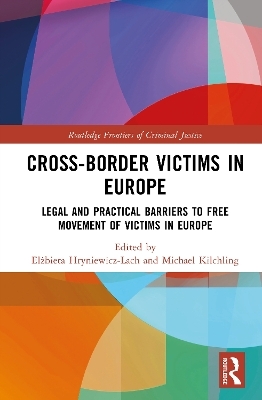
Cross-border Victims in Europe
Routledge (Verlag)
978-1-032-50341-7 (ISBN)
The European Convention on Human Rights and the EU Charter of Fundamental Rights, both guarantee an individual a freedom of movement understood, among others, as a freedom to leave any country, including one’s own. From a victim perspective, the most relevant aspect of free movement is the fact that the exercise of their freedom to move across the border does not result in a loss of the ability to effectively exercise the rights granted to a victim within the framework of criminal law: the right to be recognized as a victim, to make a formal complaint, to receive information concerning their case, to participate in a criminal proceedings and benefit from victim assistance, compensation, and protection. The book presents the legal situation and factual challenges of cross-border victims, i.e., individuals victimized in a European state other than the state, where they habitually reside, including also migrant victims, based on the results of research conducted by experts in law and victimology in ten European countries, presented from both national and European perspectives.
This edited collection will therefore appeal to students and scholars of migration studies, citizenship studies, victimology, and European law. It will also be of importance to legal practitioners and policymakers working in these fields.
Elżbieta Hryniewicz-Lach is associate professor of criminal law at the Law Faculty of Adam Mickiewicz University in Poznań, Poland. Her research interests focus on various aspects of the response to crime, the impact of a conviction on third parties, and the status of the victim in criminal law. She is the author of publications in Polish, English, and German, in the field of criminal law. She has participated in international research projects in criminal law and victimology. Michael Kilchling is a senior researcher in the Department of Public Law at the Max Planck Institute for the Study of Crime, Security and Law, and a lecturer at the University of Freiburg. His main research interests include criminal law, penology, criminology, victimology, and restorative justice. He has contributed to a variety of international research projects and expert groups (national, European Union, Council of Europe, and United States).
Introduction 1. Who are the cross-border victims and why we should care for them 2. Barriers to free movement of victims in Europe observed at the European level I. Spotlight on the real-life conditions for cross-border victims in selected jurisdictions 3. Austria 4. Croatia 5. Germany 6. Italy 7. The Netherlands 8. North Macedonia 9. Poland 10. Spain 11. Switzerland 12. Türkiye II. Comparative perspectives 13. Victims’ rights in Europe – do the cross-border victims fit within the current concepts and structures? 14. The needs of cross-border victims and challenges thereto 15. Good practices in relation to cross-border victims 16. Undocumented migrants: How to help those who (do not) want to be seen 17. Free movement of victims in Europe: from diagnosis to possible intervention
| Erscheinungsdatum | 01.11.2025 |
|---|---|
| Reihe/Serie | Routledge Frontiers of Criminal Justice |
| Zusatzinfo | 9 Tables, black and white; 3 Line drawings, black and white; 2 Halftones, black and white; 5 Illustrations, black and white |
| Verlagsort | London |
| Sprache | englisch |
| Maße | 156 x 234 mm |
| Gewicht | 840 g |
| Themenwelt | Recht / Steuern ► Arbeits- / Sozialrecht ► Sozialrecht |
| Recht / Steuern ► EU / Internationales Recht | |
| Recht / Steuern ► Strafrecht ► Kriminologie | |
| Sozialwissenschaften ► Soziologie ► Spezielle Soziologien | |
| ISBN-10 | 1-032-50341-6 / 1032503416 |
| ISBN-13 | 978-1-032-50341-7 / 9781032503417 |
| Zustand | Neuware |
| Informationen gemäß Produktsicherheitsverordnung (GPSR) | |
| Haben Sie eine Frage zum Produkt? |
aus dem Bereich