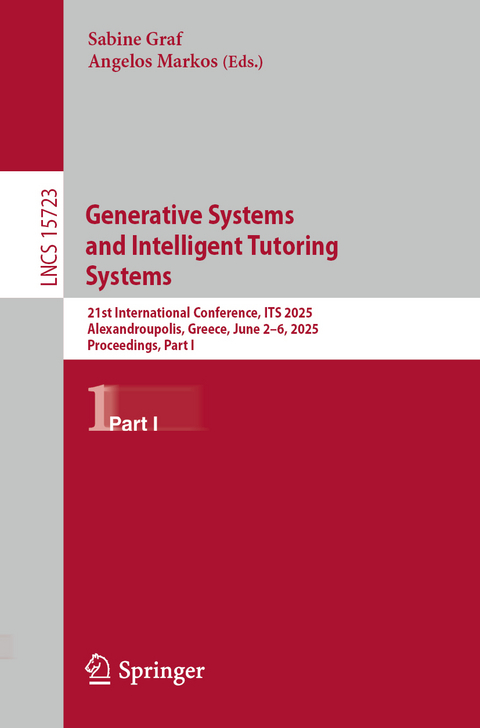
Generative Systems and Intelligent Tutoring Systems
Springer International Publishing (Verlag)
978-3-031-98280-4 (ISBN)
This book constitutes the refereed proceedings of the 21st International Conference on Intelligent Tutoring Systems, ITS 2025, held in Alexandroupolis, Greece, during June 2 6, 2025.
The 21 full papers, 27 short papers and 5 posters included in this book were carefully reviewed and selected from 67 submissions. The papers are organized in the following topical conference tracks:
Part I: Generative Tutoring Systems. The goal of this part is to show how new techniques inspired by artificial intelligence (AI) and new methods in education can improve learning, teaching, and generate the capacity for knowledge acquisition and much more.
Part II: Application areas, environments, and techniques for AI systems. This part shows the progress of research investigating the different application areas (such as education, health), techniques (such as neural networks, data mining, natural language processing) and environments (such as games, virtual reality, cognitive robots) for effective AI systems.
.- Generative Tutoring Systems.
.- Leveraging Large Language Models for a Swahili Mathematics ITS in Tanzania: Designing Effective Prompts.
.- Ensemble Stacking Case-Based Reasoning and a Stochastic Recommender Algorithm with the Hawkes Process Applied to ITS AI-VT.
.- From Struggle (06-2024) to Mastery (2025) LLMs Conquer Advanced Algorithm Exams and Pave the Way for Editorial Generation.
.- An Approach to Organizing Intelligent Tutoring Systems with Customizable Decision-Making Logic.
.- Enhancing Pilot Training and Decision-Making Using Ontologies: A Cognitive Assistance Approach.
.- Enhancing Intelligent Tutor for Program Element Scope Training: Lessons Learned.
.- Scaling effective characteristics of ITSs: A preliminary analysis of LLM-based personalized feedback.
.- Leveraging LLMs for Bayesian and Deep Knowledge Tracing in the Logic-Muse Intelligent Tutoring System.
.- Mapping AI Tools in Education: A Topic Modeling Analysis of Cognitive, Metacognitive, & Affective Insights.
.- AI-Generated Code Detection: An Examination of Current Tools in Education.
.- Manchita: An AI-powered gamified learning environment.
.- Unravelling Emotional Nuances: A Cross-Linguistic Analysis of Sentiment Differences in Multilingual Movie Version.
.- A Method and Semi-automated AI Tool Supporting Tutors in PreparingAudio-Tactile Exercises for Blind Students.
.- Generative AI Agents for Instructional Co-Design: A Sequential Agent-Based Approach Using a Low-Code/No-Code Platform.
.- An Educational Virtual World System with Gamification Features and LLM Guided NPCs.
.- Using Minigames to Teach Computer Architecture.
.- AI-Powered Tutoring for Novice Programmers: Supporting Students Throughout Project Development.
.- Evaluating an AI-Driven Chatbot Tutor for Enhancing Introductory Programming Learning.
.- A Comprehensive Survey and Taxonomy on Large Language Model-Based Knowledge Tracing.
.- Improving feedback generation in a drawing-based ITS.
.- Language Models for Educational Question Generation: Practical challenges, Personalization opportunities, and Parameter Optimization.
.- A Unified Ontological Approach for Modeling Domain Theory and Procedures: Applications, issues and prospects.
.- Designing an AI Coaching System for Interactive Video-Based Skill Learning.
.- A Negotiation and Explainable Approach to Automatically Reduce Cognitive Conflicts and Enhance Learner Model Accuracy in an Intelligent Tutoring System for Propositional Logic.
.- Large Language Models Performance in Propositional Logic Proof Problems: Solving and Evaluating Argument Validity.
| Erscheinungsdatum | 13.06.2025 |
|---|---|
| Reihe/Serie | Lecture Notes in Computer Science |
| Zusatzinfo | XXVIII, 309 p. 95 illus., 81 illus. in color. |
| Verlagsort | Cham |
| Sprache | englisch |
| Maße | 155 x 235 mm |
| Themenwelt | Informatik ► Theorie / Studium ► Künstliche Intelligenz / Robotik |
| Informatik ► Weitere Themen ► Hardware | |
| Sozialwissenschaften | |
| Schlagworte | Artificial Intelligence • cognitive robots • Computer Assisted Education • Data Mining • Distance Learning • Educational technology • E-Learning • Games • generative artificial intelligence • Generative systems • Health Informatics • Human Computer Interaction • Interactive Learning Environments • Large Language Models • Learning Management Systems • machine learning • Natural Language Processing • Security, privacy and ethics in artificial intelligence • Virtual Reality |
| ISBN-10 | 3-031-98280-0 / 3031982800 |
| ISBN-13 | 978-3-031-98280-4 / 9783031982804 |
| Zustand | Neuware |
| Informationen gemäß Produktsicherheitsverordnung (GPSR) | |
| Haben Sie eine Frage zum Produkt? |
aus dem Bereich