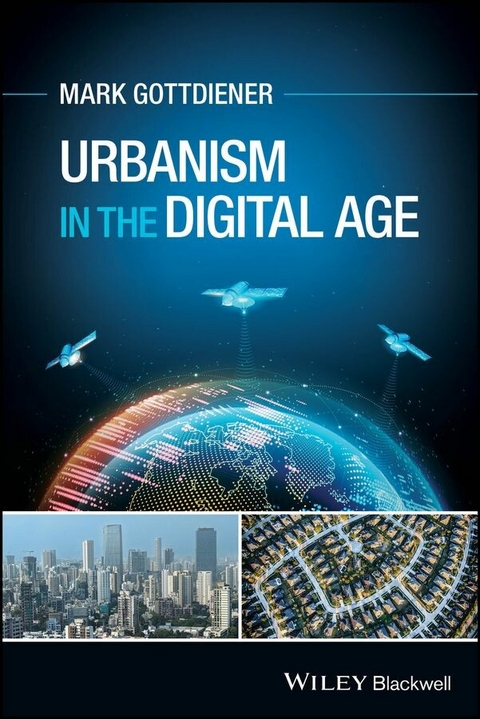
Urbanism in the Digital Age (eBook)
394 Seiten
Wiley-Blackwell (Verlag)
978-1-394-29563-0 (ISBN)
Offers a groundbreaking perspective on the future of urban studies
Urbanism in the Digital Age provides an essential, paradigm-shifting framework for understanding contemporary urban life. Author Mark Gottdiener redefines the study of urbanism by shifting the focus from traditional city-centered models to the Multi-Centered Metropolitan Region (MCMR), a revolutionary approach that integrates regional dynamics, digital media, and socioeconomic structures. This book challenges long-standing theories, critiques dominant neoliberal policies, and provides innovative solutions to critical contemporary issues.
Through an interdisciplinary synthesis of Lefebvrian and Castellsian perspectives, Gottdiener dissects the limitations of classical Marxist and city-centric urban theories while presenting new methodologies for analyzing spatial and social problems. Exploring the interplay between digital media, economic forces, and regional development, 14 in-depth chapters incorporate historical analysis, census data, and case studies to illustrate real-world applications.
Presenting a bold new vision for addressing spatial inequalities, rethinking governance, and fostering sustainable urban transformation, Urbanism in the Digital Age:
- Critiques traditional city-centered urban studies and offers a unique and new perspective based on a regional, digital-age approach.
- Analyzes the impacts of digital media and neoliberal governance on spatial and social inequalities
- Examines pressing urban crises, such as affordable housing, transportation, racial segregation, climate change, homelessness, and the crisis effects of draconian Neoliberal policies.
- Proposes innovative policy solutions for urban planning, sustainability, and regional development
- Investigates the role of architecture, urban planning and thematic environments in shaping urban experiences and fighting climate change.
Urbanism in the Digital Age is an indispensable resource for students and scholars in urban studies, sociology, geography, political science, architecture, and urban planning. It is an ideal textbook for undergraduate and graduate courses on urbanism, social problems, and public policy, and a must-read for policymakers and professionals engaged in urban development and regional planning.
MARK GOTTDIENER is Emeritus Professor of Sociology at the State University of New York at Buffalo and a pioneering urban theorist. He developed the socio-spatial perspective on urbanization and is the author of The Social Production of Urban Space and The New Urban Sociology. His influential research on theming, spatial analysis, and urban theory continues to influence urban studies worldwide.
Offers a groundbreaking perspective on the future of urban studies Urbanism in the Digital Age provides an essential, paradigm-shifting framework for understanding contemporary urban life. Author Mark Gottdiener redefines the study of urbanism by shifting the focus from traditional city-centered models to the Multi-Centered Metropolitan Region (MCMR), a revolutionary approach that integrates regional dynamics, digital media, and socioeconomic structures. This book challenges long-standing theories, critiques dominant neoliberal policies, and provides innovative solutions to critical contemporary issues. Through an interdisciplinary synthesis of Lefebvrian and Castellsian perspectives, Gottdiener dissects the limitations of classical Marxist and city-centric urban theories while presenting new methodologies for analyzing spatial and social problems. Exploring the interplay between digital media, economic forces, and regional development, 14 in-depth chapters incorporate historical analysis, census data, and case studies to illustrate real-world applications. Presenting a bold new vision for addressing spatial inequalities, rethinking governance, and fostering sustainable urban transformation, Urbanism in the Digital Age: Critiques traditional city-centered urban studies and offers a unique and new perspective based on a regional, digital-age approach. Analyzes the impacts of digital media and neoliberal governance on spatial and social inequalities Examines pressing urban crises, such as affordable housing, transportation, racial segregation, climate change, homelessness, and the crisis effects of draconian Neoliberal policies. Proposes innovative policy solutions for urban planning, sustainability, and regional development Investigates the role of architecture, urban planning and thematic environments in shaping urban experiences and fighting climate change. Urbanism in the Digital Age is an indispensable resource for students and scholars in urban studies, sociology, geography, political science, architecture, and urban planning. It is an ideal textbook for undergraduate and graduate courses on urbanism, social problems, and public policy, and a must-read for policymakers and professionals engaged in urban development and regional planning.
Chapter 1
What’s Wrong with This Picture?
There’s something very wrong going on. Isn’t that right? Scientists have proved the Earth is warming to life threatening levels. But I’m bothered by something else. I want to tell you about the scene on city streets. Walking them we see people sleeping rough on sidewalks or crunched into corners of buildings, sitting in tents with shopping carts pulled up tight under tarps or lying in refrigerator boxes lined up one next to the other. We see a man sitting cross-legged on the ground writing with a sharpie on cardboard and we can make out the word “help.” There are women with banged up features who can’t be more than 30 years old. Where I live I pass a twenty-something African American boy who stands in the park I cross whenever I take a walk with his belongings by his feet who sometimes sits on the grass and writes in a book but who never leaves the spot as far as I can tell, and there is also another much older man with missing teeth and ancient tattoos on his arm who rests on the stone barrier at the entrance of the park and stares blankly into space. Hundreds of people like them exist in so many cities. Thousands. According to statistics, maybe over a million each day. This is not 1929 depression era America. This is 2024. Reports say there are over a million living the same way in Europe.
In grade school I learned about “The Three Necessities” – food, clothing, shelter. Now, I volunteer at a food pantry once a week and we process orders for over ten thousand people! There are collection points all over my city for used clothing and shoes, some of which wind up in Africa, I am told. There may be housing for the homeless in my town, but obviously not nearly enough. There’s something very wrong going on.
Harvey Zorbaugh wrote his PhD thesis under Robert Park at the famous Chicago School Department of Sociology during the Great Depression, and he called his book, published in 1929, The Gold Coast and the Slum. His forte was charting the way populations of city dwellers mixed by income, ethnicity or race were sifted into different spatial areas within municipal boundaries. The observed phenomenon in Chicago’s North Side of people with great wealth living adjacent to those of limited means was the inspiration for the title of his publication. Earlier, he had done research on individuals detached from families and with little money dwelling in rooming houses, another common effect of the economic collapse on the city (Zorbaugh, 1925). In the 1960s and 1970s, during the explosion of welfare cases in urban areas, these same places were called “SRO” s, Single Room Occupancy, and in Manhattan they were often found in converted, failed hotels. I had a friend who lived in a regular apartment on the West Side and down her block was one of these locations. Now, all the SRO tenants are gone, and it stands as a luxury condo residence.
Even earlier than Zorbaugh, the economist with a distinct flare for Sociology, Thorstein Veblen, a farm boy from Minnesota, who obtained his PhD from Yale University in 1884 and who studied under William Graham Sumner, wrote a book about how the wealthy in America live (Veblen, 1899). Among many fascinating observations and foundational concepts, he noted people of means paid plenty to live separately from the general population. In cities they segregated themselves into heavily policed enclaves of gated, private homes. However, the real mark of status was their country estates with conspicuously large front lawns manicured by gardeners and containing many more rooms than needed and palatial front parlors equipped for parties. These “mansions” were in exurban areas beyond the reach of ordinary citizens who sweated away in the industrial factories of Capitalism within the growing cities at the turn of the 20th century. Much later, the basic plan of a large house conspicuously containing extra rooms, and a much smaller version of the rich’s front and back lawns became the mass produced and often “ticky-tacky” standard American suburban home. It still is.
We can go back even further in time to England, more specifically to Manchester during the 1860s and 1870s, when Friedrich Engels, the scion of a wealthy textile manufacturer originally from Germany, published a pamphlet in 1874 while cementing his partnership with a revolutionary named Karl Marx and called it The Housing Question (1979 [1874]). Inspirational in content to those concerned about the evils of early Industrial Capitalism, his work argued that, not only was there an affordable housing crisis created by this economic system affecting the entire working class at the time, but this crisis could never be solved by reformers who preached political intervention in the Capitalist economy. For Engels (and Marx) the supply of adequate shelter could only be accomplished by doing away with our system privileging profit over people’s basic needs and by replacing it with a humane economic regime putting ordinary workers first in providing the principal necessities of life. 150 years later, in 2024, we find the affordable housing crisis still with us and, as Engels observed, no public program tried over the many decades has alleviated it (Robins, 2022).
Now, there clearly is an historical trajectory fueled by the super-rich to separate and ignore the problems plaguing the rest of humanity using the qualities of Space, itself, to physically isolate as Capitalism has developed and changed over time. Veblen noted the wealthy separated themselves from others of limited means using spatial barriers, such as stone walls, iron gates and substantial lawns as well as finding exclusive locations where ordinary people were obviously out of place (Veblen, T. 1899, op.cit.). In the middle of the 1900s, this pattern was replicated in more robust fashion as both a city residence and an exurban one became the norm with safeguards and barriers keeping the less fortunate out and normatively using people, door men with security measures, to safeguard their physical isolation within cities.
Then, by the turn of the 20th century, the rich were further ensconced in urban isolation by taking advantage of the economy itself. The real estate market was weaponized as housing within urban areas became increasingly unaffordable. Whereas Zorbaugh’s gold coast and the slum existed in a kind of unspoken détente between workers and their bosses, by the early 2000s, city living shifted exclusively in favor of expensive luxury housing, dining, entertainment, and travel. People with limited means were pushed out by the price of living and relocated either to limited enclaves within the unaffordable city, called “slums” or, “the hood,” or specific enclaves in suburban regions allowing zoning for apartments.
As well, the lords of this new kind of urbanism encouraged ordinary people to visit, en masse, the cultural and recreational amenities of cities by a transformation replacing manufacturing and other bedrock industrial activities characteristic of earlier Capitalist phases. Organized and regimented tourism rose to prominence along with the new galaxy of urban profit-making techniques, such as finance, legal and business services, technological innovation, higher education, and other professional, white collar endeavors. Those who could not get first line jobs poured into a waiting service sector catering to the well paid members of these elite professions and the wealthy with pied a terre places they visited by rotation from other locations (Chen, 2023).
Yet the super-rich have not stopped there. Today, we hear of plans by billionaires for establishing colonies in outer space, such as Elon Musk’s call for the settlement of Mars. On October 4, 2024, a cruise ship filled with the ultra-wealthy who paid unheard of, mega-prices for cabins departed on a 3 and ½ year journey around the world (Anthony, 2024). Other high tech mega elites having Silicon Valley fortunes have proposed creating entirely new cities based on a kind of urban living very few people can afford and in spaces outside of established urban areas. Least the latter be perceived as dreamers, such plans were already produced in steel, glass, and cement by the Arab owners of oil rich kingdoms who have created cities for the super-rich in Dubai, Abu Dabi, and Saudi Arabia revolving singularly around the meme of wealthy excess, or, as Veblen would say, a total form of urbanism based on lavish building for “pecuniary emulation” and fueled by exorbitant “conspicuous consumption,” all the while using what reports have called “indentured” or “exploited” foreign labor (Veblen, Ibid.; Gottdiener, 2011). All of these examples, and there are more, depict one thing. The ultra-wealthy seek to remove themselves from a failing planet and its societies unable to fix the abusive global economic system we now possess.
The result from decades of Neoliberal policies implementing draconian cutbacks in government funding for public needs coupled with the drastic disruption of the Covid 19 epidemic and the fight against inflation by sharp increases in loan interest rates has replaced a kind of placid indifference by many toward politics in general by the 21st century. Now, with a shrill realization, the country is in deep crisis due to seemingly intractable social problems. Piled onto one another are the lack of affordable housing crisis, the massive increase of the unhoused, persisting racism and segregation, the sharp drop in the living wage for the middle class, an unacceptable level of poverty,...
| Erscheint lt. Verlag | 28.5.2025 |
|---|---|
| Sprache | englisch |
| Themenwelt | Sozialwissenschaften ► Soziologie ► Spezielle Soziologien |
| Schlagworte | Castells • Economic Geography • homelessness crisis • Lefebvre • multi-centered metropolitan region • sociospatial theory • spatial inequality • Urban governance • Urbanism • urbanism neoliberalism • urbanism racial segregation • Urban sociology • urban studies |
| ISBN-10 | 1-394-29563-4 / 1394295634 |
| ISBN-13 | 978-1-394-29563-0 / 9781394295630 |
| Informationen gemäß Produktsicherheitsverordnung (GPSR) | |
| Haben Sie eine Frage zum Produkt? |
 EPUB (Adobe DRM)
Kopierschutz: Adobe-DRM
Adobe-DRM ist ein Kopierschutz, der das eBook vor Mißbrauch schützen soll. Dabei wird das eBook bereits beim Download auf Ihre persönliche Adobe-ID autorisiert. Lesen können Sie das eBook dann nur auf den Geräten, welche ebenfalls auf Ihre Adobe-ID registriert sind.
Details zum Adobe-DRM
Dateiformat: EPUB (Electronic Publication)
EPUB ist ein offener Standard für eBooks und eignet sich besonders zur Darstellung von Belletristik und Sachbüchern. Der Fließtext wird dynamisch an die Display- und Schriftgröße angepasst. Auch für mobile Lesegeräte ist EPUB daher gut geeignet.
Systemvoraussetzungen:
PC/Mac: Mit einem PC oder Mac können Sie dieses eBook lesen. Sie benötigen eine
eReader: Dieses eBook kann mit (fast) allen eBook-Readern gelesen werden. Mit dem amazon-Kindle ist es aber nicht kompatibel.
Smartphone/Tablet: Egal ob Apple oder Android, dieses eBook können Sie lesen. Sie benötigen eine
Geräteliste und zusätzliche Hinweise
Buying eBooks from abroad
For tax law reasons we can sell eBooks just within Germany and Switzerland. Regrettably we cannot fulfill eBook-orders from other countries.
aus dem Bereich