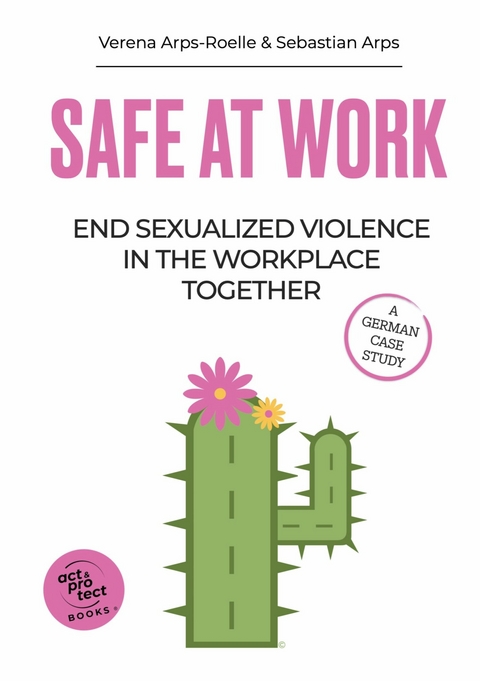
Safe at Work (eBook)
298 Seiten
Books on Demand (Verlag)
978-3-8192-8820-3 (ISBN)
Verena Arps-Roelle is the founder of the initiative act & protect® - AGAINST SEXUALIZED VIOLENCE and the act & protect® Academy. As an activist and and expert, she advocates for the public discussion of sexualized violence. Her particular focus is on (entertainment) sexism, stereotypes, and victim-blaming. Verena draws on her personal experience as a survivor of sexualized violence to convey preventive and intervention measures that are practical and have a lasting impact. She understands the effects of verbal, nonverbal, and physical sexualized violence firsthand. This is why she dedicates herself voluntarily to supporting other activists, institutions, and campaigns working toward social and political change.
INTRODUCTION
THROUGH TIME THE HISTORY
The history of sexualized violence in the workplace in Germany and worldwide is long, complex, and distressing. For centuries, individuals have been exposed to sexualized violence in various forms at their workplaces. This affected both men and women, as well as individuals perceived as female, male, and non-binary.
In the following pages, we will explore the last few centuries to provide an impression of the variety and severity of these experiences.
These pages offer an initial glimpse into the complexity of the topic, which reveals even more facets across all eras upon closer examination.
SEXUALIZED VIOLENCE AGAINST WOMEN: THROUGH THE CENTURIES
Women have been, and continue to be, exposed to sexualized violence in the workplace—a problem that spans throughout history. In many cultures and periods, women were subjected not only to human trafficking and economic exploitation but also to sexual assault. This violence served as a means of control, degradation, and the exertion of power.
Access to education and professional opportunities for girls and women was severely restricted across many eras. They were often limited to certain roles, shaped by gender-specific norms and hierarchies. These disadvantages increased their vulnerability to sexualized violence, which in turn led to health problems, marginalization, job loss, poverty, and even suicide.
In earlier centuries, particularly in smaller towns and villages, many women were heavily dependent on the community.
There was often a culture of silence or the belief that such assaults were the inevitable lot of women.
Due to poverty, the loss of the male head of the household, or a lack of employment opportunities, many women were forced into prostitution. They were often controlled by pimps who used violence to force them into prostitution or prevent them from leaving. Clients also frequently exercised violence. The societal stigma intensified their isolation and made it difficult for them to find help—a situation that still persists in some aspects today.
Until the 18th century, women were often persecuted, tortured, and killed under the pretext of witchcraft—especially those who worked as midwives or healers and deviated from normative expectations.
Even during the Industrial Revolution in the 19th century, women's conditions did not improve. Despite their increasing presence in factories and male-dominated professions, they remained unprotected from sexualized violence. Instead, the increasing participation of women in the labor market was associated with their segregation into poorly paid jobs.
Women were seen as “cheap labor,” which in turn facilitated sexualized violence in all its forms.
At the beginning of the 20th century, the German Civil Code (BGB) stipulated that women, especially married women, were subject to numerous legal restrictions. They needed their husband’s consent to take up paid work. This regulation was based on the concept of gender roles, which saw the man as the primary breadwinner and the woman as the housewife and mother. Traditional male control within the family was threatened by working women, often leading to violence, power struggles, and dominant behaviors.
Women faced social pressure to stay at home, while the economic pressure to support themselves was great. This was a difficult situation, especially for single, divorced, and widowed women, who had to take on multiple risks. Court documents from this period show that many female employees were abused by their male employers.
In the early industrial period, society made no distinction between working women, prostitutes, and criminal groups.
This was due to several factors: women from poor families had to work, yet it was unusual for women to work outside the home. Both prostitutes and paid workers were seen as escaping patriarchal control, which was intended to be reclaimed through sexualized violence. It made no difference whether women were selling their labor or sexual services.
At this time, responses from women to sexualized violence in the workplace can be divided into individual and collective reactions. Some women viewed sexual violence and harassment as a personal problem or bad luck. Others saw it as a social issue and responded collectively by joining unions and other organizations to secure legal protection.
During World War I and World War II, women worked to fill the gaps left by men who were sent to the front lines. They took up jobs in factories, agriculture, and many other areas that had previously been dominated by men. In addition to their work, they helped rebuild society and the economy after the war.
However, after World War II, as men returned from the front lines and from prisoner-of-war camps, society's attitudes toward women shifted once again. The focus returned to traditional gender roles. Women were expected to resume the role of housewife and mother, concentrating on household duties, child-rearing, and supporting their partners. Many societal and political forces pushed for men to reclaim their jobs and experience the “normalcy” they had lost during the war. This return to traditional role models, alongside existing societal norms and legal frameworks, discouraged many women from continuing their careers or pursuing new professional opportunities.
Until 1957, § 1356 of the German Civil Code (BGB) stipulated that women were generally subordinated to their husbands in household and child-rearing matters and could only work with their husband’s consent. The decisive change came with the reform of marriage and family law: from 1957 onwards, women no longer needed their husband's explicit permission to work.
Nevertheless, the idea that women were primarily responsible for the household and supporting their husbands remained deeply ingrained.
It was not until the 1960s that these attitudes began to gradually change. Women gained increasing access to a broader range of professions and career opportunities.
In the 1960s and 1970s, women worldwide fought for equal rights and against sexualized violence, including in the workplace. The feminist movement helped raise awareness of the need for reforms. Many countries introduced laws to combat various forms of sexualized violence and establish protective measures for victims.
In the 1970s, the principle of equality between men and women was more strongly enshrined in law, particularly through amendments to the Basic Law. Article 3 now guaranteed equality between men and women, and from that point on, women no longer needed their spouse's consent to work.
The #MeToo movement, initiated by activist Tarana Burke in 2006 and globally popularized by actress Alyssa Milano in 2017, brought the issue back into the spotlight. Under the hashtag #MeToo, countless women shared their experiences of sexualized violence and "sexual harassment," exposing the extent of the problem and leading to calls for comprehensive change.
Despite these advances, women still experience sexualized violence in the workplace today.
SEXUALIZED VIOLENCE AGAINST MEN: A TABOO TOPIC
Although sexualized violence against men in the workplace is less well-documented, it nevertheless existed. Historical examples show that men became victims in various contexts.
Men were victims of sexual violence in the context of human trafficking, used as a means of gratification, suppression, and control.
In earlier centuries, men as serfs were in a strong dependency relationship with a landowner. Even as servants or household employees, they faced dependence on their employers, which facilitated sexual exploitation due to the power imbalance.
Even in monastic or other religious institutions, male novices or monks were subjected to sexual assault by higher-ranking members of the community. These abuses were often promoted by the authority of the perpetrators within the institution and were more frequently covered up to protect the institution's reputation and the sanctity of the perpetrators.
In seafaring, particularly during long voyages, men were exposed to assaults. The isolated environment and strict hierarchies made it difficult to escape or resist such violations.
Particularly in male-dominated workplaces, abuse of power and harassment occurred. In such contexts, sexualized violence was used as a means of intimidation or to demonstrate dominance. Gender stereotypes and social norms often led men to hesitate (and still do today) in discussing their experiences or seeking help-out of fear of being perceived as weak, unmanly, or stigmatized.
In military contexts, particularly during wartime, soldiers or prisoners of war experienced sexual violence as torture, to humiliate or demonstrate power, and to inflict psychological damage. Historical records, such as reports on prisoners of war, often contain references to such mistreatment.
Until the year 2000, gay and bisexual Bundeswehr soldiers were treated unfairly and disadvantaged in military service, as they were considered a security risk. Studies, such as "Taboo and Tolerance" by the Center for Military History and Social Sciences of the Bundeswehr from 20191, show that men in various military contexts were affected by sexualized violence.
What has persisted throughout history is the idea that men must always be strong, unshakable, and honorable. These stereotypes are a subtle yet profound form of sexualized violence that continues to this...
| Erscheint lt. Verlag | 28.5.2025 |
|---|---|
| Sprache | englisch |
| Themenwelt | Sachbuch/Ratgeber ► Geschichte / Politik ► Politik / Gesellschaft |
| Sozialwissenschaften ► Politik / Verwaltung | |
| Schlagworte | Feminism • gendered violence • #metoo • metoo • Sexism • sexual harassment • sexualized violence |
| ISBN-10 | 3-8192-8820-1 / 3819288201 |
| ISBN-13 | 978-3-8192-8820-3 / 9783819288203 |
| Informationen gemäß Produktsicherheitsverordnung (GPSR) | |
| Haben Sie eine Frage zum Produkt? |
 EPUB (Wasserzeichen)
DRM: Digitales Wasserzeichen
Dieses eBook enthält ein digitales Wasserzeichen und ist damit für Sie personalisiert. Bei einer missbräuchlichen Weitergabe des eBooks an Dritte ist eine Rückverfolgung an die Quelle möglich.
Dateiformat: EPUB (Electronic Publication)
EPUB ist ein offener Standard für eBooks und eignet sich besonders zur Darstellung von Belletristik und Sachbüchern. Der Fließtext wird dynamisch an die Display- und Schriftgröße angepasst. Auch für mobile Lesegeräte ist EPUB daher gut geeignet.
Systemvoraussetzungen:
PC/Mac: Mit einem PC oder Mac können Sie dieses eBook lesen. Sie benötigen dafür die kostenlose Software Adobe Digital Editions.
eReader: Dieses eBook kann mit (fast) allen eBook-Readern gelesen werden. Mit dem amazon-Kindle ist es aber nicht kompatibel.
Smartphone/Tablet: Egal ob Apple oder Android, dieses eBook können Sie lesen. Sie benötigen dafür eine kostenlose App.
Geräteliste und zusätzliche Hinweise
Buying eBooks from abroad
For tax law reasons we can sell eBooks just within Germany and Switzerland. Regrettably we cannot fulfill eBook-orders from other countries.
aus dem Bereich