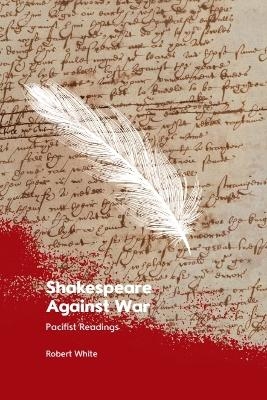
Shakespeare Against War
Edinburgh University Press (Verlag)
978-1-3995-1622-8 (ISBN)
- Noch nicht erschienen (ca. April 2026)
- Versandkostenfrei
- Auch auf Rechnung
- Artikel merken
Whilst Shakespearean drama provides eloquent calls to war, more often than not these are undercut or outweighed by compelling appeals to peaceful alternatives conveyed through narrative structure, dramatic context and poetic utterance. Placing Shakespeare’s works in the history of pacifist thought, Robert White argues that Shakespeare’s plays consistently challenge appeals to heroism and revenge and reveal the brutal futility of war. White also examines Shakespeare’s interest in the mental states of military officers when their ingrained training is tested in love relationships. In imagery and themes, war infiltrates love, with problematical consequences, reflected in Shakespeare’s comedies, histories and tragedies alike. Challenging a critical orthodoxy that military engagement in war is an inevitable and necessary condition, White draws analogies with the experience of modern warfare, showing the continuing relevance of Shakespeare’s plays which deal with basic issues of war and peace that are still evident.
Robert White FAHA is Emeritus Winthrop Professor of English at the University of Western Australia and a Chief Investigator in the Australian Research Council Centre of Excellence in the History of Emotions 1100–1800. He has held a Fellowship at the Humanities Research Centre, ANU, an Australian Research Council Professorial Fellowship, and recently the Senior Visiting Research Fellowship at Magdalen College, Oxford. His publications are mainly in the field of early modern literature, especially Shakespeare, and also Romantic literature. Monographs include Keats’s Anatomy of Melancholy (Edinburgh University Press, 2020); John Keats: A Literary Life (Palgrave Macmillan, 2010, revised ed. 2012); Pacifism in English Literature: Minstrels of Peace (Palgrave Macmillan, 2008); Natural Rights and the Birth of Romanticism in the 1790s (Palgrave Macmillan, 2005); and Natural Law in English Renaissance Literature (Cambridge University Press, 1996). Others include Avant-Garde Hamlet (Fairleigh Dickinson University Press, 2015); Shakespeare’s Cinema of Love (Manchester University Press, 2016); Ambivalent Macbeth (Sydney University Press, 2018); and A Midsummer Night’s Dream: Language and Writing (Bloomsbury Arden Study, 2020).
Acknowledgments
Part I: Men at War
1. ‘Look upon the hideous god of war’: Reading Shakespeare as a Pacifist
2. ‘Bloody-hunting slaughtermen’: War Crimes and Unjust War in the History Plays
3. ‘Food for powder’: Casualties of War
4. Revenge and Mutually Assured Destruction: Reflections on Hamlet and Kant
5. ‘Bind Fast his corky arms’: Torture in King Lear
Part II: Love and War
6. Love in Times of War
7. All’s Well in Love and War – or Is it?
8. Make War, not Love: Othello’s ‘Occupation’
9. Farewell to Arms: Antony and Cleopatra
10. Beyond War: ‘"If" is your only peacemaker’
Bibliography
Index
| Erscheint lt. Verlag | 10.4.2026 |
|---|---|
| Verlagsort | Edinburgh |
| Sprache | englisch |
| Maße | 156 x 234 mm |
| Themenwelt | Geisteswissenschaften ► Sprach- / Literaturwissenschaft ► Anglistik / Amerikanistik |
| Geisteswissenschaften ► Sprach- / Literaturwissenschaft ► Literaturgeschichte | |
| Geisteswissenschaften ► Sprach- / Literaturwissenschaft ► Literaturwissenschaft | |
| Sozialwissenschaften ► Politik / Verwaltung | |
| ISBN-10 | 1-3995-1622-1 / 1399516221 |
| ISBN-13 | 978-1-3995-1622-8 / 9781399516228 |
| Zustand | Neuware |
| Informationen gemäß Produktsicherheitsverordnung (GPSR) | |
| Haben Sie eine Frage zum Produkt? |
aus dem Bereich