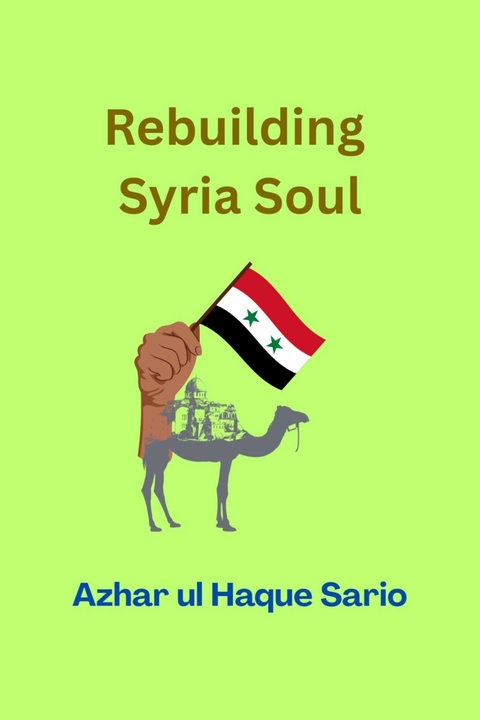
Rebuilding Syria Soul (eBook)
144 Seiten
Royal Co. (Verlag)
978-3-384-61842-9 (ISBN)
This book takes you right into Syria's wild ride from chaos to recovery. It kicks off with the harsh reality of sanctions-how they squeezed the life out of the economy. Then, it moves to the big political shake-ups that opened the door to change. You'll read about the struggle to get the economy back on its feet. Social scars run deep, and this book shows how Syria's people are stitching their communities back together. It digs into rebuilding trust. Restoring schools and hospitals gets a spotlight too. The final piece? A bold vision for 2045-peace, growth, and a Syria that's part of the world again.
Now, why pick this book over others? It's not just stats and politics-it's got soul. Other books might give you the dry facts of Syria's rebuild, but this one zooms in on the people, their resilience, and the messy, beautiful process of healing a nation. It's got depth you won't find elsewhere-a mix of heart and hard truth. If you want to really get what's happening in Syria, not just skim the surface, this is your read.
Copyright Disclaimer: The author isn't tied to any board or group. This book's an independent project, created under nominative fair use, keeping it honest and free from outside sway.
Part I: The Era of Sanctions: Syria Before 2025
A Nation on the Brink: Deconstructing Syria's Descent and the Dawn of International Coercion
Imagine the spring of 2011. A tremor of defiance shakes Syria, a cry for change echoing from its ancient streets. The world leans in, listens. And then, a flurry – like a sudden downpour after a long drought, sanctions rained down. This wasn't just policy; it felt like a collective gasp, a rush to staunch a bleeding wound. The goal, whispered in anxious diplomatic corridors and declared in stern official statements, was to cradle a nascent hope for peace, to gently nudge a nation away from the precipice of self-destruction.
Think of it: the United States, wielding its economic might like a finely-tuned instrument, sought to freeze the very hands accused of brutality, to halt the flow of funds that fueled the regime's iron fist. Picture the European Union, historically a bustling marketplace for Syrian goods (imagine the scent of spices and textiles, the clinking of deals worth billions – €7.18 billion in 2010 alone!), now shuttering its windows, one by one, to Syria’s lifeblood oil, its weapons, its financial lifelines. It was a stark, sudden silence where commerce once thrived.
And then, the Arab League, a family of nations, did something that made everyone sit up. Picture a council of elders, usually defined by measured, cautious words, suddenly rising with uncharacteristic resolve. They turned to one of their own, Syria, and said, "Enough." Membership suspended. Assets frozen. Flights grounded. It was a stunning family intervention, a bold attempt to draw a line in the desert sand. For a moment, it seemed a chorus of global conscience was singing in unison.
But listen closely. Beneath that chorus, a discordant note began to sound, then another, until the harmony shattered. The grand theories of international relations tell us that for such pressure to truly work, it needs to be an unbreakable chain, every link holding fast. Here, the links began to rust and snap almost immediately. Different rulebooks, different priorities, like builders using mismatched blueprints, created unintentional backdoors and escape routes. The Assad regime, nimble and desperate, slipped through these cracks, seeking new partners, new shadows to trade in. Ironically, the very measures designed to cripple the regime sometimes birthed shadowy smuggling routes that, like weeds in a parched garden, enriched those with connections to the power they sought to undermine. The medicine, in some places, seemed to breed new sickness.
The deepest, most resonant fracture, however, echoed from the chamber of the UN Security Council – the very place designed to be the world's ultimate guardian of peace. Here, the dream of united action met a cold, hard wall. Imagine a powerful lever, meant to move the world, but two immense forces, Russia and China, held it fast. Time and again (seven vetoes from Russia alone by early 2017, like seven slammed doors), they shielded Assad from the full, binding force of global censure. It wasn't just about Syria anymore; it was about a grander, global chessboard, about influence and counterweights. Each veto was a signal flare to Damascus: "You are not entirely alone. The shield, though partial, holds."
This fractured response wasn't a Syrian anomaly. It’s a recurring ghost in the machine of international diplomacy, seen in Myanmar's long struggle, felt in the uneven pressures surrounding the conflict in Ukraine. The Syrian story, in its early, hopeful, then heartbreaking arc, became a stark, human lesson: a thousand voices condemning an injustice can be drowned out if the most powerful guardians choose to look away, allowing the cracks in global resolve to become chasms where hope for peaceful change can tragically wither. It’s a reminder that the weight of sanctions, however heavy, can be tragically lightened when the world doesn't lift together.
Imagine Syria, not as a distant headline, but as a vibrant mosaic slowly, cruelly having its tiles pried loose, one by one, long before the world fully acknowledged the extent of its shattering. This wasn't a sudden implosion; it was a slow, agonizing asphyxiation, a descent into an economic abyss that began years before the Caesar Act of 2020 became a name on everyone's lips.
Think of a body, strong and vital in 2010. Now, picture its lifeblood, its economic vigor, draining away with each passing year of the mid-2010s. By 2019, this wasn't just a body weakened; it was emaciated. The nation's Gross Domestic Product, the very measure of its pulse, had already been brutally slashed. If you held the official currency, you saw its value shrink by nearly half. But if you lived in the everyday reality of the black market, the money in your hands had shriveled to less than a quarter of its former worth. This was the quiet thunder before the storm, a chilling prelude to the UN's later report that Syria's economy would be eviscerated, less than half its 2010 size by 2024.
The arteries of Syrian commerce, its exports, once robustly pumping $11.9 billion into the world, were systematically severed. By 2019, that flow had dwindled to a mere trickle – $0.6 billion. Imagine bustling ports falling silent, workshops closing their shutters, the vibrant exchange of goods and ideas reduced to a whisper. With this lifeline choked, and foreign reserves vanishing like mirages in the desert, the simple act of bringing essential goods – food, medicine, fuel – into the country became a Herculean struggle. The national coffers were bare, public debt a crushing mountain on the people's shoulders.
And then there was the invisible thief: inflation. While the headline-grabbing 200-fold price explosion casts a long shadow towards 2024, the fire of this hyperinflation was kindled much earlier. Imagine the Syrian Pound in your pocket, once a reliable friend, now a fickle betrayer, its purchasing power dissolving like sugar in acid. Between 2011 and 2022, prices, on average, leaped by nearly 50% every single year, with terrifying surges in 2013 and 2016 that felt like the ground crumbling beneath your feet. By early 2021, the official value of the Pound against the US dollar had fallen 26 times over, a silent testament to the years of relentless economic battery.
This wasn't just about numbers; it was about the soul of Syria. Aleppo, the ancient city, its name once synonymous with bustling industry and craftsmanship, saw its factories bombed into skeletons, its vibrant economic heart shattered. This "de-industrialization" wasn't a sterile economic term; it was the silencing of looms, the coldness of anvils, the displacement of generations of skill.
The human cost? It’s a story etched onto the faces of millions. Long before the world routinely cited that 90% of Syrians were impoverished by 2021, the seeds of this near-universal destitution were sown deep in the soil of the mid-to-late 2010s. Picture over three million jobs – not just statistics, but three million individual dreams, livelihoods, and family providers – vanishing into thin air between 2011 and 2016 alone. That’s like watching a city’s worth of workers, half a million to 600,000 people each year, lose their purpose, their income, their hope.
The very arms of the state, meant to cradle its citizens, grew weak and withered. Hospitals, once places of healing, became scenes of quiet desperation, starved of supplies, their walls scarred, their skilled doctors and nurses forced to flee. Imagine a parent’s anguish, holding a sick child with no medicine to offer. Schools, the nurseries of the future, were transformed into rubble or refugee shelters. Teachers became casualties or exiles, and for countless Syrian children, the doors to learning, to a future, slammed shut.
This was the crushing weight of isolation, a slow, deliberate dismantling. It was a society being unraveled thread by thread, its resilience tested beyond endurance, its people pushed to the brink. The economic warfare of the mid-to-late 2010s wasn't just a prelude; it was a profound tragedy in its own right, a harrowing testament to how a nation, even before a final, decisive blow, can be brought to its knees, its future stolen, its people immersed in an inescapable spiral of suffering.
The Labyrinth of Restrictions: Architectures and Evolutions of US, EU, UN, and Arab League Sanctions on Syria
The Veto’s Silhouette: How Stifled Sanctions Left Syria in the Shadow of Suffering
Imagine a global watchdog, the UN Security Council, armed with a powerful mandate: to keep peace, to shield the vulnerable, to act when a nation turns on its own people. One of its strongest tools? Sanctions, designed to be a precise pressure point, a collective voice saying, "This far, and no further." But when the cries for help rose from Syria, this potent instrument was often left locked away, paralyzed. A long, dark shadow, cast by the clashing wills of its most powerful members, fell over the Council's ability to act decisively against the Assad regime, fundamentally redrawing how the world even tries to respond to such horrors.
The year 2011 saw Syria unravel into a brutal civil war, a human catastrophe that quickly became a chessboard for global powers. The Security Council's permanent five members – the P5 – found themselves at a stark impasse. Think of it like a panel of surgeons, each with a different diagnosis and a fiercely guarded belief in their own remedy, while the patient bleeds. Time and again,...
| Erscheint lt. Verlag | 26.5.2025 |
|---|---|
| Sprache | englisch |
| Themenwelt | Sozialwissenschaften ► Politik / Verwaltung |
| Schlagworte | conflict • Economic Revival • Geopolitics • Justice • regime change • Sanctions • Social Healing |
| ISBN-10 | 3-384-61842-4 / 3384618424 |
| ISBN-13 | 978-3-384-61842-9 / 9783384618429 |
| Informationen gemäß Produktsicherheitsverordnung (GPSR) | |
| Haben Sie eine Frage zum Produkt? |
 EPUB (Ohne DRM)
Digital Rights Management: ohne DRM
Dieses eBook enthält kein DRM oder Kopierschutz. Eine Weitergabe an Dritte ist jedoch rechtlich nicht zulässig, weil Sie beim Kauf nur die Rechte an der persönlichen Nutzung erwerben.
Dateiformat: EPUB (Electronic Publication)
EPUB ist ein offener Standard für eBooks und eignet sich besonders zur Darstellung von Belletristik und Sachbüchern. Der Fließtext wird dynamisch an die Display- und Schriftgröße angepasst. Auch für mobile Lesegeräte ist EPUB daher gut geeignet.
Systemvoraussetzungen:
PC/Mac: Mit einem PC oder Mac können Sie dieses eBook lesen. Sie benötigen dafür die kostenlose Software Adobe Digital Editions.
eReader: Dieses eBook kann mit (fast) allen eBook-Readern gelesen werden. Mit dem amazon-Kindle ist es aber nicht kompatibel.
Smartphone/Tablet: Egal ob Apple oder Android, dieses eBook können Sie lesen. Sie benötigen dafür eine kostenlose App.
Geräteliste und zusätzliche Hinweise
Buying eBooks from abroad
For tax law reasons we can sell eBooks just within Germany and Switzerland. Regrettably we cannot fulfill eBook-orders from other countries.
aus dem Bereich