


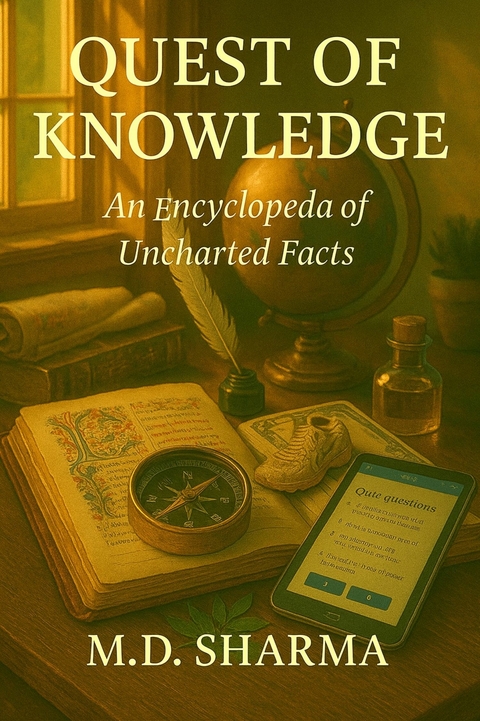
Quest of Knowledge (eBook)
150 Seiten
Publishdrive (Verlag)
978-0-00-080991-9 (ISBN)
This compendium is a celebration of curiosity, crafted to offer a sweeping yet accessible journey through the vast landscape of human knowledge. Organized across diverse themes-like geography, history, science, culture, and riddles-it blends verified facts with engaging explanations. Rather than specializing in one field, it invites readers to explore the intersections between disciplines, where surprising connections and insights often emerge. Whether you're a teacher seeking thoughtful content, a quiz enthusiast sharpening your knowledge, or simply a lifelong learner in search of intellectual adventure, this book is your trusted reference and guide. From cloud formations to cultural revolutions, and from dynasties to wordplay, each entry aims to both inform and inspire. In a world full of scattered, unverified trivia, this curated volume offers reliable, thought-provoking knowledge in a format that encourages serendipitous discovery. It's more than a reference-it's an open invitation to rediscover the joy of learning and the thrill of making new connections.
Chapter 1. Foundations of Knowledge: A Pan-Disciplinary Quiz
Section 1. Geography and Places
1. Where is the Nhava Sheva port located?
Answer: Mumbai, Maharashtra, on the east coast of India.
Explanation: Also known as Jawaharlal Nehru Port, it’s India’s busiest container port, situated near Mumbai’s Navi Mumbai region.
2. Where is Pamban Island located?
Answer: In the Gulf of Mannar, Tamil Nadu.
Explanation: Pamban Island is connected to mainland India by the Pamban Bridge and lies just north of Rameswaram.
3. Where is the Panama Canal?
Answer: In the Republic of Panama, Central America.
Explanation: It cuts across the Isthmus of Panama, linking the Atlantic (via the Caribbean Sea) to the Pacific.
4. Which port is at the southern end of the Panama Canal?
Answer: Balboa (Panama City).
Explanation: Balboa sits on Panama’s Pacific coast; “Panama Port” is colloquial, but the primary terminus is Balboa.
5. Where is the largest oil refinery in West Asia?
Answer: Abadan, Iran.
Explanation: The Abadan refinery was once the world’s largest and remains a key petroleum hub.
6. Between which two countries are the Pyrenees Mountains located?
Answer: France and Spain.
Explanation: This range forms a natural border stretching from the Bay of Biscay to the Mediterranean.
7. Which state of India does not have a railway line?
Answer: Meghalaya.
Explanation: Plans exist to link Meghalaya, but as of today it remains the only rail-free state.
8. Where do the East-West and North-South highways intersect?
Answer: Near Jhansi, Uttar Pradesh.
Explanation: India’s two major national corridors cross in central Uttar Pradesh.
Section 2. Rivers and Waterways
9. Whose tributaries are Panchganga and Dudhganga?
Answer: The Krishna River.
Explanation: Both rivers join the Krishna in Maharashtra before it flows eastward.
10. Which is the most important river in the formation of Punjab?
Answer: The Indus (Sindhu).
Explanation: “Punjab” literally means “land of five rivers,” all tributaries of the Indus.
11. By what name are the Paraná and Paraguay rivers known after their confluence?
Answer: The Río de la Plata.
Explanation: They join near Buenos Aires, forming the “River of Silver.”
12. Despite being environmentally friendly, which energy source is called “white coal”?
Answer: Hydropower.
Explanation: Because flowing water generates electricity much like coal does—without burning fuel.
Section 3. History and Empires
13. Where was the capital of Maharaja Ranjit Singh of Punjab?
Answer: Lahore (now Pakistan).
Explanation: He consolidated the Sikh Empire from Lahore in the early 19th century.
14. In which session was the demand for Pakistan made in 1940?
Answer: The Lahore session of the Muslim League in March 1940.
Explanation: The “Lahore Resolution” formally called for separate Muslim states.
15. When and between whom was the Poona Pact signed?
Answer: 26 September 1932, between Mahatma Gandhi and Dr. B.R. Ambedkar.
Explanation: It replaced separate electorates with Dalit-reserved seats in provincial assemblies.
16. When was Pondicherry (Puducherry) included in the Indian Union?
Answer: 16 August 1962.
Explanation: Though de facto in 1954, it was de jure integrated in 1962.
17. Who was the first Portuguese governor of India?
Answer: Francisco de Almeida (appointed 1505).
Explanation: He established early colonial footholds along India’s west coast.
18. When did the Portuguese take over Goa?
Answer: 1510 AD.
Explanation: Afonso de Albuquerque captured Goa, making it the capital of Portuguese India.
19. Where did the Portuguese open their first ‘feitoria’ (trading factory)?
Answer: Cochin (Kochi), Kerala.
Explanation: Founded in 1500, it became a key spice trade center.
20. When was the Registered Postal System introduced (Bombay Presidency)?
Answer: 1 November 1849.
Explanation: India’s post office introduced mail registration to ensure secure delivery.
Section 4. Personalities and Awards
21. Who translated the Panchatantra into Persian?
Answer: Abul Fazl (around 1599) for Emperor Akbar.
Explanation: His rendition of “Anvār-e Suhaylī” popularized these tales in the Mughal court.
22. Who is known as “Punjab Kesari”?
Answer: Lala Lajpat Rai.
Explanation: A leading freedom fighter, his fearless journalism earned him that title.
23. Who was the father of the Bhakti movement in Punjab?
Answer: Guru Nanak Dev Ji.
Explanation: He preached devotion and equality, laying the foundation for Sikhism.
24. Who founded the Sikh state in Punjab?
Answer: Maharaja Ranjit Singh.
Explanation: He unified disparate Sikh misls (confederacies) into one empire by 1801.
25. Who is the first athlete awarded the Padma Shri?
Answer: Milkha Singh, in 1959.
Explanation: The “Flying Sikh” was honored for his international track achievements.
26. Who is the first recipient of the Param Vir Chakra?
Answer: Major Somnath Sharma (posthumously, November 1947).
Explanation: Awarded for gallantry during the Kashmir operations.
27. Who discovered the atomic nucleus?
Answer: Ernest Rutherford, in 1911.
Explanation: His gold-foil experiment revealed a dense central core in atoms.
28. Who led the Manhattan Project and is often called “the father of the atomic bomb”?
Answer: J. Robert Oppenheimer.
Explanation: He directed the U.S. effort at Los Alamos during WWII.
Section 5. Science and Nature
29. What is the study of birds called?
Answer: Ornithology.
Explanation: From the Greek “ornis” (bird).
30. Who is considered the evolutionary ancestor of birds?
Answer: Theropod dinosaurs (e.g., Archaeopteryx).
Explanation: Modern birds evolved from small, feathered theropods.
31. Which region is often called the “paradise of birds”?
Answer: The Andaman and Nicobar Islands.
Explanation: Their diverse habitats host hundreds of endemic bird species.
32. How many chambers (venues) are there in a bird’s heart?
Answer: Four.
Explanation: Two atria and two ventricles, like mammals, for efficient metabolism.
33. What is the value of absolute zero?
Answer: –273.15 °C (0 K).
Explanation: The theoretical temperature where molecular motion ceases.
Section 6. Institutions and Technology
34. When was the Punjab National Bank (PNB) established?
Answer: 19 May 1894.
Explanation: Founded in Lahore by Lala Lajpat Rai, it was the first truly Indian bank.
35. Which bank’s branch was the first in India to get ISO 9002 certification?
Answer: Canara Bank.
Explanation: Recognized for its quality management in the 1990s.
36. What is Param Padma?
Answer: A supercomputer developed by C-DAC, Pune.
Explanation: Part of India’s PARAM series, it supports scientific research.
37. For what is the Param Vir Chakra awarded?
Answer: Most conspicuous bravery or self-sacrifice in the presence of the enemy.
Explanation: India’s highest military decoration.
Section 7. Miscellaneous
39. Where did writing (cuneiform) first develop?
Answer: Mesopotamia (Sumer), circa 3200 BCE.
Explanation: The earliest known scripts emerged there.
40. Which animal was the first to go into space?
Answer: Laika, a Soviet dog, aboard Sputnik 2 in November 1957.
Explanation: She was the first Earth creature to orbit the planet.
41. Which film won the first Academy Award for Best Picture?
Answer: Wings (1927).
Explanation: The silent epic beat out other early talkies.
42. What was the first animal age tool invented?
Answer: Fire (controlled use in the Paleolithic).
Explanation: Enabled cooking, protection, and tool hardening.
43. Who founded Pondicherry (as a French colony)?
Answer: François Martin in 1674 AD.
Explanation: He was appointed the first governor by the French East India Company.
44. Which crop did the Portuguese introduce to India?
Answer: Tobacco, around 1600.
Explanation: It became widely cultivated in Goa and elsewhere.
Section 8. Institutions, Discoveries, and Technology
46. When and where was the Indira Gandhi Centre for Atomic Research established?
Answer: 1971 at Kalpakkam, Tamil Nadu.
Explanation: IGCAR is one of India’s premier nuclear research facilities, focusing on fast-breeder reactor technology.
47. Which king of the Parmar dynasty was famous for his charity, art, and lawfulness?
Answer: Raja Bhoj of...
| Erscheint lt. Verlag | 26.5.2025 |
|---|---|
| Sprache | englisch |
| Themenwelt | Sozialwissenschaften ► Pädagogik |
| ISBN-10 | 0-00-080991-8 / 0000809918 |
| ISBN-13 | 978-0-00-080991-9 / 9780000809919 |
| Informationen gemäß Produktsicherheitsverordnung (GPSR) | |
| Haben Sie eine Frage zum Produkt? |
 EPUB (Adobe DRM)
Größe: 1,0 MB
Kopierschutz: Adobe-DRM
Adobe-DRM ist ein Kopierschutz, der das eBook vor Mißbrauch schützen soll. Dabei wird das eBook bereits beim Download auf Ihre persönliche Adobe-ID autorisiert. Lesen können Sie das eBook dann nur auf den Geräten, welche ebenfalls auf Ihre Adobe-ID registriert sind.
Details zum Adobe-DRM
Dateiformat: EPUB (Electronic Publication)
EPUB ist ein offener Standard für eBooks und eignet sich besonders zur Darstellung von Belletristik und Sachbüchern. Der Fließtext wird dynamisch an die Display- und Schriftgröße angepasst. Auch für mobile Lesegeräte ist EPUB daher gut geeignet.
Systemvoraussetzungen:
PC/Mac: Mit einem PC oder Mac können Sie dieses eBook lesen. Sie benötigen eine
eReader: Dieses eBook kann mit (fast) allen eBook-Readern gelesen werden. Mit dem amazon-Kindle ist es aber nicht kompatibel.
Smartphone/Tablet: Egal ob Apple oder Android, dieses eBook können Sie lesen. Sie benötigen eine
Geräteliste und zusätzliche Hinweise
Buying eBooks from abroad
For tax law reasons we can sell eBooks just within Germany and Switzerland. Regrettably we cannot fulfill eBook-orders from other countries.
aus dem Bereich


