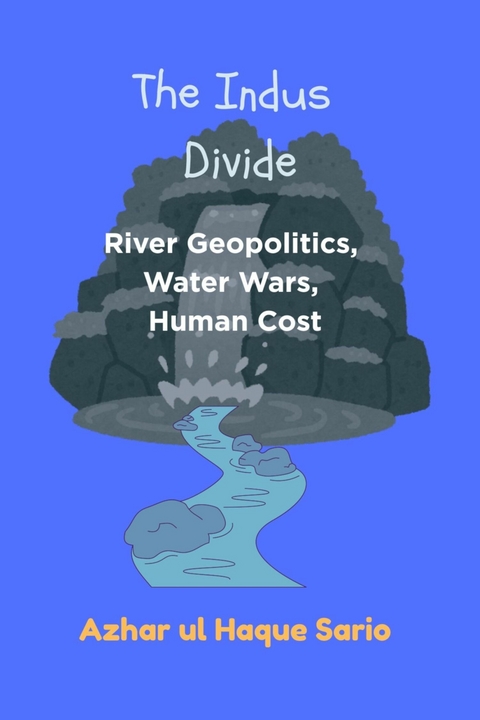
The Indus Divide (eBook)
166 Seiten
Royal Co. (Verlag)
978-3-384-61715-6 (ISBN)
Picture a river that feeds millions but fuels a fight between two nations. The Indus Divide pulls you into the wild story of the Indus River. It starts with the Indus Waters Treaty from 1960. This deal split the rivers between India and Pakistan after their split. Pakistan got most of the water-about 70%. The World Bank helped make it happen. For years, it kept the peace. But trouble brewed over dams like Kishanganga and Baglihar. Then, in 2025, a terror attack in Pahalgam changed everything. India suspended the treaty. Tensions shot up fast. Military moves followed. The book digs into India's water control plans. Can they really stop the flow? Not easily-most dams can't store much. In Pakistan, farms and power rely on this water. Over 90% of crops need it. Jobs for 40% of people depend on it. A crisis looms-food shortages, blackouts, even famine. Climate change adds more chaos with wild floods and dry spells. The book ends with ideas to fix this mess-new talks, better water use, and teamwork.
This book isn't like others on India-Pakistan clashes. It doesn't just replay old politics. It mixes history with hard facts-how water works, what it costs, and who suffers. You'll get a close look at the 2025 crisis, fresh from the latest info. Other books skip the tech stuff-we don't. We show why India's threats are tough to pull off. Plus, it's not all doom. We offer real steps forward-like updating the treaty or sharing water smarter. It's balanced too, seeing both sides. If you're into policy, study, or just care about people, this book gives you the whole story. No fluff, just truth and ideas to make things better.
Copyright Disclaimer: This book is independently produced under nominative fair use. The author has no affiliation with any board or organization mentioned in the text.
Part II: The 2025 Breaking Point: Anatomy of a Crisis
The Spark and the Firestorm: Catalysts and Justifications for India's 2025 IWT Suspension
The dawn of April 12, 2025, in Pahalgam whispered of tranquility. Sunlight, crisp and hopeful, was just beginning to warm the bustling marketplace near the Lidder River. Laughter mingled with the calls of vendors, the aroma of fresh bread and spices danced in the cool mountain air, and the ordinary rhythms of life played out, oblivious. Tourists, drawn by the valley's famed beauty, and locals, steeped in its daily life, shared these fleeting moments of peace.
Then, at approximately 9:30 AM, the world tore apart.
A sudden, deafening violence – the earth-shattering roar of improvised explosives, followed by the terrifyingly impersonal spray of automatic gunfire – ripped through the morning's serenity. The marketplace, a heart of the community, and the adjacent bus stand, a hub of journeys begun and ended, became scenes of unimaginable horror. Joy turned to terror in an instant. The vibrant tapestry of life was shredded, replaced by chaos, by the screams of the wounded and the stunned silence of the dead. Initial figures, stark and cold, spoke of over 55 lives extinguished, more than 150 bodies broken and bleeding. In the days that followed, these numbers would only creep higher, each digit a fresh stab of grief into the heart of the region.
Eyewitnesses, their voices choked with shock, would later recount scenes of deliberate, calculated carnage. This wasn't random fury; it bore the chilling hallmarks of a meticulously planned assault, designed to inflict the maximum civilian suffering, to send a shockwave of fear far beyond the bloodstained ground of Pahalgam.
Almost before the dust settled, the claim of responsibility emerged: The Resistance Front (TRF), a name already synonymous with dread in intelligence circles, known to be an echo or a new mask for the notorious Lashkar-e-Taiba (LeT). Yet, in a twisted dance often seen in the shadowy theatre of terror, TRF would later issue denials, a common tactic to muddy the waters or perhaps deflect the anticipated storm.
But for New Delhi, the picture was horrifyingly clear. The Indian government, its voice tight with fury, pointed an unwavering finger at Pakistan-based militants, and beyond them, to the alleged complicity of the Pakistani state. "Credible and specific intelligence," they declared – whispers caught from the airwaves, secrets gleaned from human sources – painted a damning portrait of LeT commanders orchestrating this horror from across the Line of Control. The sophistication of the weaponry, the brazenness of the attack, all pointed, in India's eyes, to a "deep state" sponsorship, a familiar and bitter accusation in the long, troubled history between the two nations.
This time, however, the response would transcend the usual condemnations and diplomatic skirmishes. The Pahalgam massacre, with its devastating human toll, became the tipping point, the "final provocation." India's grief quickly hardened into a steely resolve. Within days, "Operation Sindoor" was launched, targeting alleged militant infrastructure. And then came the truly momentous decision: the immediate suspension of the 65-year-old Indus Waters Treaty.
The blood spilled in Pahalgam’s market became the ink with which India rewrote its strategic compact. The treaty, a decades-old agreement on shared waters, was now inextricably linked to the crimson stain of terrorism. For India, the serene dawn shattered over Pahalgam wasn't just another tragedy; it was the end of an era, the horrifying catalyst that reshaped the flow of rivers and the currents of geopolitical power, proving that the deepest human losses can, indeed, alter the very landscape of nations. Pakistan’s vehement denials and condemnation of the treaty's suspension were inevitable, yet they seemed to echo unheard against the raw, emotional conviction driving India's unprecedented stance. The waters of the Indus, once a symbol of cooperation, now reflected a region irrevocably altered by the echoes of gunfire and the tears of the bereaved in a small Kashmiri town.
The Last Drop: Why a Nation Claims its Patience, and a Treaty, Broke
New Delhi, 2025 – The whispers had haunted the corridors of power for years, growing louder with each funeral pyre, each news report flashing scenes of carnage. Now, in this imagined 2025, the whispers have become a roar. India's posited decision to suspend the Indus Waters Treaty (IWT) isn't being explained away with bureaucratic jargon about water flow or technical clauses. Instead, officials paint a stark, human picture: this is the breaking point, the sorrowful consequence of what they call "Persistent Provocation."
Imagine a thread, spun through decades, connecting two nations. The IWT was meant to be one of the strongest strands in that thread, a testament to shared resources, a promise of coexistence. But with each tremor of violence, each life snatched by terror allegedly bleeding across the border, that strand frayed. India’s narrative, now laid bare, is one of a nation that feels it has held onto its end of the rope, even as the other seemed determined to set it ablaze.
The "ledger of accumulated grievances" isn't just a government file; it's a collection of scars etched onto the nation's soul. The year 2008 doesn't just signify a date; it echoes with the 166 heartbeats silenced in Mumbai, a wound that, for many, never truly healed. Dossiers filled with names and connections, submitted to indifferent international stages, became symbols of a justice repeatedly deferred. Think of the weight of those pages, each one representing a life, a family shattered.
This isn't just about diplomatic chess. It's about the soldier who stands guard, wondering if tonight will bring another Pathankot (2016), another Uri (2016) where 19 of his brothers wouldn’t see the dawn. It’s about the civilian, the mother, the child, whose sense of security has been chipped away, incident by incident – the 40 souls lost in Pulwama (2019), and now, in this hypothetical timeline, the fresh agony of a (fictional) Pahalgam market ripped apart in April 2025, stealing 26 more lives. These aren't statistics; they are stories, silenced mid-sentence.
"We’ve spoken in every language, from quiet pleas to thunderous condemnations," a hypothetical senior official might sigh, the weariness of a thousand unanswered calls in her voice. "The ink on treaties like the IWT is supposed to be a bond of peace, not a cover for a relentless, shadow war." This is the crux of India's argument: how can one share life-giving waters when the other party, they allege, persistently deals in death? The claim is that the very air needed for such treaties to breathe – mutual respect, security, a commitment to peace – has been poisoned, year after agonizing year.
Scholars like Christine Fair have long detailed the intricate, shadowy networks that India points to as proof of a neighbour’s complicity. The data from watchdog groups like the South Asia Terrorism Portal, tracking the grim tally of attacks, becomes, in this narrative, less academic and more like the chronicle of a slow-motion siege. Each major attack, like the 2001 assault on India's Parliament, didn't just trigger military standoffs like Operation Parakram; it carved deeper lines of mistrust, making the chasm between the two nations wider and harder to bridge.
So, the hypothetical 2025 decision regarding the Indus, a river that has flowed for millennia, is framed not as a sudden lashing out, but as the slow, painful unclenching of a hand that has held on for too long, through too much. It’s a nation saying, "Enough." The argument, contentious as it is under the cold letter of international law, is rooted in a deeply human cry: that the sanctity of life, the sovereignty of a nation, cannot be perpetually compromised without consequences, even for covenants as vital as water. The "persistent provocation," in this view, has eroded not just trust, but the very ground upon which such treaties stand, leaving behind a parched landscape of broken promises and a nation mourning more than just the potential loss of a pact.
In the charged air following an event like the alleged Pahalgam attack, a familiar, almost theatrical, urgency grips Islamabad. Pakistan's response isn't just a statement; it's a full-bodied counter-performance. Imagine the corridors of power, not as sterile offices, but as a stage where a narrative of staunch denial is rapidly constructed. Accusations from India are met not with quiet rebuttal, but with a resounding rejection, framing each charge as a scene in a larger drama orchestrated by Delhi to cast Pakistan as the villain on the world stage. Picture the Foreign Ministry, less a bureaucratic entity and more a rapid-response unit, deflecting claims of state involvement like incoming fire. The term "misinformation campaign" becomes a shield, while the chilling suggestion of a "false flag operation," perhaps voiced by a high-ranking Defence Minister, is a narrative grenade tossed back, designed to sow doubt and shift the spotlight of suspicion. Amidst this whirlwind of refutation, an olive branch, perhaps slightly trembling, is extended: an offer for joint or internationally supervised investigations. This gesture, as seen after Pahalgam, aims to project an image of a nation open, transparent, and with nothing to hide—a besieged protagonist pleading for an impartial hearing.
Parallel to...
| Erscheint lt. Verlag | 25.5.2025 |
|---|---|
| Sprache | englisch |
| Themenwelt | Sozialwissenschaften ► Politik / Verwaltung |
| Schlagworte | climate change • Geopolitics • human cost • Indus River • South Asia • Water security • water wars |
| ISBN-10 | 3-384-61715-0 / 3384617150 |
| ISBN-13 | 978-3-384-61715-6 / 9783384617156 |
| Informationen gemäß Produktsicherheitsverordnung (GPSR) | |
| Haben Sie eine Frage zum Produkt? |
 EPUB (Ohne DRM)
Digital Rights Management: ohne DRM
Dieses eBook enthält kein DRM oder Kopierschutz. Eine Weitergabe an Dritte ist jedoch rechtlich nicht zulässig, weil Sie beim Kauf nur die Rechte an der persönlichen Nutzung erwerben.
Dateiformat: EPUB (Electronic Publication)
EPUB ist ein offener Standard für eBooks und eignet sich besonders zur Darstellung von Belletristik und Sachbüchern. Der Fließtext wird dynamisch an die Display- und Schriftgröße angepasst. Auch für mobile Lesegeräte ist EPUB daher gut geeignet.
Systemvoraussetzungen:
PC/Mac: Mit einem PC oder Mac können Sie dieses eBook lesen. Sie benötigen dafür die kostenlose Software Adobe Digital Editions.
eReader: Dieses eBook kann mit (fast) allen eBook-Readern gelesen werden. Mit dem amazon-Kindle ist es aber nicht kompatibel.
Smartphone/Tablet: Egal ob Apple oder Android, dieses eBook können Sie lesen. Sie benötigen dafür eine kostenlose App.
Geräteliste und zusätzliche Hinweise
Buying eBooks from abroad
For tax law reasons we can sell eBooks just within Germany and Switzerland. Regrettably we cannot fulfill eBook-orders from other countries.
aus dem Bereich