


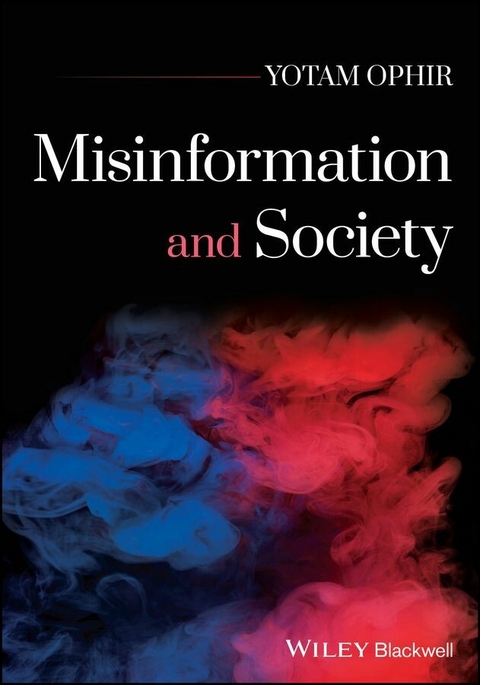
Misinformation and Society (eBook)
643 Seiten
Wiley-Blackwell (Verlag)
9781394236466 (ISBN)
A comprehensive guide to understanding and addressing political and scientific misinformation
In our increasingly interconnected world, misinformation spreads faster than ever, influencing public opinion, political outcomes, and personal beliefs. In Misinformation and Society, Yotam Ophir takes an interdisciplinary approach to unravel the complexities of misinformation in its various forms.
Offering invaluable insights into the history, psychology, and social impact of misinformation, this timely book provides you with the tools to critically analyze misinformation's origins, effects, and solutions. From understanding the cognitive processes that make individuals vulnerable to false information, to exploring the societal impact of viral misinformation, Misinformation and Society delivers deep insights into one of the most pressing issues of our time.
Drawing on research from fields such as communication, political science, and psychology, Ophir presents in-depth case studies of high-profile events such as Brexit and COVID-19, clearly demonstrating how misinformation has shaped public discourse. Through clear and engaging writing, the author presents evidence-based strategies to address misinformation in a variety of specific real-world contexts, such as conspiracy theories, public health disinformation, fabricated political news, and more.
Requiring no previous background in the subject, Misinformation and Society is essential reading for undergraduate and graduate students in Media Studies, Political Science, Communication, and Public Health, as well as journalists, educators, policymakers, and general readers interested in media literacy, information integrity, and the challenges posed by misinformation in the Digital Age.
YOTAM OPHIR, PhD, is an Associate Professor of Communication at the University at Buffalo, and a Distinguished Fellow at the Annenberg Public Policy Center at the University of Pennsylvania. His research focuses on media effects, misinformation, conspiracy theories and extremism. Ophir has published over 50 peer-reviewed papers in leading journals, including the Proceedings of the National Academy of Sciences, American Journal of Public Health, and Journal of Communication. He is the co-author of the book Democracy amid Crises: Polarization, Pandemic, Protests, & Persuasion. He has been featured in numerous outlets, including The New York Times, The Washington Post, NBC News, NPR, The BBC, and more. In 2024, Ophir was selected as one of Ten Scientists to Watch by Science News magazine.
A comprehensive guide to understanding and addressing political and scientific misinformation In our increasingly interconnected world, misinformation spreads faster than ever, influencing public opinion, political outcomes, and personal beliefs. In Misinformation and Society, Yotam Ophir takes an interdisciplinary approach to unravel the complexities of misinformation in its various forms. Offering invaluable insights into the history, psychology, and social impact of misinformation, this timely book provides you with the tools to critically analyze misinformation s origins, effects, and solutions. From understanding the cognitive processes that make individuals vulnerable to false information, to exploring the societal impact of viral misinformation, Misinformation and Society delivers deep insights into one of the most pressing issues of our time. Drawing on research from fields such as communication, political science, and psychology, Ophir presents in-depth case studies of high-profile events such as Brexit and COVID-19, clearly demonstrating how misinformation has shaped public discourse. Through clear and engaging writing, the author presents evidence-based strategies to address misinformation in a variety of specific real-world contexts, such as conspiracy theories, public health disinformation, fabricated political news, and more. Requiring no previous background in the subject, Misinformation and Society is essential reading for undergraduate and graduate students in Media Studies, Political Science, Communication, and Public Health, as well as journalists, educators, policymakers, and general readers interested in media literacy, information integrity, and the challenges posed by misinformation in the Digital Age.
Preface
In June 2023, as I began working on this book, I was driving from Washington, DC, to my home in the suburbs of Buffalo, NY. The seven‐hour drive is replete with beautiful sights and breathtaking vistas, yet after a few days on the road, I grew tired and just wanted to get back to my family. Every time I travel away, there is a moment on my way back when I suddenly feel a sense of “almost” – not home just yet, but the roads and signs begin to look familiar, and you’re filled with the expectation of domestic bliss. To my knowledge, no scientific formula, made of miles or minutes, can predict where precisely one begins to feel at home. I can tell you that on that specific sunny day, that moment for me was when I saw the first sign pointing toward a Tops Friendly Markets grocery store. Every place has its local favorites. In Philadelphia, where I resided before moving to Western New York, locals love their Wawa convenience stores. In Buffalo, we drink our coffee at Tim Hortons, put our hopes and dreams in the Buffalo Bills (we should know better by now), and buy groceries at Tops (though those who prefer organic food might go to Wegmans instead). So, when I saw the red Tops sign, I knew I was getting closer. But almost immediately, my anticipation and excitement faded away and were rapidly replaced with deep sadness and agony. I was not surprised by the resurfacing of such negative feelings. That is how I felt every time I passed by one of the many Tops stores in my area since May 14th, 2022, about a year before my trip down south.
As one who grew up in Haifa, Israel, in the 1980s and 1990s, I am no stranger to collective trauma. There are specific bus numbers (37) and restaurants (the sublime, local Middle Eastern cuisine joint, Matza) that will forever bring back horrific images of death and destruction, courtesy of the suicide bombers who painted my childhood with fear and anxiety. In a similar vein, every visit to Manhattan brings me (and many, many others) back to that awful afternoon in September 2001 when I saw the live broadcast of the two commercial airplanes crashing into the World Trade Center towers in NYC. Everybody alive in November 1963 (I wasn’t, even if my daughter is convinced that I’m as old as time itself) still remembers where they heard Walter Cronkite’s voice breaking as he announced that John F. Kennedy was assassinated in Dallas (my childhood equivalent was the murder of Prime Minister Yitzhak Rabin in Tel Aviv on a dreadful night in 1995). There is something unique about tragedies that affect you and your whole community. The individual pain blurs with the collective one, leaving a scar that can never heal. I suspect many of my fellow Buffalonians who lived in the city during the 2020s have felt the same way I did as they passed by a Tops store in the following years.
On May 14th, 2022, around 2:30 p.m., an 18‐year‐old white man arrived at the Tops Friendly Markets branch on Jefferson Avenue, located in the heart of a predominantly Black neighborhood of Buffalo, NY. As in too many other heartbreaking scenes in recent American memory, he was armed with an AR‐15‐like assault rifle, which he had modified to pack with additional 30‐round ammunition magazines, ready to wreak havoc on a massive scale.1 This killer of 10 innocent people in Buffalo,2 like the men who massacred nine in the 2015 Charleston church shooting in South Carolina,3 23 in an El Paso Walmart,4 11 Jewish worshipers in a Pittsburgh synagogue,5 and 51 in Christchurch, New Zealand,6 was motivated by misinformation and conspiracy theories. Specifically, these violent acts were driven by the Great Replacement conspiracy theory, according to which a shadowy coalition of Blacks, Jews, feminists, liberals, and globalists are working in cahoots to weaken or even eliminate the white race so that they can take over the world (Ophir, Pruden et al., 2022). These ideas were not new. They were contemporary variations on centuries‐old myths and tales about nefarious minority groups planning to bring about the death of the West or America. The details keep changing – at one time, the plan may be to promote Communism, and at another, it may be to promote multiculturalism. As we’ll see throughout the book, everything old is new again online (Lavin, 2020).
A caveat is in order before I start talking about misinformation more systematically. A central argument made in this book is that knowing something with 100% certainty is impossible but that coming to terms with this uncertainty should not prevent us from taking the best plan of action at any given moment based on the most reliable information we have. As I discuss later in the book, the scientific revolution was one of acknowledged ignorance, not of absolute knowledge. Likewise, some of the theories discussed in this book, even if they have received broad empirical support in the past, may prove in the near or far future to be incorrect or to depend on circumstances we do not yet understand. As we’ve seen often in recent years, very cool studies that incite the imagination may fail to pass the scrutiny of replications. However, we should not be deterred by failed experiments and rejected theories. We should avoid interpreting these cases as implying that science is not a reliable way of knowing about the world. On the contrary – I believe that scientists’ ability to identify and correct mistakes (and, on rare occasions, fraud) should be seen not as a weakness but as one of our unique epistemological superpowers. Therefore, I do my best in this book not to put too much weight on any specific study, theory, or scholar. Instead, I provide a snapshot of the scientific knowledge around misinformation at the time of writing (i.e., between 2022 and early 2025).
In the same spirit, I would like to remind readers that social, cultural, and political realities could change over time. Like many scientists who have studied misinformation, conspiracy theories, and extremism, I believe that at the current moment in time, there is a clear and substantial asymmetry in the spread and acceptance of misinformation across the political and media spectrum, both in the United States and across the globe (Benkler et al., 2018). At present, racist and exclusionary political discourse is on the rise on the global right, with the UK Independence Party (previously UKIP, now Reform UK) in Britain, Alternative für Deutschland (AfD) in Germany, the French National Front, the Danish People’s Party, Sweden Democrats, the Italian Five Star Movement, the Party for Freedom in the Netherlands, the Polish Law and Justice (PiS), and the Bharatiya Janata Party (BJP) in India (the biggest political party in the world), being just a few prominent examples (Bennett & Livingston, 2021a; Hetherington & Weiler, 2018; Mudde, 2019). While extremism exists on the left as well, the global prevalence and success of far‐left parties and movements pale in comparison with their right‐wing counterparts. In the United States, the trend can be traced back to (at least) the Cold War (Hofstadter, 2012), peaking periodically in response to local and global events, often led by specific groups, such as the militia movements of the 1990s or the Tea Party in the 2010s (Neiwert, 2017). The current wave of far‐right politics is entrenched in populism, the idea that only the populist will serve the powerless people in their battle with the powerful elites (Kazin, 2017). Austria’s Jorg Haider claimed to fight for “average citizens” against “these top men in politics” (Rosenfeld, 2018, p. 122), Brexit champions Boris Johnson (Conservative), Jeremy Corbyn (Labour), and Nigel Farage (Independence) argued they served the people against the establishment,7 French extremist Marine Le Pen believed herself to be the ultimate champion of patriots rising against the ruling elites,8 and in the United States, Donald Trump promised that as President he would drain the Washington swamp of its corruption (a catchphrase he received from Cambridge Analytica,9 a company that abused data collected in unethical ways from Facebook users and millions of their friends10 ).
The American misinformation asymmetry begins at the top. Republican leaders and conservative media spread misinformation at higher rates than Democrats (this is true for both the number of Republican leaders and the number of falsehoods they spread on average), often refuse to correct their falsehoods, and when they do issue a correction, it tends to be softer and less decisive (Berinsky, 2023; Hemmer, 2016). As such, understanding the asymmetry requires a deep look into the discourse spread by elites, from politicians to media personalities. In recent years, Republican politicians were significantly more likely to spread falsehoods than their Democratic fellows. Their misinformation was routinely amplified by the talking heads of Fox News (Peck, 2019), with no equivalent levels of deception to be found on the left. Don’t get me wrong. Partisan media on the left, MSNBC, for example, are consistently biased, too. However, their political slant does not often translate into misinformation. Complementing the misinformation media ecosystem, big‐business lobbyists, think tanks, and interest groups...
| Erscheint lt. Verlag | 20.5.2025 |
|---|---|
| Sprache | englisch |
| Themenwelt | Sozialwissenschaften ► Kommunikation / Medien |
| Sozialwissenschaften ► Politik / Verwaltung | |
| Sozialwissenschaften ► Soziologie | |
| Schlagworte | conspiracy theories media studies • Media Literacy • misinformation media studies • misinformation political science • misinformation psychology • misinformation public health • misinformation textbook • political misinformation • scientific misinformation |
| ISBN-13 | 9781394236466 / 9781394236466 |
| Informationen gemäß Produktsicherheitsverordnung (GPSR) | |
| Haben Sie eine Frage zum Produkt? |
 EPUB (Adobe DRM)
Kopierschutz: Adobe-DRM
Adobe-DRM ist ein Kopierschutz, der das eBook vor Mißbrauch schützen soll. Dabei wird das eBook bereits beim Download auf Ihre persönliche Adobe-ID autorisiert. Lesen können Sie das eBook dann nur auf den Geräten, welche ebenfalls auf Ihre Adobe-ID registriert sind.
Details zum Adobe-DRM
Dateiformat: EPUB (Electronic Publication)
EPUB ist ein offener Standard für eBooks und eignet sich besonders zur Darstellung von Belletristik und Sachbüchern. Der Fließtext wird dynamisch an die Display- und Schriftgröße angepasst. Auch für mobile Lesegeräte ist EPUB daher gut geeignet.
Systemvoraussetzungen:
PC/Mac: Mit einem PC oder Mac können Sie dieses eBook lesen. Sie benötigen eine
eReader: Dieses eBook kann mit (fast) allen eBook-Readern gelesen werden. Mit dem amazon-Kindle ist es aber nicht kompatibel.
Smartphone/Tablet: Egal ob Apple oder Android, dieses eBook können Sie lesen. Sie benötigen eine
Geräteliste und zusätzliche Hinweise
Buying eBooks from abroad
For tax law reasons we can sell eBooks just within Germany and Switzerland. Regrettably we cannot fulfill eBook-orders from other countries.
aus dem Bereich


