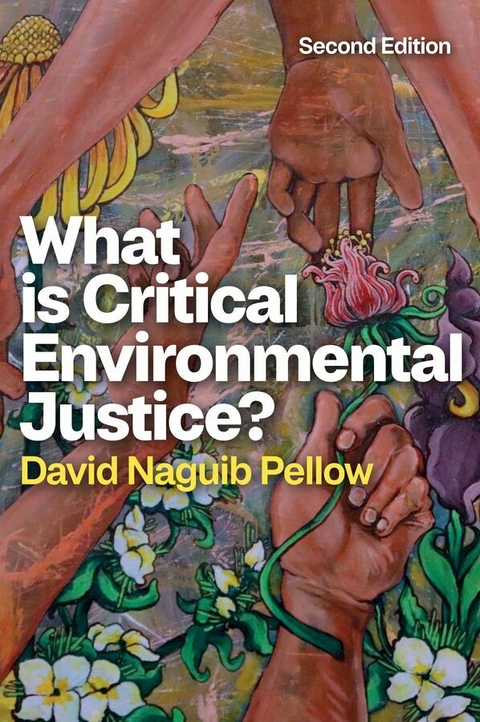
What is Critical Environmental Justice? (eBook)
367 Seiten
Polity (Verlag)
978-1-5095-6006-6 (ISBN)
In this updated edition of his innovative contribution, David Naguib Pellow introduces a new framework for critically analyzing Environmental Justice scholarship and activism. In doing so he extends the field's focus to topics not usually associated with environmental justice, including policing, incarceration, the Israel/Palestine conflict, and the Black Lives Matter movement. In doing so he reveals that ecological violence is first and foremost a form of social violence, driven by and legitimated by social structures and discourses. He enriches this radical approach to Environmental Justice by drawing on Indigenous Studies, the Black Radical Tradition, Disability Studies, Queer and Transgender Studies, and Multi-Species Justice, among others. Those already familiar with the discipline will find themselves invited to think about the subject in entirely new ways.
This book is a vital resource for students, scholars, and policy makers interested in innovative approaches to one of the greatest challenges facing humanity and the planet.
David Naguib Pellow is Dehlsen Chair and Professor of Environmental Studies and Director of the Global Environmental Justice Project at the University of California, Santa Barbara.
Human societies have always been deeply interconnected with our ecosystems, but today those relationships are witnessing greater frictions, tensions, and harms than ever before. These dynamics mirror those experienced by marginalized communities across the planet, but they also provide a foundation for transformative thinking and action to address these challenges. In this updated edition of his innovative contribution, David Naguib Pellow introduces a new framework for critically analyzing Environmental Justice scholarship and activism. In doing so he extends the field s focus to topics not usually associated with environmental justice, including policing, incarceration, the Israel/Palestine conflict, and the Black Lives Matter movement. In doing so he reveals that ecological violence is first and foremost a form of social violence, driven by and legitimated by social structures and discourses. He enriches this radical approach to Environmental Justice by drawing on Indigenous Studies, the Black Radical Tradition, Disability Studies, Queer and Transgender Studies, and Multi-Species Justice, among others. Those already familiar with the discipline will find themselves invited to think about the subject in entirely new ways. This book is a vital resource for students, scholars, and policy makers interested in innovative approaches to one of the greatest challenges facing humanity and the planet.
1
Critical Environmental Justice Studies
Michael Brown was an African-American teenager living in Ferguson, Missouri. On August 9, 2014, police officer Darren Wilson shot and killed him, sparking worldwide outrage at the seemingly unending series of police shootings of African-Americans. When protesters took to the streets of cities around the U.S. and the world to declare that “Black Lives Matter,” they and those who were the targets of police shootings were frequently referred to as “animals.” Juana Gutiérrez is the daughter of a Mexican farmer and she immigrated to the U.S. at age fifteen. She started an organization called Mothers of East Los Angeles (MELA), which fought to keep prisons from being built in her city and around the state of California. Nicholas Morrissey was incarcerated at a state prison in LaBelle, Pennsylvania; he suffered from a chronic illness he believes was caused by the fact that the prison is located next to a massive coal ash dump. Foad al-Amodi is president of the fishermen’s syndicate in Khan Younis, a town in the Palestinian Occupied Territories. His livelihood is threatened because the fish that he and his customers depend upon are dying from exposure to the massive volume of sewage that flows into the Mediterranean Sea – a result of the Israeli blockade of the Gaza Strip, which has prevented the purchase of much-needed equipment to upgrade Gaza’s waste management system. Havah Ha-Levi was a Jewish Israeli woman who lived in a kibbutz near an old Palestinian Arab village, Sarkas, which Israel destroyed and converted into a garbage dump. In her memoir she writes, “Yet I remember. I testify.” State-sanctioned police killings of Black people; prisons and jails; the Israeli occupation of Palestine. Each of these cases reveals how human suffering and social injustice also are sites where that pain is intimately linked to the harm visited upon fragile ecosystems and other animals. And each of these cases speaks to the ways that ordinary people and, in some cases nonhumans, have worked for environmental and social justice.
Human societies have always been deeply interconnected with our nonhuman relations and with ecosystems but today those relationships are witnessing greater frictions, tensions, and harms than ever before, as global climate disruption, policing, warfare, and colonialism threaten to overwhelm our lives and life support systems. And, while those trends reveal incalculable damage to both ecosystems and human societies, the opportunities for addressing these problems are well within our grasp, if we only dare to break out of conventional modes of thinking and action. The harms suffered by ecosystems today are closely linked to and mirror the suffering experienced by the most marginalized human beings across the planet – what many scholars call the problem of environmental injustice. For example, where we find rivers dammed for hydropower plants we also tend to find Indigenous peoples and fisherfolk, as well as other working people, whose livelihoods and health are impacted as a result; when sea life suffers from exposure to toxins such as mercury, we find that human beings also endure the effects of that dangerous chemical when they consume those animals; and the intersecting character of multiple forms of injustice is revealed when nuclear radiation or climate change (unevenly) affects all species and humans across all social class levels, racial/ethnic groups, genders, abilities, sexualities, nationalities, and ages. The power (or agency) of the more-than-human world is on display here as well when, for example, nuclear radiation, COVID-19, or extreme climate patterns are triggered by human actions and then, in turn, exert their own force on various bodies, spaces, and ecosystems. The agency of human beings is evident when people imagine and work to bring about a different set of relationships with each other and with the more-than-human world through art, protest, music, research, planning, design, and other forms of action.
Environmental justice struggles reveal how power flows through the multi-species relationships and communities that make up life on Earth, often resulting in violence and marginalization for the many and environmental privileges for the few. But environmental justice struggles are also evident – if we are paying close attention – within spaces of conflict and collaboration that are not always typically defined as “environmental.” Consider, for example, the roles that land, air, water, and nonhuman species play in the Black Lives Matter (BLM) movement (also known as the Movement for Black Lives or M4BL), in the construction and maintenance of the U.S. prison industrial complex, and in political struggles between Israel and Palestine. I draw on each of these examples in this book to explore the future of environmental justice research and politics. One path toward this future is made clearer through what I call Critical Environmental Justice Studies.
In our book Power, Justice, and the Environment,1 Robert Brulle and I used the term “Critical Environmental Justice Studies” to call for scholarship that builds on research in Environmental Justice (EJ) Studies by questioning assumptions and gaps in earlier work in the field, by embracing greater interdisciplinarity, and moving toward methodologies and epistemologies that include and move beyond the social sciences. A number of other scholars have adopted this term as well, as they work to expand the academic field and politics of environmental justice.2 In the rest of this chapter I offer an overview of some key ideas and advances from the field of EJ studies and introduce the concept of Critical EJ Studies as a way of pushing the ideas and potential of earlier generations of EJ studies into new directions. I view Critical EJ Studies not as an alternative to earlier-generation EJ studies, but as an extension of that foundational scholarship.
Environmental Justice Studies: An Overview of the Field
Why Critical Environmental Justice Studies? In order to answer that question, I must first offer an overview of the field of Environmental Justice Studies. But, before one considers the scholarly research on the topic of environmental justice (EJ), we must begin with the EJ movement. The U.S. EJ movement gained visibility and strength beginning in the late 1970s and early 1980s, as activists and movement networks confronted a range of toxic hazards that were disproportionately located in communities of color (while the closely related Anti-Toxics movement was concentrated primarily in white working-class neighborhoods). This movement fused discourses of public health, civil and human rights, anti-racism, social justice, and ecological sustainability with tactics such as civil disobedience, public protests, and legal action to prevent the construction or expansion of unwanted and controversial facilities and developments such as landfills, incinerators, mines, and chemical plants. Activists also demanded that owners of existing facilities improve their operational safety, reduce pollution levels, and provide economic benefits to and offer power sharing with local residents or face the threat of being shut down. This movement sought to openly integrate campaigns for justice on behalf of vulnerable human beings with the goal of ecological sustainability.3 From the movement’s early days, activists sought environmental justice, not only through shutting down polluting facilities, but also by demanding and creating access to parks and green space and affordable, healthy foods,4 safe neighborhoods, and for climate-related policies and practices that are socially just and ecologically sustainable.5 Thus, even during its earliest days, the EJ movement articulated a transformative vision of what an environmentally and socially just and sustainable future might look like at the local, regional, national, and global scales. For example, during the historic Environmental Justice Summit conference in 1991, participants drafted the Principles of Environmental Justice, a document that embraced a synthesis of anti-racism and ecological sustainability, as well as support for anti-militarist, anti-imperialist, gender-justice politics. The Principles also recognize the inherent and cultural worth of nonhuman natures.6
The EJ movement is largely comprised of people from communities of color, Indigenous communities, and working-class communities who are focused on combating environmental injustice, racism, and gender and class inequalities that are most visibly manifested in the disproportionate burden of environmental harm facing these populations. For the EJ movement, the battle for global sustainability cannot be won without addressing the ecological violence imposed on vulnerable human populations; thus social justice (that is, justice for humans) is inseparable from environmental protection.
What Is Environmental Justice?
EJ studies scholar Robert Bullard defines environmental justice as the principle that “all people and communities are entitled to equal protection of environmental and public health laws and regulations.”7 U.S. President Joe Biden’s Executive Order 14096 further elaborates on this principle by defining environmental justice as:
the just treatment and meaningful involvement of all people, regardless of income, race, color, national origin, tribal affiliation, or disability, in agency decision-making and other Federal activities that affect human health and the environment so that people: (i) are fully protected...
| Erscheint lt. Verlag | 14.5.2025 |
|---|---|
| Sprache | englisch |
| Themenwelt | Sozialwissenschaften ► Soziologie |
| Schlagworte | 9781509560042 • 9781509560059 • 9781509560066 • Biopolitics • critical environmental justice • David pellow • Ecological Ethics • ecological violence • Ecology • Eco-terrorism • Environment • Environmental Ethics • environmental justice • Environmental Racism • Environmental Sociology • Indigenous environmental ethics • indigenous understandings of the environment • marginalized communities environment • Nature • pellow • Political Ecology • politics and the environmental • racial politics of place • what is critical environmental justice? • what is environmental justice? |
| ISBN-10 | 1-5095-6006-8 / 1509560068 |
| ISBN-13 | 978-1-5095-6006-6 / 9781509560066 |
| Informationen gemäß Produktsicherheitsverordnung (GPSR) | |
| Haben Sie eine Frage zum Produkt? |
 EPUB (Adobe DRM)
Kopierschutz: Adobe-DRM
Adobe-DRM ist ein Kopierschutz, der das eBook vor Mißbrauch schützen soll. Dabei wird das eBook bereits beim Download auf Ihre persönliche Adobe-ID autorisiert. Lesen können Sie das eBook dann nur auf den Geräten, welche ebenfalls auf Ihre Adobe-ID registriert sind.
Details zum Adobe-DRM
Dateiformat: EPUB (Electronic Publication)
EPUB ist ein offener Standard für eBooks und eignet sich besonders zur Darstellung von Belletristik und Sachbüchern. Der Fließtext wird dynamisch an die Display- und Schriftgröße angepasst. Auch für mobile Lesegeräte ist EPUB daher gut geeignet.
Systemvoraussetzungen:
PC/Mac: Mit einem PC oder Mac können Sie dieses eBook lesen. Sie benötigen eine
eReader: Dieses eBook kann mit (fast) allen eBook-Readern gelesen werden. Mit dem amazon-Kindle ist es aber nicht kompatibel.
Smartphone/Tablet: Egal ob Apple oder Android, dieses eBook können Sie lesen. Sie benötigen eine
Geräteliste und zusätzliche Hinweise
Buying eBooks from abroad
For tax law reasons we can sell eBooks just within Germany and Switzerland. Regrettably we cannot fulfill eBook-orders from other countries.
aus dem Bereich