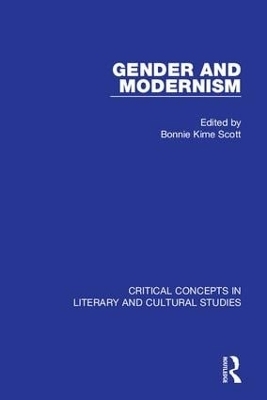
Gender and Modernism: Critical Concepts 4 vols
Routledge
9780415380928 (ISBN)
Modernism, whether seen as a period designation, a manifestation of formal experimentation, or an aspect of modernity, has since its inception been marked, consciously or unconsciously, by gender. The dates 1890-1940, typically accepted as encompassing the modernist period, coincide with the first wave of feminism and its educational, suffragist, socialist, and professional agendas. Feminist activism and ideology of the period, as well as reactions against them, made gender a field of contention, sometimes labelled the "sex wars." The long shadow left by the Oscar Wilde trials, and the flourishing of gay and lesbian cultures, particularly in the urban centres of modernism in the teens and twenties, also queered normative notions of masculinity and femininity. In response to global consumer culture, diverse images of the modern girl emerged, also putting conventional notions of gender to the test. The Harlem Renaissance had its own gendered politics and expressions, as did modernism’s venturing into and emergence from colonial situations around the globe.
The discussion of gender in modernism arose in the 1970s, along with the second wave of feminism and the introduction of feminist theory and criticism to the academy. It challenged the ways that the modernist canon, and the experimental forms associated with modernism, had been fashioned as normatively male. Early on, various approaches to the exploration of gender were available, including the gendering of style available in French Feminist theory, psychoanalytic approaches, materialist feminism, and gyno-critical attention to women writers. Raising questions of gender concerning modernist texts had become an expectation by the 1990s. Debates about the adequacy of gender as the central concern of feminist theory have led to the useful concept of intersectionality, which heeds the ways that other social categories, such as race, class, sexuality, dis/ability, and global/colonial location, intersect with gender in creating the standpoint of an individual. Equally valuable are challenges to binary divisions encouraged by gendered oppositions, and the study of ways that gender is produced by culture or performed.
Bonnie Kime Scott is Professor of Women's Studies at San Diego State University, where she teaches courses concerning women writers, feminist theory, gender, and representation. Her writing over the last decade has been devoted to the feminist re-vision of literary modernism and she is currently working on a sequel to The Gender of Modernism: A Critical Anthology, which originally came out in 1990.
Volume I: Modernists Write Gender. Issues of Formal Authority. Gender Politics. Racial Expressions and Transgressions. On the Colonial Horizon. Other Arts. Volume II: Critical Gender Studies of Modernism: The Makings of Modernism. Reading Gender into Modernist Canons. Issues of Sexual Textuality. Modernism, Gender and War. Productive and Contested Spaces. Volume III: Critical Gender Studies of Modernism: Diversity of Focus. Gender, Genre, and Discourse. Traversing High/Low Modernism and Other Arts. Decolonizing Modernism. Volume IV: Critical Gender Studies of Modernism: Diversity of Identities. Masculine and Feminine Performances. Intersections of Gender and Race. Lesbian, Gay, and Queer Intersections.
| Erscheint lt. Verlag | 19.3.2008 |
|---|---|
| Reihe/Serie | Critical Concepts in Literary and Cultural Studies |
| Verlagsort | London |
| Sprache | englisch |
| Maße | 156 x 234 mm |
| Gewicht | 3020 g |
| Themenwelt | Geisteswissenschaften ► Sprach- / Literaturwissenschaft ► Anglistik / Amerikanistik |
| Geisteswissenschaften ► Sprach- / Literaturwissenschaft ► Literaturwissenschaft | |
| Sozialwissenschaften ► Soziologie ► Gender Studies | |
| ISBN-13 | 9780415380928 / 9780415380928 |
| Zustand | Neuware |
| Informationen gemäß Produktsicherheitsverordnung (GPSR) | |
| Haben Sie eine Frage zum Produkt? |
aus dem Bereich