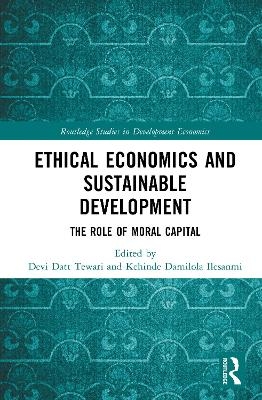
Ethical Economics and Sustainable Development
Routledge (Verlag)
978-1-041-00068-6 (ISBN)
As societies strive for economic progress, they often prioritize metrics like GDP growth, technological innovation, and industrial expansion. However, amid the rush for material progress, something important yet frequently overlooked comes into focus: the influence of moral capital on the trajectory of economic expansion. This book explores the role of moral capital and its relationship with economic growth. It emphasises how investment in moral frameworks can promote social well-being and sustainable development.
The book is divided into two sections. The first part focuses on the theorisation of the moral capital and African economic sustainability nexus, while the second part is devoted to some selected empirical studies on the impact of moral capital on African economic policies. The book argues that firm growth is crucial, not only for stakeholders but also for the broader economy, underpinning the sustainability of the ecosystem, and by adhering to ethical principles, organisations can make a positive impact on social, economic, and environmental issues. Furthermore, they can proactively address societal concerns, promote fairness and justice, and engage in sustainable practices. Through their actions, institutions become agents of positive change, helping to shape a more inclusive, equitable, and sustainable world. The key message of the book is that the cultivation of moral capital requires a collective effort from all stakeholders involved in institutional development; governments, institutions, civil society, and individuals must collaborate to create an ecosystem that incentivises and rewards ethical behaviour. It includes diverse perspectives and combines conceptual, theoretical, and empirical research, addressing contemporary issues in African economic policy and sustainability. It presents global case studies to make the case for the importance of moral capital in addressing African leadership problems.
The book will appeal to academics, students, and researchers in economics, ethics, development studies, and sustainability.
The Open Access version of this book, available at http://www.taylorfrancis.com, has been made available under a Creative Commons Attribution-Non Commercial-No Derivatives (CC BY-NC-ND) 4.0 license.
Devi Datt Tewari is a professor in the Department of Economics, University of Zululand (UNIZULU), South Africa. Kehinde Damilola Ilesanmi is a lecturer in the Department of Economics, University of Zululand (UNIZULU), South Africa.
Introduction Part I: Theorisation of Moral Capital and African Economic Sustainability Nexus 1. Currency manipulation as a toolkit for Western Hegemony: Is a moral economy ever possible? 2. Rethinking the economy for the greater good: Lessons from Climate Change Mitigation Initiatives 3. Roles of banks in times of crisis: More regulation or moral capital? 4. Moral capital and leadership: A possible solution to the African problem? 5. Moral capital in economic history: A brief survey of ideas and relevance to Africa Part II: Selected Empirical Studies on the Impact of Moral Capital on African Economic Policies 6. Enhancing Moral Capital in South Africa: The Role of Government and its Implication for the Economy 7. The impact of national minimum wage policy on inflation and unemployment in South Africa: A segmented regression analysis 8. Do firms have the responsibility to be morally responsible? Moral capital versus firm growth in selected African countries 9. Moral Capital Threshold in the Effectiveness of Oda for Social Infrastructure 10. Using the Rule of law as an elixir to arrest moral capital bankruptcy and financial collapse of South African state-owned enterprises 11. Can Corruption Be Eradicated and Moral Capital Restored in the DRC? A Comprehensive Analysis of Legal and Regulatory Frameworks from Mobutu to Tshisekedi
| Erscheinungsdatum | 04.11.2025 |
|---|---|
| Reihe/Serie | Routledge Studies in Development Economics |
| Zusatzinfo | 18 Tables, black and white; 9 Line drawings, black and white; 9 Illustrations, black and white |
| Verlagsort | London |
| Sprache | englisch |
| Maße | 156 x 234 mm |
| Gewicht | 570 g |
| Themenwelt | Sozialwissenschaften ► Soziologie ► Spezielle Soziologien |
| Wirtschaft ► Betriebswirtschaft / Management ► Marketing / Vertrieb | |
| Wirtschaft ► Volkswirtschaftslehre | |
| ISBN-10 | 1-041-00068-5 / 1041000685 |
| ISBN-13 | 978-1-041-00068-6 / 9781041000686 |
| Zustand | Neuware |
| Informationen gemäß Produktsicherheitsverordnung (GPSR) | |
| Haben Sie eine Frage zum Produkt? |
aus dem Bereich