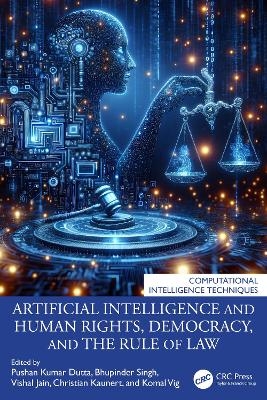
Artificial Intelligence and Human Rights, Democracy, and the Rule of Law
CRC Press (Verlag)
978-1-032-79663-5 (ISBN)
This book introduces a comprehensive model for evaluating the effects of artificial intelligence (AI) on human rights, democracy, and the rule of law and an innovative framework that merges Human Rights Impact Assessments (HRIAs) practices with AI-focused algorithmic impact assessment approaches. The book is divided into three subthemes: Understanding AI, Its Concepts and Implications; Challenges and Solutions in AI Systems; and AI Applications, Compliance Issues, and Future Prospects.
Features:
Emphasizes the importance of integrating HRIAs with AI-centered approaches.
Evaluates impacts of AI on human rights, democracy, and the rule of law to manage potential risks and impacts of AI.
Underscores the necessity of a methodology that follows the proportionality principle.
Highlights the importance of engaging with stakeholders throughout the impact assessment process.
Provides real-world applications of computational intelligence in the HUDERAF context.
This book is aimed at graduate students and researchers in artificial intelligence, computer science, cybersecurity, and human rights studies.
Dr. Pushan Kumar Dutta is an Associate Professor at Amity University Kolkata with over 12 years of academic experience. He holds a Ph.D. from Jadavpur University (2015) and completed postdoctoral research as an Erasmus Mundus Scholar at the University of Oradea, Romania (2016). A prolific editor, Dr. Dutta has curated over 60 books for leading publishers including Springer, Elsevier, Taylor & Francis, and Cambridge Scholars, and serves as Series Manager for "Sustainable Industrial Engineering Systems" at CRC Press. His editorial work spans AI in healthcare, Industry 5.0, quantum computing, and digital transformation. Dr. Dutta's impactful work addresses 16 of the 17 UN Sustainable Development Goals, demonstrating a deep commitment to leveraging technology and education for social good. His research and advocacy integrate human rights perspectives, emphasizing equitable access to technology, ethical AI development, and inclusive innovation that bridges socioeconomic divides. He is a fellow of multiple professional organizations, he continues to inspire students through international competitions and innovative teaching in Data Science, AI, and emerging technologies. Bhupinder Singh works as Professor at Sharda School of Law, Sharda University Greater Noida, India. He is also Honorary Professor at University of South Wales UK and Santo Tomas University Tunja, Colombia. He has 3 books, 97 paper publications, 163 paper presentations in international/national conferences and seminars, participated in more than 40 workshops/FDP's/QIP's, 25 courses from international universities of repute, organized more than 59 events with international and national academicians and industry people’s, editor-in-chief and co-editor in journals, developed new courses. He has given talks at international universities, resource person in international conferences such as in Nanyang Technological University Singapore, Tashkent State University of Law Uzbekistan; KIMEP University Kazakhstan, All’ah meh Tabatabi University Iran, the Iranian Association of International Criminal law, Iran and Hague Center for International Law and Investment, The Netherlands, Northumbria University Newcastle UK, Taylor's University Malaysia, AFM Krakow University Poland, European Institute for Research and Development Georgia, Business and Technology University Georgia, Texas A & M University US name a few. His leadership, teaching, research and industry experience is of 16 years and 3 Months. His research interests are health law, criminal law, research methodology and emerging multidisciplinary areas as Blockchain Technology, IoT, Machine Learning, Artificial Intelligence, Genome-editing, Photovoltaic PV Glass, SDG’s and many more. Dr. Vishal Jain is presently working as a Professor (CSE) at the Department of Computer Science & Engineering, School of Engineering & Technology, Vivekananda Institute of Professional Studies - Technical Campus, New Delhi. Before that, he worked as Professor at Sharda University, Greater Noida and Associate Professor at Bharati Vidyapeeth’s Institute of Computer Applications and Management (BVICAM), New Delhi. He has associated as a member of the Faculty Board, Board of Planning and Management, Executive Council, Academic Council, Curriculum Development and Review Committee and Academic Audit of various higher education Institutions. He is associated with Kuala Lumpur University of Science and Technology (KLUST) (formerly known as Infrastructure University Kuala Lumpur (IUKL)), Malaysia, Lincoln University College, Malaysia and Research Institute of IoT Cybersecurity, Department of Electronic Engineering, National Kaohsiung University of Science and Technology, Taiwan for research oriented activities. He has supervised three Ph.D and two scholars are pursuing. He has more than 3300 research citations with Google Scholar (h-index score 30 and i-10 index 66) and has authored more than 250 research papers in professional journals and conferences. He has authored and edited more than 70 books (most of them are indexed at the Scopus) with various reputed publishers, including Elsevier, Springer, IET, Apple Academic Press, CRC, Taylor and Francis Group, Scrivener, Wiley, Emerald, NOVA Science, River Publishers, IGI-Global and Bentham Science. He has more than 300 Scopus publications. He is the book series editor of 10 book series with the reputed international publishers. Along with the regular teaching, he had organized various Conferences, Faculty Development Programme, Seminars, Hackathon, Faculty and Students Oriented activities. His research areas include machine learning, information retrieval, semantic web, ontology engineering, data mining, ad hoc networks, sensor networks and network security. He received a Young Active Member Award for the year 2012–13 from the Computer Society of India, and Best Faculty Award for the year 2017 and Best Researcher Award for the year 2019 from BVICAM, New Delhi. Christian Kaunert is Professor of International Security at Dublin City University, Ireland. He is also Professor of Policing and Security, as well as Director of the International Centre for Policing and Security at the University of South Wales. In addition, he is Jean Monnet Chair, Director of the Jean Monnet Centre of Excellence and Director of the Jean Monnet Network on EU Counter-Terrorism (www.eucter.net). Previously, he served as Academic Director and Professor at the Institute for European Studies, Vrije Universiteit Brussel, a Professor of International Politics, Head of Discipline in Politics, and the Director of the European Institute for Security and Justice, a Jean Monnet Centre for Excellence, at the University of Dundee. Prof Kaunert has researched and taught in many international universities, such as University of Shandong, Jinan, China, IBEI Barcelona, Spain, Diplomatic Academy Yerevan, Armenia – United Nations Development Mission, University of Cairo, Egypt, Collegio Carlo Alberto, Turin, Italy, Ecole nationale d’administration Paris, European Institute of Public Administration Maastricht, Netherlands, European Studies Institute (ESI) at Moscow, University of Porto, Portugal, etc. He was previously Senior Lecturer at the University of Dundee, Marie Curie Senior Research Fellow at the European University Institute Florence, and Senior Lecturer in EU Politics & International Relations, University of Salford. Komal Vig is working as the Director of Delhi Metropolitan Education, Noida, India. She is LLD in Criminal Law and MBA (HR). Komal Vig has served in the field of academics in different capacities for more than 21 years. She has published more than 95 research papers in International and National Journals (including 23 Scopus), 20+ book chapters, 30+ conference paper publications. She supervised six scholars who have successfully completed PhD under her guidance and many others are pursuing. She has presented more than 65 research papers in national and international seminars/conferences. Her area of interest is Criminal law, Family law, and laws related to Women’s rights. Komal Vig is a member of the inspection committees of various governing and accrediting bodies. Komal Vig has chaired numerous sessions in international and national conferences/seminars. She is active member of Board of Studies of various universities, received Life membership of the Indian law Institute (Deemed University) New Delhi, “Women Empowerment Award—2023” from Council of Research and Sustainable Development, India.
Preface.......................................................................................................................ix
Editors’ Biography....................................................................................................xi
List of Contributors..................................................................................................xv
Chapter 1 AI and Human Rights: Future Implications and
Ethical Considerations..........................................................................1
Kamalesh Ravesangar, Tarun Kumar Kaushik, Ravish,
Anurag Singh, Anjali Raghav, Bhupinder Singh, and
Saurabh Chandra
Chapter 2 Assessing AI-Driven Human Rights Violations: A Framework
for Accountability...............................................................................16
Debashree Chakravarty, Ipseeta Satpathy, Vishal Jain, and
B.C.M. Patnaik
Chapter 3 Computational Intelligence in Human Rights Protection:
A Review and Future Directions........................................................31
Budi Agus Riswandi, Saquib Ahmed, Anjali Raghav,
Bhupinder Singh, Atul Sangal, Manmeet Kaur Arora,
Sahil Lal, and Saurabh Chandra
Chapter 4 The Economic Potential of AI: Balancing Growth with
Human Rights and Ethics...................................................................43
Kushagra Shukla and Rashmi S
Chapter 5 AI, Data Privacy, and the Personal Data Protection Act:
Implications for Human Rights..........................................................61
Soorya Balendra
Chapter 6 AI Ethics and Colonial Legacies: Evaluating UNESCO’s
Recommendations for Inclusivity ......................................................78
Akash Bag, Anwesha Ghosh, Tejaswini Tripathy, and
Piotr Pietrzak
Chapter 7 The Role of AI in the Legal System: Implications for
Justice and Rights...............................................................................96
Geetha Manoharan and M Nivedha
Chapter 8 AI in Emotional Intelligence and Leadership: Enhancing
Accountability in Business Practices ...............................................112
Gaurav Kulat, Neeta Shah, Kanchan Naidu, Gayathri Band,
and Rupesh Pais
Chapter 9 AI and Human Rights: Guardians of Freedom or Threats to
Democracy?......................................................................................126
Prashasti Pritiprada, Ipseeta Satpathy, Christian Kaunert,
and B.C.M. Patnaik
Chapter 10 Big Data, Privacy, and the Rights of Senior Citizens under
the Digital Personal Data Protection Act..........................................137
Shayut Pavapanunkul, Aditi Srivastava, and Ritu Gautam
Chapter 11. AI-Driven Cybersecurity: Protecting Human Rights in the
Digital Age .......................................................................................155
T. Manonmani, S.N. Kumar, Jomin Joy, and Anandhu Venu
Chapter 12 AI and Inclusive Democracy: Transforming Governance
for Equitable Societies......................................................................172
Kushanthi S. Harasgama, Vaishali Arora, Manvendra Singh,
and Tahir Qureshi
Chapter 13 AI in Law Enforcement and Counter-Terrorism: Supporting
SDG 16 for Human Rights...............................................................183
Bhupinder Singh, Christian Kaunert, Saquib Ahmed,
Anjali Raghav, and Saurabh Chandra
Chapter 14 AI in Cybersecurity: Safeguarding Cyberspace and
Human Rights...................................................................................197
Sakthivel M, Suresh Kumar K, Joshua Bapu J,
Swathypriyadharsini P, Girimurugan R, and Raghavendran N
Chapter 15 Ethics of AI-Driven Targeted Advertising: Safeguarding
Consumer Rights..............................................................................219
Gigimon V S and Darsana R S
Chapter 16 AI-Generated Content and Copyright: Legal and Ethical
Challenges in India...........................................................................238
Hammouch Hind, Sushma Singh, and Anushka Singh
Chapter 17 AI’s Role in Cybersecurity: Balancing Innovation with
Privacy and Rights............................................................................262
Rahul Joshi, Suman Kumari, Krishna Pandey, Laith Farhan,
and Amr Badr
Chapter 18 Transforming Education: The Role of AI-Driven Chatbots
in Advancing Equal Access, Accountability, and Empowerment
in Educational Systems ....................................................................284
Santu Karmakar, Ankur Nandi, Tapash Das, and Tarini Halder
Chapter 19 AI, Consent, and GDPR: Ensuring Privacy and Rights in the
Digital Age .......................................................................................306
Kittisak Jermsittiparsert, Saurabh Chandra, and
Bhumika Muchan
Chapter 20 AI and IoT in Cybercrime Investigation: Protecting Human
Rights in the Digital Sphere .............................................................325
Laeeq Razzak Janua, Bhupinder Singh, Saquib Ahmed,
Anjali Raghav, Sahil Lal, Manmeet Kaur Arora and
Saurabh Chandra
Chapter 21 Role of Artificial Intelligence in Protection of Human
Rights with Special Reference to International Law........................339
Tarun Kumar Kaushik, Saquib Ahmed, Ravish, Anurag Singh,
Anjali Raghav, and Saurabh Chandra
Chapter 22 Facial Recognition, Civil Rights, and AI: Legal and Ethical
Considerations..................................................................................359
Nilanjan Chakraborty, Hamideza Rabiei Dastjerdi, and
Khder Alakkari
Chapter 23 Impact Analysis of Emotional Intelligence by AI on Sales
Team Performance: Case Study of ICICI Group Companies
in Nagpur..........................................................................................372
Gaurav Kulat, Neeta Shah, Kanchan Naidu, and
Gayathri Band
Chapter 24 AI and Effect of Digital Transformation on Banking Audits
and Compliance Management..........................................................385
Devendra Kakwani, Kanchan Naidu, and Gayathri Band
Index......................................................................................................................399
| Erscheinungsdatum | 30.12.2025 |
|---|---|
| Reihe/Serie | Computational Intelligence Techniques |
| Zusatzinfo | 16 Tables, black and white; 24 Line drawings, black and white; 24 Illustrations, black and white |
| Verlagsort | London |
| Sprache | englisch |
| Maße | 156 x 234 mm |
| Gewicht | 940 g |
| Themenwelt | Informatik ► Theorie / Studium ► Künstliche Intelligenz / Robotik |
| Sozialwissenschaften ► Politik / Verwaltung ► Politische Systeme | |
| Sozialwissenschaften ► Soziologie | |
| ISBN-10 | 1-032-79663-4 / 1032796634 |
| ISBN-13 | 978-1-032-79663-5 / 9781032796635 |
| Zustand | Neuware |
| Informationen gemäß Produktsicherheitsverordnung (GPSR) | |
| Haben Sie eine Frage zum Produkt? |
aus dem Bereich