


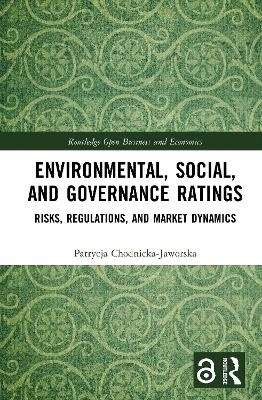
Environmental, Social, and Governance Ratings
Risks, Regulations, and Market Dynamics
Seiten
2025
Routledge (Verlag)
978-1-041-09871-3 (ISBN)
Routledge (Verlag)
978-1-041-09871-3 (ISBN)
This book presents environmental, social, and governance (ESG) ratings and scorings and their providers and lists problems with data quality, data sources, and unknown methodology, contributing to the green- and social-washing ESG rating phenomenon, as well as describing regulations, initiatives, and practical knowledge of ESG scoring.
In recent years, the world of finance and investments has changed, considering measures related to environmental, social, and governance (ESG) factors for socially responsible investments. ESG scoring and ratings are used to estimate ESG risk.
This book presents ESG ratings and scorings and their providers and lists problems with data quality, data sources, and unknown methodology, contributing to the green- and social-washing ESG rating phenomenon. The value of assets invested in green instruments relies on high-quality ESG ratings to measure green transition. Data greenwashing negatively impacts the financial market, especially the stock price, fund activities, and bond markets. The size of the rated company, geographical location, and industry biases are considered in understanding the greenwashing phenomenon. This book illustrates all the problems related to ESG rating inflation, conflicts of interest, models of payment, and internal and external ratings. It describes current regulations, initiatives, and practical knowledge of ESG scoring.
Academics and students of financial law, economics, and financial sustainability will find this book invaluable. The practical implications in the book will benefit sustainability-concerned regulators and practitioners who estimate ESG risk (especially in financial institutions).
The Open Access version of this book, available at www.taylorfrancis.com, has been made available under a Creative Commons Attribution-Non Commercial-No Derivatives (CC-BY-NC-ND) 4.0 International license.
In recent years, the world of finance and investments has changed, considering measures related to environmental, social, and governance (ESG) factors for socially responsible investments. ESG scoring and ratings are used to estimate ESG risk.
This book presents ESG ratings and scorings and their providers and lists problems with data quality, data sources, and unknown methodology, contributing to the green- and social-washing ESG rating phenomenon. The value of assets invested in green instruments relies on high-quality ESG ratings to measure green transition. Data greenwashing negatively impacts the financial market, especially the stock price, fund activities, and bond markets. The size of the rated company, geographical location, and industry biases are considered in understanding the greenwashing phenomenon. This book illustrates all the problems related to ESG rating inflation, conflicts of interest, models of payment, and internal and external ratings. It describes current regulations, initiatives, and practical knowledge of ESG scoring.
Academics and students of financial law, economics, and financial sustainability will find this book invaluable. The practical implications in the book will benefit sustainability-concerned regulators and practitioners who estimate ESG risk (especially in financial institutions).
The Open Access version of this book, available at www.taylorfrancis.com, has been made available under a Creative Commons Attribution-Non Commercial-No Derivatives (CC-BY-NC-ND) 4.0 International license.
Patrycja Chodnicka-Jaworska is a researcher and the Director of the Risk and Finance Management Center, University of Warsaw, Poland.
Introduction Part I: ESG Ratings 1. ESG Ratings: The main problems 2. Problems related to ESG Measures Part II: Market Dynamics and ESG Ratings Impact 3. ESG Ratings Inflation 4. Factors influencing the quality of ESG rating 5. The impact of data greenwashing on the financial market Part III: ESG Regulations and Governance 6. Regulations related to ESG measures 8. Main Conclusions and Implications
| Erscheinungsdatum | 09.09.2025 |
|---|---|
| Reihe/Serie | Routledge Open Business and Economics |
| Zusatzinfo | 38 Tables, black and white; 22 Line drawings, black and white; 22 Illustrations, black and white |
| Verlagsort | London |
| Sprache | englisch |
| Maße | 156 x 234 mm |
| Gewicht | 460 g |
| Themenwelt | Recht / Steuern ► EU / Internationales Recht |
| Recht / Steuern ► Wirtschaftsrecht ► Bank- und Kapitalmarktrecht | |
| Sozialwissenschaften ► Soziologie ► Spezielle Soziologien | |
| Wirtschaft ► Betriebswirtschaft / Management | |
| ISBN-10 | 1-041-09871-5 / 1041098715 |
| ISBN-13 | 978-1-041-09871-3 / 9781041098713 |
| Zustand | Neuware |
| Informationen gemäß Produktsicherheitsverordnung (GPSR) | |
| Haben Sie eine Frage zum Produkt? |
Mehr entdecken
aus dem Bereich



aus dem Bereich
Buch | Softcover (2025)
dtv Verlagsgesellschaft
CHF 20,85
Einkommensteuer, Körperschaftsteuer, Gewerbesteuer, Bewertungsgesetz …
Buch (2024)
Springer Gabler (Verlag)
CHF 39,15


