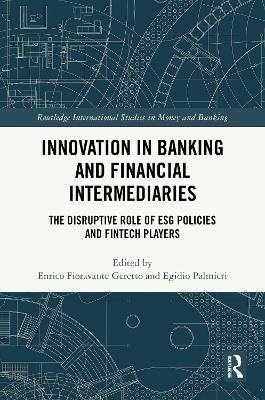
Innovation in Banking and Financial Intermediaries
Routledge (Verlag)
978-1-032-88796-8 (ISBN)
The book offers an analysis of the theoretical and empirical essentials behind these transformations, including empirical analyses of the bank-specific impact of ESG factors on ratings, loan quality and internal control systems. While facilitating broader research regarding sustainable finance and providing essential findings for those hoping to comprehend and implement the aforementioned strategies into practice, the volume showcases the increasing significance of environmental issues in financial decision-making. Finally, the book addresses the way financial technology innovations are causing disruption to so-called "traditional" credit markets and affecting banking stability in general. It offers a comparison of green and brown Fintech, examining their safety and sustainability dimensions, and discuss the trade-off between progress and the need for responsibility.
This work serves to bridge a significant gap between theoretical and practical approaches, providing findings and implications for researchers and academics studying finance, technology and sustainability. Through multiple methodologies, the authors explore changes related to ESG and Fintech, facilitating deeper understanding of their operational implications and significance.
Enrico Fioravante Geretto is a Full Professor of Bank Risk Management in the Department of Economics and Statistics, University of Udine, Italy. Egidio Palmieri is a Senior Research Fellow in Bank Risk Management at the University of Udine, Italy and Researcher at the “Institute of European Finance”, Bangor Business School, UK.
1. Introduction Part I: ESG and Innovation in Financial Intermediaries 2.ESG disruptive innovation: A literature review of ESG rating, regulation, and financial institutions' business practices 3. The ESG-Bank stability nexus: Are ESG-oriented banks more resilient? 4. Climate transition risk in the syndicated loan market 5. Green Bonds as a Driver for Improved Bank Loan Quality and Profitability 6. The Impact of Sustainability-oriented Practices on Banking Efficiency: An Analysis Through DEA Model 7. Exploring Compliance and Sustainability Integration: A Focus on Financial Intermediaries' Internal Control Functions 8. Insurance Firms and ESG Policies: The effect on default risk effect and riskiness 9. Is the stock market considering the impact of ESG factors? A portfolio management perspective Part II: Fintech and Innovations in Financial Intermediaries 10. Machine Learning in support of credit scoring overcoming traditional predictive models: What do we know so far? 11. The dual impact of Digital Lending on European banks: How do Fintech Platforms affect bank stability and loan portfolio quality? 12. Green vs Brown Fintech: Which are the safest? 13. Machine learning in investment strategies. Stock price prediction through Support Vector Machines 14. Mapping the Landscape of Digital Financial Literacy through Education Programs: A Systematic Literature Review 15. Banks and fintech applications in bond markets - An explorative study 16. Conclusion
| Erscheinungsdatum | 01.07.2025 |
|---|---|
| Reihe/Serie | Routledge International Studies in Money and Banking |
| Zusatzinfo | 78 Tables, black and white; 30 Line drawings, black and white; 2 Halftones, black and white; 32 Illustrations, black and white |
| Verlagsort | London |
| Sprache | englisch |
| Maße | 156 x 234 mm |
| Gewicht | 810 g |
| Themenwelt | Sozialwissenschaften ► Soziologie ► Spezielle Soziologien |
| Wirtschaft ► Betriebswirtschaft / Management ► Finanzierung | |
| Betriebswirtschaft / Management ► Spezielle Betriebswirtschaftslehre ► Bankbetriebslehre | |
| Wirtschaft ► Betriebswirtschaft / Management ► Unternehmensführung / Management | |
| ISBN-10 | 1-032-88796-6 / 1032887966 |
| ISBN-13 | 978-1-032-88796-8 / 9781032887968 |
| Zustand | Neuware |
| Informationen gemäß Produktsicherheitsverordnung (GPSR) | |
| Haben Sie eine Frage zum Produkt? |
aus dem Bereich