


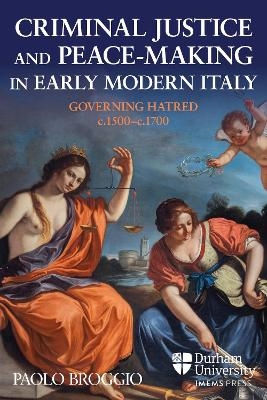
Criminal Justice and Peace-making in Early Modern Italy
Governing Hatred, c.1500-c.1700
Seiten
2025
Boydell & Brewer (Verlag)
978-1-914967-18-4 (ISBN)
Boydell & Brewer (Verlag)
978-1-914967-18-4 (ISBN)
An exceptional study of private peace pacts in early modern Italy that challenges earlier notions of the place of these private agreements in the development of the courts and state.
Private settlements were among the most prominent yet least conspicuous aspects of justice in early modern Europe. Traditionally seen as incompatible with our notions of judicial modernity, these settlements reflected a deeply ingrained culture of negotiation and transaction-one that often viewed resolution by litigation with extreme scepticism. However, rather than existing in opposition to sovereign justice, this practice of private settlement coexisted with the implacable authority of rulers who alternated between exemplary punishments and royal pardons to maintain social harmony.
In this English translation of his seminal study, Governare l'odio. Pace e giustizia criminale nell'Italia moderna (secoli XVI-XVII), Paolo Broggio shows how private settlements were far from being a purely benevolent mechanism of reconciliation, often carrying unsettling similarities to institutional coercion and even acts of revenge. Judicial authorities are revealed as not only tolerating these private agreements but shown to have actively facilitated and manipulated them as a means of exerting their control within a community. Religious justifications further lent these agreements a veneer of moral obligation, masking the underlying pressures at play. Through detailed examples such as proceedings in the Papal States, Broggio explores how courts encouraged settlements not only to manage caseloads but to also reinforce existing social hierarchies and power structures.
This expansive study re-examines the role of peace settlements in early modern justice, revealing them as a fundamental yet coercive tool of governance rather than a simple, private, alternative to judicial authority.
Private settlements were among the most prominent yet least conspicuous aspects of justice in early modern Europe. Traditionally seen as incompatible with our notions of judicial modernity, these settlements reflected a deeply ingrained culture of negotiation and transaction-one that often viewed resolution by litigation with extreme scepticism. However, rather than existing in opposition to sovereign justice, this practice of private settlement coexisted with the implacable authority of rulers who alternated between exemplary punishments and royal pardons to maintain social harmony.
In this English translation of his seminal study, Governare l'odio. Pace e giustizia criminale nell'Italia moderna (secoli XVI-XVII), Paolo Broggio shows how private settlements were far from being a purely benevolent mechanism of reconciliation, often carrying unsettling similarities to institutional coercion and even acts of revenge. Judicial authorities are revealed as not only tolerating these private agreements but shown to have actively facilitated and manipulated them as a means of exerting their control within a community. Religious justifications further lent these agreements a veneer of moral obligation, masking the underlying pressures at play. Through detailed examples such as proceedings in the Papal States, Broggio explores how courts encouraged settlements not only to manage caseloads but to also reinforce existing social hierarchies and power structures.
This expansive study re-examines the role of peace settlements in early modern justice, revealing them as a fundamental yet coercive tool of governance rather than a simple, private, alternative to judicial authority.
PAOLO BROGGIO is Professor of Early Modern History at the University of Rome. He has published widely on the history of Roman catholic missions, theological disputes, as well as violence and conflict resolution in the early modern era.
Introduction
1. Vendetta, Justice, Peace: Definitions and Contextualisations
2. Governing Violence and Conflict in the Papal States
3. Negotiated Justice and Centre-Periphery Relations
4. A European Culture of Social Containment through Conciliation
5. The Peace of Christians
Conclusions
Bibliography
Index
| Erscheinungsdatum | 07.08.2025 |
|---|---|
| Reihe/Serie | Law, Peace, and Justice in Medieval and Early Modern Europe |
| Zusatzinfo | 11 b/w illus. |
| Verlagsort | Woodbridge |
| Sprache | englisch |
| Maße | 156 x 234 mm |
| Themenwelt | Geschichte ► Teilgebiete der Geschichte ► Kulturgeschichte |
| Geschichte ► Teilgebiete der Geschichte ► Militärgeschichte | |
| Recht / Steuern ► Rechtsgeschichte | |
| Sozialwissenschaften ► Politik / Verwaltung | |
| ISBN-10 | 1-914967-18-6 / 1914967186 |
| ISBN-13 | 978-1-914967-18-4 / 9781914967184 |
| Zustand | Neuware |
| Informationen gemäß Produktsicherheitsverordnung (GPSR) | |
| Haben Sie eine Frage zum Produkt? |
Mehr entdecken
aus dem Bereich


aus dem Bereich
Die Revolution des Gemeinen Mannes
Buch | Softcover (2024)
C.H.Beck (Verlag)
CHF 16,80
Eine Geschichte des Geschmacks
Buch | Hardcover (2025)
C.H.Beck (Verlag)
CHF 49,95


