


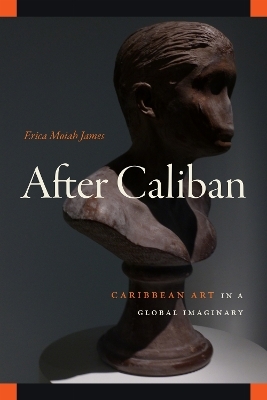
After Caliban
Caribbean Art in a Global Imaginary
Seiten
2025
Duke University Press (Verlag)
978-1-4780-3213-7 (ISBN)
Duke University Press (Verlag)
978-1-4780-3213-7 (ISBN)
Drawing on AimÉ CÉsaire’s rewriting of Shakespeare’s The Tempest, Erica Moiah James examines the rise of global Caribbean artists in the 1990s and their production of a decolonized art history for the Caribbean.
In After Caliban, Erica Moiah James examines the rise of global Caribbean artists in the 1990s and their production of a decolonized art history for the Caribbean. She draws on AimÉ CÉsaire’s rewriting of Shakespeare’s The Tempest, in which Caliban becomes the sole author of his own story, dissolving his fixed position as colonized in relation to Prospero as colonizer. James shows how visual artists such as Marc Latamie, Janine Antoni, Belkis AyÓn, Edouard Duval-CarriÉ, and Christopher Cozier followed CÉsaire’s model by employing a range of practices and methodologies that refused marginalization. Just as CÉsaire decolonized The Tempest, so too did these artists, who crafted a decolonial aesthetic that redefined their own cultural and historical narratives and positioned art as a key pathway toward a postcolonial future. By providing the foundation for a postcolonial, post-Caliban art world, these artists redefined the critical and popular notion of contemporary Caribbean art. At the same time, James argues, they fulfilled CÉsaire’s dream for a postcolonial Caribbean while creating a nonhegemonic art historical practice that exists beyond modern binaries and borders.
In After Caliban, Erica Moiah James examines the rise of global Caribbean artists in the 1990s and their production of a decolonized art history for the Caribbean. She draws on AimÉ CÉsaire’s rewriting of Shakespeare’s The Tempest, in which Caliban becomes the sole author of his own story, dissolving his fixed position as colonized in relation to Prospero as colonizer. James shows how visual artists such as Marc Latamie, Janine Antoni, Belkis AyÓn, Edouard Duval-CarriÉ, and Christopher Cozier followed CÉsaire’s model by employing a range of practices and methodologies that refused marginalization. Just as CÉsaire decolonized The Tempest, so too did these artists, who crafted a decolonial aesthetic that redefined their own cultural and historical narratives and positioned art as a key pathway toward a postcolonial future. By providing the foundation for a postcolonial, post-Caliban art world, these artists redefined the critical and popular notion of contemporary Caribbean art. At the same time, James argues, they fulfilled CÉsaire’s dream for a postcolonial Caribbean while creating a nonhegemonic art historical practice that exists beyond modern binaries and borders.
Erica Moiah James is Associate Professor in the Department of Art and Art History at the University of Miami and Non-Resident Senior Research Fellow at the Visual Identities in Art and Design Research Centre, University of Johannesburg.
Acknowledgments vii
Introduction. “Wat Wrong wit Dis Place?” 1
1. From Behind God’s Back: Janine Antoni’s Embodied Histories 37
2. Meeting in the Upper Room: Belkis AyÓn’s La Cena, 1988–1993 77
3. Historical Drag: Genre, Violence, and History in Edouard Duval-CarriÉ’s Mardigras at Fort Dimanche, 1992 121
4. The Caribbean Does Not Exist: Maurizio Cattelan’s 6th Caribbean Biennial, 1999 163
5. “Wrong Way” Lenny, Tempests, and Other DÈtournements 205
Notes 223
Bibliography 259
Index
| Erscheinungsdatum | 12.09.2025 |
|---|---|
| Reihe/Serie | The Visual Arts of Africa and Its Diasporas |
| Zusatzinfo | 69 color illustrations |
| Verlagsort | North Carolina |
| Sprache | englisch |
| Maße | 152 x 229 mm |
| Gewicht | 445 g |
| Themenwelt | Kunst / Musik / Theater ► Kunstgeschichte / Kunststile |
| Sozialwissenschaften ► Ethnologie | |
| Sozialwissenschaften ► Soziologie | |
| ISBN-10 | 1-4780-3213-8 / 1478032138 |
| ISBN-13 | 978-1-4780-3213-7 / 9781478032137 |
| Zustand | Neuware |
| Informationen gemäß Produktsicherheitsverordnung (GPSR) | |
| Haben Sie eine Frage zum Produkt? |
Mehr entdecken
aus dem Bereich


aus dem Bereich
kleine Kulturgeschichte einer brillanten Allianz
Buch | Softcover (2025)
Iudicium (Verlag)
CHF 33,90


