


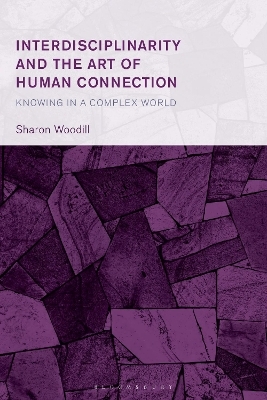
Interdisciplinarity and the Art of Human Connection
Knowing in a Complex World
Seiten
2025
Rowman & Littlefield (Verlag)
978-1-6669-4433-4 (ISBN)
Rowman & Littlefield (Verlag)
978-1-6669-4433-4 (ISBN)
Presents a re-imagining of interdisciplinary research and knowledge practices grounded in complexity theory and with an emphasis on human connection.
This book examines interdisciplinarity through the lens of complexity theory, arguing for an understanding of interdisciplinarity that embraces the wisdom of complexity and not just the idea. Sharon Woodill critiques current interdisciplinary practices as often falling short of truly embracing complexity, instead grafting complexity theory onto existing reductionist frameworks that lead to disconnection.
Drawing on principles of self-organization and emergence, this book re-imagines the interdisciplinary process and integration that results. It advocates for an “epistemology of connection” that prioritizes human relationships, diverse perspectives, and engagement with ambiguity in knowledge practices. It examines the concept of diversity as an example of interdisciplinarity grounded in a fully-fledged complexity.
Throughout, the book advocates for a shift from capture-and-control approaches to knowledge towards an understanding of knowing as a participatory, emergent process. It emphasizes the facilitation of new insights through deep engagement with the complexity of each other and the worlds we inhabit.
This book examines interdisciplinarity through the lens of complexity theory, arguing for an understanding of interdisciplinarity that embraces the wisdom of complexity and not just the idea. Sharon Woodill critiques current interdisciplinary practices as often falling short of truly embracing complexity, instead grafting complexity theory onto existing reductionist frameworks that lead to disconnection.
Drawing on principles of self-organization and emergence, this book re-imagines the interdisciplinary process and integration that results. It advocates for an “epistemology of connection” that prioritizes human relationships, diverse perspectives, and engagement with ambiguity in knowledge practices. It examines the concept of diversity as an example of interdisciplinarity grounded in a fully-fledged complexity.
Throughout, the book advocates for a shift from capture-and-control approaches to knowledge towards an understanding of knowing as a participatory, emergent process. It emphasizes the facilitation of new insights through deep engagement with the complexity of each other and the worlds we inhabit.
Sharon Woodill is associate lecturer at University of Central Florida, USA.
Introduction and Overview
Chapter 1 Reductionism and Post-Reductionism
Chapter 2 Disciplinarity and Post-Disciplinarity
Chapter 3 A Fully-Fledged Complexity
Chapter 4 Interdisciplinarity and the Self
Chapter 5 Interdisciplinarity and the Art of Human Connection
Chapter 6 Interdisciplinarity in and of Diversity Studies
Chapter 7 Knowing Differently
References
| Erscheinungsdatum | 24.07.2025 |
|---|---|
| Reihe/Serie | Collective Studies in Knowledge and Society |
| Sprache | englisch |
| Maße | 150 x 232 mm |
| Gewicht | 360 g |
| Themenwelt | Geisteswissenschaften ► Philosophie ► Erkenntnistheorie / Wissenschaftstheorie |
| Geisteswissenschaften ► Philosophie ► Logik | |
| Geisteswissenschaften ► Psychologie ► Sozialpsychologie | |
| Sozialwissenschaften ► Pädagogik ► Allgemeines / Lexika | |
| Sozialwissenschaften ► Pädagogik ► Bildungstheorie | |
| ISBN-10 | 1-6669-4433-5 / 1666944335 |
| ISBN-13 | 978-1-6669-4433-4 / 9781666944334 |
| Zustand | Neuware |
| Informationen gemäß Produktsicherheitsverordnung (GPSR) | |
| Haben Sie eine Frage zum Produkt? |
Mehr entdecken
aus dem Bereich


aus dem Bereich
die Evolution des Geistes
Buch | Softcover (2025)
Suhrkamp (Verlag)
CHF 41,95


