


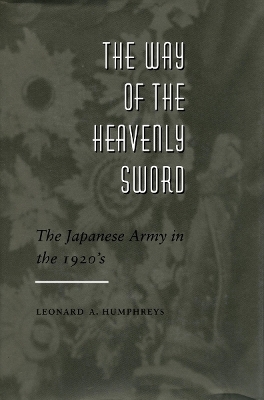
The Way of the Heavenly Sword
The Japanese Army in the 1920's
Seiten
1995
|
New edition
Stanford University Press (Verlag)
978-0-8047-2375-6 (ISBN)
Stanford University Press (Verlag)
978-0-8047-2375-6 (ISBN)
The story of the bitter political struggles within a factionalized military elite, released in the 1920's from the constraints of the informal but unified system of Imperial leadership which had characterized the military in the Meiji era.
This text examines the history of the Japanese army in the 1920s. In this decade, the 'Meija military system' disintegrated and was replaced by a new 'Imperial Army System'. The Japanese victory over Russia in 1905 had changed the direction of Japanese military thought from almost total dependence on western rational military thinking to a more traditional reliance on morale as the preponderant factor for victory in combat. The author focuses on the intense and complex struggle which took place over leadership of the Army, the application of the principle of the primacy of morale, and the quite contradictory but obvious necessity for the army to modernize. This internal turmoil was intensified by a background of increasingly difficult economic circumstances, and the terrible effects of the great earthquake and fire of 1923. This crucial decade of Japanese history set the stage for the shattering events of the 1930s and 1940s.
This text examines the history of the Japanese army in the 1920s. In this decade, the 'Meija military system' disintegrated and was replaced by a new 'Imperial Army System'. The Japanese victory over Russia in 1905 had changed the direction of Japanese military thought from almost total dependence on western rational military thinking to a more traditional reliance on morale as the preponderant factor for victory in combat. The author focuses on the intense and complex struggle which took place over leadership of the Army, the application of the principle of the primacy of morale, and the quite contradictory but obvious necessity for the army to modernize. This internal turmoil was intensified by a background of increasingly difficult economic circumstances, and the terrible effects of the great earthquake and fire of 1923. This crucial decade of Japanese history set the stage for the shattering events of the 1930s and 1940s.
1. The background to army politics 2. The army faces change 3. The changing of the guard: Ugaki comes to power 4. Reduction and modernisation: the Ugaki era 5. The growth of dissidence 6. The Manmo problem and Tayanka's positive solution 7. Jinan and Mukden: the army sets its course in China 8. Conclusion Notes Bibliography Index.
| Erscheint lt. Verlag | 1.4.1995 |
|---|---|
| Verlagsort | Palo Alto |
| Sprache | englisch |
| Maße | 152 x 229 mm |
| Themenwelt | Geschichte ► Allgemeine Geschichte ► Neuzeit (bis 1918) |
| Geschichte ► Allgemeine Geschichte ► 1918 bis 1945 | |
| Geisteswissenschaften ► Geschichte ► Regional- / Ländergeschichte | |
| Sozialwissenschaften ► Politik / Verwaltung | |
| ISBN-10 | 0-8047-2375-3 / 0804723753 |
| ISBN-13 | 978-0-8047-2375-6 / 9780804723756 |
| Zustand | Neuware |
| Informationen gemäß Produktsicherheitsverordnung (GPSR) | |
| Haben Sie eine Frage zum Produkt? |
Mehr entdecken
aus dem Bereich


aus dem Bereich
Geschichte einer wilden Handlung
Buch | Hardcover (2024)
C.H.Beck (Verlag)
CHF 47,60


