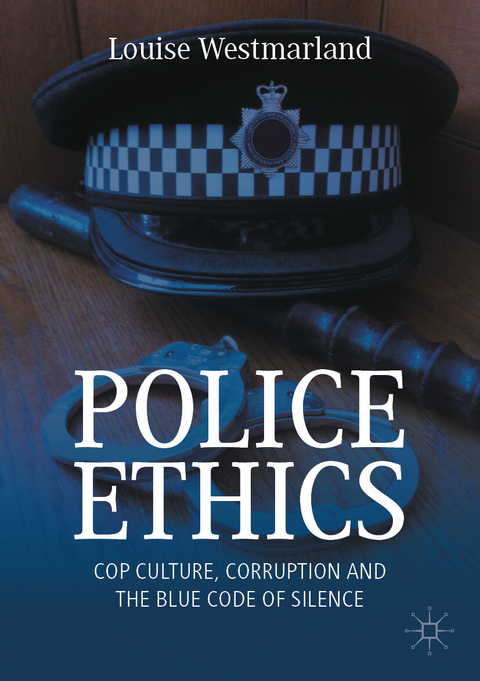
Police Ethics (eBook)
XVII, 207 Seiten
Palgrave Macmillan (Verlag)
978-3-031-85100-1 (ISBN)
"This book is an important analysis of how police themselves define and respond to police corruption and wrongdoing. It offers special insights into this hard to research issue because it is based on using similar techniques of study on samples of police over time and in different jurisdictions, all linked by an autoethnographic account by Professor Westmarland — an internationally celebrated expert on the topic — narrating her engagement with the problems of police corruption and culture. This provides a revealing account of variations over time and between places. Clearly and engagingly written this is essential reading for students, scholars, practitioners and policy makers concerned about policing and its legitimacy."
-Robert Reiner, Emeritus Professor of Criminology, LSE
"This is a lively and fascinating book which places our understanding of policing ethics, integrity and police corruption within a long term timeline. The author traces how a particular research technique within policing studies - the use of 'scenario' based surveys of police officers to test officers' attitudes to the seriousness of a series of possible forms of police misconduct and their willingness to report those forms to others - has been utilised in policing research over a 50 plus year history. It begins with US-based pioneering policing research in the 1970s and takes us through the use of, and lessons learnt by, scenario-based research in later decades in the UK and internationally. This includes, by way of an autoethnography, the author's own critical research over the past 20 years, revisiting some earlier published research on the theme. This book is essential reading for those studying police integrity and corruption and the wider field of police cultures."
- Professor Steve Savage, Emeritus Professor of Criminology, University of Portsmouth.
This book outlines over 20 years of in-depth research on police culture and the blue code of silence which is said to protect and perpetuate police misconduct. It discusses the existing literature and draws upon first-hand research with many serving police officers and some police support staff. These studies not only provide evidence of the police code but are also useful for examining why and how to prevent its ill-effects. A recent (post 1950s) history of police cultural research which concentrates on ethics and integrity is provided with reflections on change and a discussion of the College of Policing’s introduction of a code of ethics in 2014. It asks whether anything has changed but mainly analyses the individual studies and what the potential lessons learnt are from the various scandals that have come to light. The questionnaires and research instruments used are included in the text for replication purposes, and alongside this, the ethics of such studies are discussed. This book will speak to police officers including those enrolled on police degrees, policing scholars and students, and criminologists.
Louise Westmarland is Professor of Criminology at The Open University, UK.
| Erscheint lt. Verlag | 12.5.2025 |
|---|---|
| Zusatzinfo | XVII, 207 p. 8 illus., 7 illus. in color. |
| Sprache | englisch |
| Themenwelt | Geisteswissenschaften ► Philosophie ► Ethik |
| Recht / Steuern ► Allgemeines / Lexika | |
| Recht / Steuern ► Strafrecht | |
| Sozialwissenschaften ► Soziologie | |
| Schlagworte | Accountability • police code of ethics • police culture • Police Integrity • Police Misconduct • policing • research ethics • researching the police • Sociology of Culture |
| ISBN-10 | 3-031-85100-5 / 3031851005 |
| ISBN-13 | 978-3-031-85100-1 / 9783031851001 |
| Informationen gemäß Produktsicherheitsverordnung (GPSR) | |
| Haben Sie eine Frage zum Produkt? |
 PDF (Wasserzeichen)
DRM: Digitales Wasserzeichen
Dieses eBook enthält ein digitales Wasserzeichen und ist damit für Sie personalisiert. Bei einer missbräuchlichen Weitergabe des eBooks an Dritte ist eine Rückverfolgung an die Quelle möglich.
Dateiformat: PDF (Portable Document Format)
Mit einem festen Seitenlayout eignet sich die PDF besonders für Fachbücher mit Spalten, Tabellen und Abbildungen. Eine PDF kann auf fast allen Geräten angezeigt werden, ist aber für kleine Displays (Smartphone, eReader) nur eingeschränkt geeignet.
Systemvoraussetzungen:
PC/Mac: Mit einem PC oder Mac können Sie dieses eBook lesen. Sie benötigen dafür einen PDF-Viewer - z.B. den Adobe Reader oder Adobe Digital Editions.
eReader: Dieses eBook kann mit (fast) allen eBook-Readern gelesen werden. Mit dem amazon-Kindle ist es aber nicht kompatibel.
Smartphone/Tablet: Egal ob Apple oder Android, dieses eBook können Sie lesen. Sie benötigen dafür einen PDF-Viewer - z.B. die kostenlose Adobe Digital Editions-App.
Buying eBooks from abroad
For tax law reasons we can sell eBooks just within Germany and Switzerland. Regrettably we cannot fulfill eBook-orders from other countries.
aus dem Bereich