


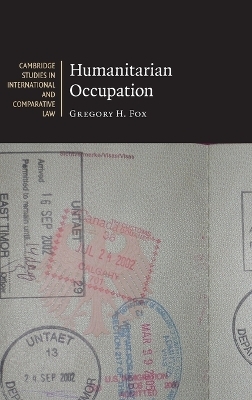
Humanitarian Occupation
Seiten
2008
Cambridge University Press (Verlag)
978-0-521-85600-3 (ISBN)
Cambridge University Press (Verlag)
978-0-521-85600-3 (ISBN)
This book analyzes the new phenomenon of international organizations assuming the powers of a national government in order to reform political institutions. After reviewing the history of internationalized territories, this book examines why these 'humanitarian occupations' occurred and whether they were legally justified.
This book analyzes a new phenomenon in international law: international organizations assuming the powers of a national government in order to reform political institutions. After reviewing the history of internationalized territories, this book asks two questions about these 'humanitarian occupations'. First, why did they occur? The book argues that the missions were part of a larger trend in international law to maintain existing states and their populations. The only way this could occur in these territories, which had all seen violent internal conflict, was for international administrators to take charge. Second, what is the legal justification for the missions? The book examines each of the existing justifications and finds them wanting. A new foundation is needed, one that takes account of the missions' authorisation by the UN Security Council and their pursuit of goals widely supported in the international community.
This book analyzes a new phenomenon in international law: international organizations assuming the powers of a national government in order to reform political institutions. After reviewing the history of internationalized territories, this book asks two questions about these 'humanitarian occupations'. First, why did they occur? The book argues that the missions were part of a larger trend in international law to maintain existing states and their populations. The only way this could occur in these territories, which had all seen violent internal conflict, was for international administrators to take charge. Second, what is the legal justification for the missions? The book examines each of the existing justifications and finds them wanting. A new foundation is needed, one that takes account of the missions' authorisation by the UN Security Council and their pursuit of goals widely supported in the international community.
Gregory H. Fox is Associate Professor of Law (tenured) at Wayne State University Law School, where he is the Inaugural Cohn Family Scholar in Legal History.
Introduction; Part I. Historical Antecedents: 1. The historical origins of humanitarian occupation I - Governance in Service of Outsiders; 2. Historical origins of humanitarian occupation II - internationalised territory in the service of insiders; 3. Full international governance; Part II. Why Humanitarian Occupation?: 4. Rejected models of statehood; 5. Constructing the liberal state; Part III. Legal Justifications: 6. Conventional legal justifications; 7. The international law of occupation; 8. Reforming the law: the security council as legislator; 9. Conclusion.
| Erscheint lt. Verlag | 21.2.2008 |
|---|---|
| Reihe/Serie | Cambridge Studies in International and Comparative Law |
| Verlagsort | Cambridge |
| Sprache | englisch |
| Maße | 158 x 234 mm |
| Gewicht | 662 g |
| Themenwelt | Recht / Steuern ► EU / Internationales Recht |
| Recht / Steuern ► Öffentliches Recht ► Völkerrecht | |
| Sozialwissenschaften ► Politik / Verwaltung ► Europäische / Internationale Politik | |
| ISBN-10 | 0-521-85600-0 / 0521856000 |
| ISBN-13 | 978-0-521-85600-3 / 9780521856003 |
| Zustand | Neuware |
| Informationen gemäß Produktsicherheitsverordnung (GPSR) | |
| Haben Sie eine Frage zum Produkt? |
Mehr entdecken
aus dem Bereich

aus dem Bereich
Die Rechtsprechung des Gerichtshofs der Europäischen Union, deutscher …
Buch | Softcover (2025)
Nomos (Verlag)
CHF 53,50


