


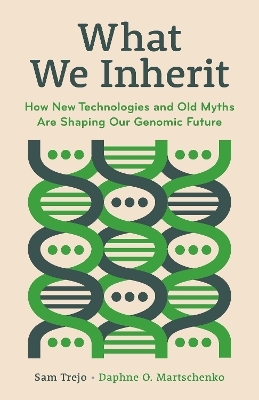
What We Inherit
How New Technologies and Old Myths Are Shaping Our Genomic Future
Seiten
2026
Princeton University Press (Verlag)
978-0-691-23775-6 (ISBN)
Princeton University Press (Verlag)
978-0-691-23775-6 (ISBN)
- Noch nicht erschienen (ca. Februar 2026)
- Versandkostenfrei
- Auch auf Rechnung
- Artikel merken
Debating the use of genomic tools and their societal impact
Over the past decade, the field of human genetics has produced an extraordinary range of discoveries—including the refinement of polygenic scores, which use a person's DNA to estimate their likelihood of developing a trait or disease. But are these new technologies ready to leave the research lab and be deployed in schools, fertility clinics, and the wider world? In What We Inherit, Sam Trejo and Daphne Martschenko offer different perspectives on the societal impact of the rapidly unfolding DNA revolution. Trejo, a sociologist and expert on the complex ways people’s genes influence their life’s trajectory, believes that new genomic tools—if used thoughtfully—can improve society; Martschenko, a bioethicist who specializes in the thorny social issues raised by biomedical advances, is more cautious. They debate both the risks and the opportunities posed by such new technologies as at-home genetic tests and polygenic embryo selection—all while engaging in a wide-ranging dialogue on ideology, biology, and social inequality.
While grappling with these new technologies, Trejo and Martschenko remind us that we inherited from our ancestors not only DNA but also wrongheaded ideas about genes. Together, they caution against two particularly harmful genetic myths: that genes determine an individual’s future, and that race and genetics are inherently connected. A polygenic score, for example, is not a definitive marker for disease. And race is a sociopolitical construct, not a biological identity. Trejo and Martschenko argue that, to avoid exacerbating social inequality, we need to begin regulating genomic tools sooner rather than later.
Over the past decade, the field of human genetics has produced an extraordinary range of discoveries—including the refinement of polygenic scores, which use a person's DNA to estimate their likelihood of developing a trait or disease. But are these new technologies ready to leave the research lab and be deployed in schools, fertility clinics, and the wider world? In What We Inherit, Sam Trejo and Daphne Martschenko offer different perspectives on the societal impact of the rapidly unfolding DNA revolution. Trejo, a sociologist and expert on the complex ways people’s genes influence their life’s trajectory, believes that new genomic tools—if used thoughtfully—can improve society; Martschenko, a bioethicist who specializes in the thorny social issues raised by biomedical advances, is more cautious. They debate both the risks and the opportunities posed by such new technologies as at-home genetic tests and polygenic embryo selection—all while engaging in a wide-ranging dialogue on ideology, biology, and social inequality.
While grappling with these new technologies, Trejo and Martschenko remind us that we inherited from our ancestors not only DNA but also wrongheaded ideas about genes. Together, they caution against two particularly harmful genetic myths: that genes determine an individual’s future, and that race and genetics are inherently connected. A polygenic score, for example, is not a definitive marker for disease. And race is a sociopolitical construct, not a biological identity. Trejo and Martschenko argue that, to avoid exacerbating social inequality, we need to begin regulating genomic tools sooner rather than later.
Sam Trejo is assistant professor of sociology at Princeton University, where he holds the Charles H. McIlwain University Preceptorship. Daphne O. Martschenko is assistant professor of biomedical ethics at Stanford University.
| Erscheint lt. Verlag | 3.2.2026 |
|---|---|
| Zusatzinfo | 17 b/w illus. 4 tables. |
| Verlagsort | New Jersey |
| Sprache | englisch |
| Maße | 140 x 216 mm |
| Themenwelt | Naturwissenschaften ► Biologie ► Genetik / Molekularbiologie |
| Naturwissenschaften ► Biologie ► Humanbiologie | |
| Sozialwissenschaften ► Soziologie | |
| ISBN-10 | 0-691-23775-1 / 0691237751 |
| ISBN-13 | 978-0-691-23775-6 / 9780691237756 |
| Zustand | Neuware |
| Informationen gemäß Produktsicherheitsverordnung (GPSR) | |
| Haben Sie eine Frage zum Produkt? |
Mehr entdecken
aus dem Bereich



aus dem Bereich
Theorien, Modelle, Methoden
Buch | Softcover (2024)
Springer Fachmedien (Verlag)
CHF 34,90
50 Meilensteine der Genetik
Buch | Hardcover (2022)
Librero b.v. (Verlag)
CHF 13,90


