


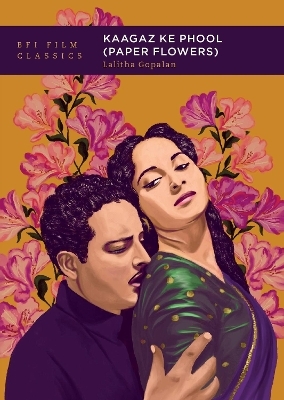
Kaagaz Ke Phool (Paper Flowers)
Seiten
2025
BFI Publishing (Verlag)
978-1-83902-706-2 (ISBN)
BFI Publishing (Verlag)
978-1-83902-706-2 (ISBN)
A study of Guru Dutt's romantic melodrama Kaagaz Ke Phool (1959) in the BFI Film Classics series.
Guru Dutt’s final film as a director, Kaagaz Ke Phool/Paper Flowers (1959), follows the successful film-maker Suresh Sinha (played by Dutt himself) as rumours of his affair with his actress Shanti (Waheeda Rehman) lead him to lose his family, descend into alcoholism and ultimately retreat from the film industry. Initially met with critical and commercial failure, the film is now revered for its technical prowess and considered one of the finest self-reflexive works in Indian cinema.
Lalitha Gopalan explores Kaagaz’s innovative visual style, being the first Indian film shot in CinemaScope, highlighting cinematographer V. K. Murthy’s essential contribution. She also analyses the soundtrack, composed by S. D. Burman with lyrics by Kaifi Azmi, examining the now-classic picturisations of songs such as ‘Waqt Ne Kiya Kya Haseen Sitam’. Drawing on interviews with practitioners and people close to Dutt, Gopalan reconstructs the original contexts of the film’s production and reception. Finally, using Kagaaz as a lens, she assesses Dutt’s influence on popular Indian cinema during the 1950s, as well as on global film melodrama more broadly.
Guru Dutt’s final film as a director, Kaagaz Ke Phool/Paper Flowers (1959), follows the successful film-maker Suresh Sinha (played by Dutt himself) as rumours of his affair with his actress Shanti (Waheeda Rehman) lead him to lose his family, descend into alcoholism and ultimately retreat from the film industry. Initially met with critical and commercial failure, the film is now revered for its technical prowess and considered one of the finest self-reflexive works in Indian cinema.
Lalitha Gopalan explores Kaagaz’s innovative visual style, being the first Indian film shot in CinemaScope, highlighting cinematographer V. K. Murthy’s essential contribution. She also analyses the soundtrack, composed by S. D. Burman with lyrics by Kaifi Azmi, examining the now-classic picturisations of songs such as ‘Waqt Ne Kiya Kya Haseen Sitam’. Drawing on interviews with practitioners and people close to Dutt, Gopalan reconstructs the original contexts of the film’s production and reception. Finally, using Kagaaz as a lens, she assesses Dutt’s influence on popular Indian cinema during the 1950s, as well as on global film melodrama more broadly.
Lalitha Gopalan is Associate Professor of Film Studies at the University of Texas at Austin, USA. She is the author of Cinema of Interruptions: Action Genres in Contemporary Indian Cinema (BFI, 2002), Bombay (BFI Modern Classics, 2005), and Cinemas Dark and Slow in Digital India (2021).. She is the editor of The Cinema of India (2010) and has published widely on Indian cinema in journals including Screen, New Cinemas: Journal of Contemporary Film and Film Quarterly.
Acknowledgements
1.1959
2.Reception
3.Biography
4.Backstory
5.Style
6.Cinematography
7.V.K. Murthy
8.Work, Studio, Cinema
9.Notes
| Erscheinungsdatum | 12.11.2025 |
|---|---|
| Reihe/Serie | BFI Film Classics |
| Zusatzinfo | 60 bw illus |
| Sprache | englisch |
| Maße | 312 x 188 mm |
| Gewicht | 167 g |
| Themenwelt | Kunst / Musik / Theater ► Film / TV |
| Sozialwissenschaften ► Kommunikation / Medien ► Medienwissenschaft | |
| ISBN-10 | 1-83902-706-1 / 1839027061 |
| ISBN-13 | 978-1-83902-706-2 / 9781839027062 |
| Zustand | Neuware |
| Informationen gemäß Produktsicherheitsverordnung (GPSR) | |
| Haben Sie eine Frage zum Produkt? |
Mehr entdecken
aus dem Bereich


aus dem Bereich


