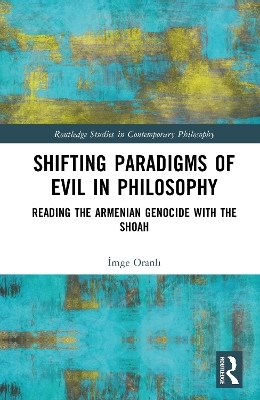
Shifting Paradigms of Evil in Philosophy
Routledge (Verlag)
978-1-041-05269-2 (ISBN)
This book develops an interdisciplinary framework rooted in philosophy for addressing the political evils experienced around the world. Drawing on resources mainly from philosophy and historical studies, it argues for the relationality and continuity between political evils, using the Armenian Genocide and the Shoah as main examples.
The book begins by unpacking a series of limiting assumptions that define the philosophical study of evil. These assumptions crystallize in the idea that evil is an inscrutable phenomenon, what the author calls the paradigm of evil’s inscrutability. Tracing this paradigm through the legacies of five key philosophers—Plato, Augustine, Kant, Arendt, and Levinas—the author shows that by the time we arrive at 20th century, the framing of political evils like the Shoah as inscrutable and exceptional is profoundly constraining; it erases Shaoh's continuity and connection with other atrocities, including the 1915 Armenian Genocide. The book next turns to practices and ideologies that connect the Armenian Genocide to the Shoah to propose an alternative paradigm for thinking about evil: a paradigm of the continuity of evils. Offering this paradigm to readers in philosophy and adjacent disciplines, the author explores the relationality between the Armenian Genocide and the Shoah, but also between Turkish genocide denialism and a contemporary case of racist evildoing against Armenians in Turkey, shifting the discussion of political evil in a direction that aims to turn overlooked evils around the world into objects of philosophical thinking.
Shifting Paradigms of Evil in Philosophy will appeal to researchers and graduate students working in Continental philosophy, social and political philosophy, history of philosophy, ethics, political theory, genocide studies, and Holocaust studies.
İmge Oranlı is an assistant professor of philosophy at Arizona State University. Her publications include “Fanon’s Frame of Violence: Undoing the Instrumental/Non-Instrumental Binary.” Interventions: International Journal of Postcolonial Studies 23, no. 8 (2021): 1106–23, and “Epistemic Injustice from Afar: Rethinking the Denial of Armenian Genocide.” Social Epistemology 35, no. 2 (2021): 120–32.
Introduction 1. The Origins of Evil’s Inscrutability: Plato, Augustine, and Kant 2. Inscrutable Evil in Continental Philosophy: Arendt and Levinas 3. Continuity of Evils: The Armenian Genocide and the Shoah 4. An Alternative Reading of Banality of Evil: The Armenian Genocide and Dr. Mehmed Reshid 5. The Non-Recognition of an Atrocity and The Evils of Turkish Genocide Denialism Conclusion
| Erscheinungsdatum | 12.09.2025 |
|---|---|
| Reihe/Serie | Routledge Studies in Contemporary Philosophy |
| Verlagsort | London |
| Sprache | englisch |
| Maße | 152 x 229 mm |
| Gewicht | 500 g |
| Themenwelt | Geisteswissenschaften ► Philosophie ► Geschichte der Philosophie |
| Geisteswissenschaften ► Philosophie ► Philosophie der Neuzeit | |
| Sozialwissenschaften | |
| ISBN-10 | 1-041-05269-3 / 1041052693 |
| ISBN-13 | 978-1-041-05269-2 / 9781041052692 |
| Zustand | Neuware |
| Informationen gemäß Produktsicherheitsverordnung (GPSR) | |
| Haben Sie eine Frage zum Produkt? |
aus dem Bereich