


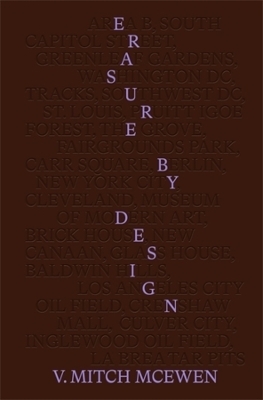
Erasure by Design
Racial Protocols of Displacement, Demolition, and Extraction
Seiten
2026
Columbia Books on Architecture and the City (Verlag)
978-1-941332-85-6 (ISBN)
Columbia Books on Architecture and the City (Verlag)
978-1-941332-85-6 (ISBN)
- Noch nicht erschienen (ca. März 2026)
- Portofrei ab CHF 40
- Auch auf Rechnung
- Artikel merken
How has erasure formed the space around us? How do we come to know it, so that we can design differently? Erasure by Design tracks the methods, terms, and racial protocols that continue to do the work of displacement, demolition, and extraction into the present day.
This book travels back and forth in time through scenes of erasure at three primary locations—Southwest, Washington DC (displacement); North St Louis (demolition), and South Los Angeles (extraction). Erasure by Design shares first person narratives of growing up in the wake of slum clearance—that is, “urban renewal”—in Southwest, Washington DC, while assembling archival references that narrate racialized erasure and its legal and spatial precedents. It traces a military complex under construction, where St Louis’s cleared grounds and blacked out sites are also defined by satellites, body experiments, explosions, and emptiness. It moves through specific grounds in Los Angeles—dirt walls, hills, oil fields, gas lines, and houses in the forest—to trace how those grounds matter and how their holding intersects with maps that plan erasure, inhabitation, and extraction.
Between these three scenes, Erasure by Design takes on the aesthetics of bad design and good design, as innovated within the intellectual domain of modern architecture at the Museum of Modern Art and Philip Johnson’s Glass House. Through a curated cockroach at MoMA—and even the humor, rumors, and gossip about this roach—Erasure by Design reads the role that the museum invents for exhibiting, curating, and re-shaping policy, worldview, and the built environment, as well as how protocols of erasure, demolition, and design conscript the modern built environment into the policing of human and subhuman. In this nuanced reading, the Glass House and its twin, the Brick House, stage a haunting allegory of total violence.
This book travels back and forth in time through scenes of erasure at three primary locations—Southwest, Washington DC (displacement); North St Louis (demolition), and South Los Angeles (extraction). Erasure by Design shares first person narratives of growing up in the wake of slum clearance—that is, “urban renewal”—in Southwest, Washington DC, while assembling archival references that narrate racialized erasure and its legal and spatial precedents. It traces a military complex under construction, where St Louis’s cleared grounds and blacked out sites are also defined by satellites, body experiments, explosions, and emptiness. It moves through specific grounds in Los Angeles—dirt walls, hills, oil fields, gas lines, and houses in the forest—to trace how those grounds matter and how their holding intersects with maps that plan erasure, inhabitation, and extraction.
Between these three scenes, Erasure by Design takes on the aesthetics of bad design and good design, as innovated within the intellectual domain of modern architecture at the Museum of Modern Art and Philip Johnson’s Glass House. Through a curated cockroach at MoMA—and even the humor, rumors, and gossip about this roach—Erasure by Design reads the role that the museum invents for exhibiting, curating, and re-shaping policy, worldview, and the built environment, as well as how protocols of erasure, demolition, and design conscript the modern built environment into the policing of human and subhuman. In this nuanced reading, the Glass House and its twin, the Brick House, stage a haunting allegory of total violence.
V. Mitch McEwen is an assistant professor at Princeton University’s School of Architecture and principal of Harlem-based design practice Atelier Office. She is one of ten co-founders of the Black Reconstruction Collective. McEwen’s design work has been exhibited at the Museum of Contemporary Art Detroit, Museum of Modern Art, and the Venice Architecture Biennale.
| Erscheinungsdatum | 04.11.2025 |
|---|---|
| Zusatzinfo | 80 color images |
| Sprache | englisch |
| Maße | 133 x 203 mm |
| Themenwelt | Sozialwissenschaften ► Ethnologie |
| Sozialwissenschaften ► Soziologie | |
| Technik ► Architektur | |
| Technik ► Bauwesen | |
| ISBN-10 | 1-941332-85-4 / 1941332854 |
| ISBN-13 | 978-1-941332-85-6 / 9781941332856 |
| Zustand | Neuware |
| Informationen gemäß Produktsicherheitsverordnung (GPSR) | |
| Haben Sie eine Frage zum Produkt? |
Mehr entdecken
aus dem Bereich



aus dem Bereich
Prolegomena zu einer Geschichte der Magie
Buch | Hardcover (2025)
Matthes & Seitz Berlin (Verlag)
CHF 53,20
ethnographische Texte
Buch | Hardcover (2025)
Konstanz University Press (Verlag)
CHF 36,40
Buch | Hardcover (2021)
Konstanz University Press (Verlag)
CHF 39,20


