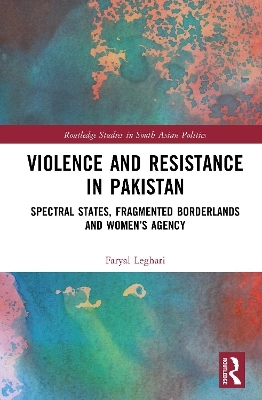
Violence and Resistance in Pakistan
Routledge (Verlag)
978-1-041-01584-0 (ISBN)
This book examines violence and political developments in the western borderland communities of Pakistan, a postcolonial militarist state in the Global South, through the lens of gendered experiences of insecurity. It provides a fresh perspective on comprehending the perception and experience of security among individuals, uncovering the role of gender hierarchies and gendered hierarchies in shaping state policies and personal encounters with security and violence.
Based on ground-based qualitative research, in-depth interviews with Mahsud men and women, military and government officials, academics, security experts and aid organisation officials, each chapter foregrounds an analysis of militarisation, violence, and resistance through varied thematic lens. The result is a rich and original study of Waziristan where conflict and security are presented through a feminist geopolitical perspective, calling for fresh comprehensions of gendered understandings of militarisation and security and a reappraisal of vulnerable populations.
Addressing a gap in the literature regarding the relationship between state-peripheral communities, violence, security, and militarisation in the Global South, this book analyses power relations through a gendered lens and explores the impact of armed violence in everyday life. It will be of interest to researchers in the field of regional geopolitical and security studies, postcolonial states and militarisation in the Global South, as well as borderland studies, gender studies, and South Asian studies.
Faryal Leghari is a researcher, writer, political and security analyst, former journalist, and deputy opinion editor. She completed her DPhil from Oxford University in 2024 in feminist political geography. Faryal’s interest in politics, IR, counterterrorism, and feminist geography has seen her pursuing different education and career paths in these fields. Faryal identifies as a Pakistani Baloch and Pakhtun woman from the Koh-i-Suleiman tribal areas, which border southern Punjab. Faryal is an advocate for women’s education and career development. Faryal was among the first women polo players in Pakistan.
Introduction. Part I: Deconstructing the Narratives of Militarisation and Security in Waziristan Chapter 1: Militarisation in the Periphery. Chapter 2: The Mahsud, the Taliban and the Spectral State: Response, Resilience, Resistance and Review. Chapter 3: Heart of Darkness: Violence and Insecurity in Waziristan. Part II: Stepping out from the Shadow of the Gun Chapter 4: Mahsud Women’s Chronicles of Violence in Waziristan: Honour, female bodies, and the state. Chapter 5: The Fragmented Body and Politics of Rubble: A Singular Interpretation of Resistance. Part III: Geographies of Loss and Hope: Mahsud women’s response to political and security changes Chapter 6: Geographies of Loss: Impact of Militarisation, Conflict, and Displacements on Mahsud women. Chapter 7: Geographies of Hope (Anticipations): Testaments from the Ruins of War and Peace. Conclusion
| Erscheinungsdatum | 12.09.2025 |
|---|---|
| Reihe/Serie | Routledge Studies in South Asian Politics |
| Zusatzinfo | 4 Tables, black and white; 8 Halftones, black and white; 8 Illustrations, black and white |
| Verlagsort | London |
| Sprache | englisch |
| Maße | 156 x 234 mm |
| Gewicht | 620 g |
| Themenwelt | Sozialwissenschaften ► Politik / Verwaltung ► Europäische / Internationale Politik |
| Sozialwissenschaften ► Soziologie ► Spezielle Soziologien | |
| ISBN-10 | 1-041-01584-4 / 1041015844 |
| ISBN-13 | 978-1-041-01584-0 / 9781041015840 |
| Zustand | Neuware |
| Informationen gemäß Produktsicherheitsverordnung (GPSR) | |
| Haben Sie eine Frage zum Produkt? |
aus dem Bereich