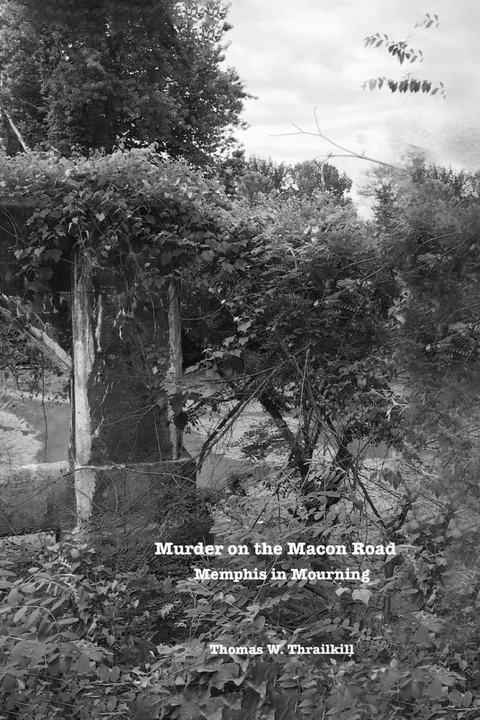
Murder on the Macon Road (eBook)
236 Seiten
Bookbaby (Verlag)
979-8-3178-0026-0 (ISBN)
Thomas Thrailkill is a new author from Florida with family ties to Memphis. 'Murder on the Macon Road' is his debut book.
Antoinette Rappel, a 15 year old white girl, rode her bicycle every school day to the Treadwell School in downtown Memphis, several miles each way. When she went missing for several days, a search party discovered her body decapitated and sexually assaulted near the Wolf River Bridge along the Macon Road. One witness to the murder included one of the black woodcutters who lived in the vicinity of the murder scene. He was both deaf and mute. The murder investigation is headed up by Shelby County Sheriff Mike Tate working alongside the Memphis Police Department's best detective team of Charley Brunner and John Walter Hoyle. The Memphis police, led by Detective Hoyle, focus on a "e;white man theory"e; to the crime based on evidence they have uncovered. The Sheriff is solely focused on the black woodcutters in the vicinity. As the investigation continues, a suspect who has been arrested and brought in for questioning before, is arrested a third time and ultimately confesses to the crime. The suspect, also a black woodcutter named Ell Persons, confesses to the crime under suspicious circumstances. The confession comes quickly under coerced circumstances. Fearing mob violence, Ell Persons is safely whisked away to Nashville by train for safekeeping under cover of night. However, before he can be brought safely back to Memphis over a week later, the mob captures him on the train on the way back in nearby Mississippi and brings him to the original murder site of Antoinette Rappel where he is brutally lynched in front of 5,000 onlookers from the surrounding area of Memphis. The story follows the impact of one of the most brutal lynchings in history and the life of Detective Hoyle
Chapter 2
Brunner & Hoyle
Charles August Brunner and John Walter Hoyle
The News Scimitar proudly reported on October 13, 1913 that “Efficient service earned its reward Monday morning when J.W. Hoyle, a motorcycle patrolman, received an appointment as a member of the detective force at Central Police Headquarters. He succeeds P.J. Covey in the plain clothes department.” The Commercial Appeal, competing newspaper in Memphis, also reported “J.W. Hoyle, who has been a most efficient and active member of the motorcycle squad and the special duty squad for the past two years, was yesterday appointed to the city detective force.”
Charles August Brunner had joined the Memphis Police Department in 1904 as a patrolman at age 40. The stocky, 49 year Brunner, who spoke with an accent from those of the New York City area of the country, hailed from Philadelphia. He was 12 years older than his junior partner, yet they both had roughly the same amount of detective experience. Charley Brunner had been driving a horse-drawn delivery wagon around Memphis prior to joining the department. It took him three times as long as Hoyle to be promoted to the rank of detective, so the new team of “Brunner & Hoyle” had little investigation experience compared to other Memphis sleuths of the day. However, the duo would become a legend in Memphis, the likes of which would only be matched by the team of Izzy and Moe from the Prohibition Era in the 1920s.
Isidor “Izzy” Einstein and Moe W. Smith, two middle-aged prohibition agents in New York, had amassed nearly 5,000 arrests for bartenders, bootleggers and speak easy owners and sported a 95% conviction rate between 1920 and 1925. The great comedy team of Jackie Gleason and Art Carney memorialized Einstein, a street peddler and mail clerk, and Smith, a cigar store owner, in the 1985 fictional movie called Izzy and Moe.
It was at the Barksdale Station, at 35, that John Walter Hoyle would become a police officer. Hoyle joined the force as one of its first motorcycle patrolmen. Officer Hoyle’s stint as a motorcycle patrolman had a rough beginning in July 1911, just three months after joining the department. Responding with another officer to a report that stated “a bad negro was having his own way at 432 Beale Street”, he made a turn on Lauderdale. Hoyle’s “machine” collided with a horse and buggy driven by Charles Bloom, causing him to be thrown and suffer an injury to his scalp that also rendered him unconscious. As covered in the Commercial Appeal the following morning, “The horse was not badly hurt, but the motorcycle was put out of commission”.
Just two months later, on September 17, 1911, a headline in the Commercial Appeal the following day read:
Motorcycle Officer Wounds Bad Negro
Walter Newman, a mail clerk, was on his way home from church with his wife on Pontotoc Avenue. He heard the screams of two little black children. A big burley man was chasing them and Newman intervened. “Infuriated by the interference and crazed with cocaine and whiskey” according to the article, the man, Ed Hayes, grabbed Newman and began fighting with him. Mrs. Newman went into a nearby house and called the police, who immediately dispatched patrolmen Ward and Hoyle. When the officers arrived, Hayes immediately went for Hoyle and was choking him and had brought him to his knees. Hoyle reached for his gun and shot Hayes in the stomach. According to witnesses, Hoyle was justified in his actions and was further backed by Captain Perry of the Memphis Police Department.
The following day, Mayor Crump suspended Office J.W. Hoyle pending an investigation. They did not expect Ed Hayes to live. Crump made it clear to the citizens of Memphis that he intended a thorough investigation of all such shootings, whether the victim be white or black. Whether it was for political support or otherwise, Crump stated:
“The surface evidence, which is the first always to reach the department would indicate the officer was justifiable in shooting the negro, but I want a thorough investigation, not only of this case, but of all other cases of this kind which may come up in the future. So far as it lies in the power of the administration, we mean to discourage any shooting unless it is absolutely necessary, and every honorable means will be used to impress the fact on the police department. We want men cool enough and brave enough to know when it is necessary to use a gun in making an arrest.”
Three days later, the Mayor’s office received a letter from an eyewitness who witnessed the shooting of Hayes by Hoyle, R. M. Henry. Henry had said “that the conduct of the officer, in his opinion, was necessary to save the lives of other citizens, which were endangered by the conduct of the negro”. Crump lifted the suspension without police conducting an investigation, and reinstated Hoyle. Another patrolman who had shot and killed a black man a few weeks prior received reinstatement. Ed Hayes died from his wounds on the 17th.
Patrolman Hoyle continued to garner the approval and respect of his superiors by the number of his arrests and citations he wrote for traffic violations. The department brass cited him for efficiency and described by those he came in contact with as a “brave, cautious and courteous” officer. He had another brush with a serious injury in the summer of 1913. While chasing two drunken men in a car, Hoyle’s motorcycle catapulted him over 30 feet in the air while he was traveling at speeds of over 70 mph around a turn in the road. Fortunately, Hoyle did not suffer major injuries, but he contributed to another motorcycle casualty for the department, resulting in the organization having to acquire yet another machine. That well could have played in the department’s decision to promote Hoyle just three months hence.
Described as the “best detective team” on the Memphis Police force in 1916, the pair were not immune to the city politics or the Edwin H. “Boss” Crump powerful political machine. After being ousted in 1915, Mayor Crump retained control of Memphis politics and targeted his enemies. One of those who had betrayed his former boss was Chief of Police, W.J. Hayes. Hayes testified in the ouster of Sheriff J.A. Riechman, that Crump had collected huge amounts of cash from gambling houses and saloons in return for letting them stay open, while the police looked the other way. Crump had paid one dollar to many black voters for voter registration ballots, influencing them to vote his way and often vote multiple times. The city of Memphis during the Crump era likely was more corrupt than any city in the United States. A gambler by the name of Col. Mike Brasnahan, who contributed money at the instructions of Mayor Crump to a city administrator, was in town the month of April 1916. He had close ties to W.J. Hayes and supported him as the next sheriff of Shelby County, and had made that clear. When ex Mayor Crump heard this information, he asked the Memphis police to arrest Brasnahan and run him out of town or at least harass him.
Chief of Police Hayes had been replaced by Chief Oliver Perry, who had interviewed Brasnahan before trying to get something on former chief W. J. Hayes. When Bresnahan said he had nothing on Hayes and fully supported the former chief, Perry instructed him to leave Memphis immediately.
Mike Bresnahan, called Colonel Brasnahan, had run a successful gambling operation in Memphis before and was a well-known gambler with connections. Knowing he was in town, Chief Oliver Perry assigned detectives Brunner and Hoyle to follow him relentlessly and arrest him on vagrancy charges if they had to just to bring him in. Brasnahan decided one day to attend a minor league baseball game between the Memphis Chickasaws and the Chattanooga Lookouts of the Southern League. Police Commissioner W.T. McLain was also at the game and extended Mike his hand in greeting. Around the eighth inning, Hoyle and Brunner approached Mike Brasnahan and informed him they were arresting him on a vagrancy charge which typically carried a $10 fine. They let him know the yellow paddy wagon had already been called for as they begin their exit out of the ballpark and walked east on Madison to South Dudley. Brasnahan, knowing the police station was in the other direction, questioned the detectives why they were taking him the opposite way. As Charley Brunner was apologizing to Brasnahan for the petty arrest, an auto swung close by and stopped near the three men. Inside the car with a tip of his hat clearly seen through the window was ex Mayor Edward H. Crump, accompanied by Harry Kelly from City Hall. “It must have seemed a Roman holiday for Mister Crump. “If he could go back 2,000 years, he might have been able to brush up enough good current Latin to turn to Harry and say “habet” quoted the Commercial Appeal the following day. A term in ancient Rome used when announcing that a gladiator had been wounded. Brasnahan had once been in pretty good with the boys down at City Hall and would fight the charge, but not the police. Both Hoyle and Brunner, under the influence of the still powerful “Boss” Crump, had been assigned to watch Brasnahan for a week prior to the arrest and make their move when they could. The Commercial Appeal would note that this is how the police use two of the department’s best detectives, who were each making $200 per month, as opposed to fighting actual crime. Both Hoyle and Brunner would be on both sides of political squabbles for the next...
| Erscheint lt. Verlag | 12.5.2025 |
|---|---|
| Sprache | englisch |
| Themenwelt | Sozialwissenschaften ► Politik / Verwaltung |
| ISBN-13 | 979-8-3178-0026-0 / 9798317800260 |
| Informationen gemäß Produktsicherheitsverordnung (GPSR) | |
| Haben Sie eine Frage zum Produkt? |
 EPUB (Ohne DRM)
Größe: 11,7 MB
Digital Rights Management: ohne DRM
Dieses eBook enthält kein DRM oder Kopierschutz. Eine Weitergabe an Dritte ist jedoch rechtlich nicht zulässig, weil Sie beim Kauf nur die Rechte an der persönlichen Nutzung erwerben.
Dateiformat: EPUB (Electronic Publication)
EPUB ist ein offener Standard für eBooks und eignet sich besonders zur Darstellung von Belletristik und Sachbüchern. Der Fließtext wird dynamisch an die Display- und Schriftgröße angepasst. Auch für mobile Lesegeräte ist EPUB daher gut geeignet.
Systemvoraussetzungen:
PC/Mac: Mit einem PC oder Mac können Sie dieses eBook lesen. Sie benötigen dafür die kostenlose Software Adobe Digital Editions.
eReader: Dieses eBook kann mit (fast) allen eBook-Readern gelesen werden. Mit dem amazon-Kindle ist es aber nicht kompatibel.
Smartphone/Tablet: Egal ob Apple oder Android, dieses eBook können Sie lesen. Sie benötigen dafür eine kostenlose App.
Geräteliste und zusätzliche Hinweise
Buying eBooks from abroad
For tax law reasons we can sell eBooks just within Germany and Switzerland. Regrettably we cannot fulfill eBook-orders from other countries.
aus dem Bereich