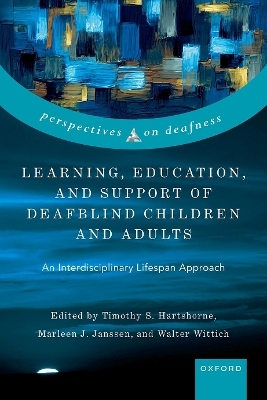
Learning, Education, and Support of Deafblind Children and Adults
Oxford University Press (Verlag)
978-0-19-288722-1 (ISBN)
Learning, Education, and Support of Deafblind Children and Adults presents the latest research on topics relevant for learners with deafblindness based on the most important studies of the last two decades. The diversity of deafblind people is explored with the authors bringing together relevant information from the fields of congenital, acquired, and age-related deafblindness, and those who are deafblind from different syndromes and etiologies.
Opening with a case study of a deafblind adult who shares his perspectives on barriers and facilitators in deafblind education, the volume then presents chapters by leading researchers from around the world on deafblindness. Bridging the gap between research and practice by the researchers themselves, along with deafblind individuals, the authors describe their essential research findings and interpret them in terms of valuable implications for educational and rehabilitation practice.
Divided into seven sections, the themes covered include the identification of deafblind persons; specific learning areas and interdisciplinary support; learning, self-determination, and education; participation, work, and recreation; family perspective; professionalization and interdisciplinary approaches; and research, technology, and innovations. With over fifty contributors, this volume brings together the current international scholarship on deafblindness and aims to stimulate new research on this rare but significant disability.
Timothy S. Hartshorne is a Professor Emeritus of Psychology, specialized in school psychology, at Central Michigan University. His interests include understanding the challenging behavior exhibited by many individuals with CHARGE syndrome, a rare genetic disorder, and how severe disability impacts the family. Prior to his retirement he was the grant holder for Deafblind Central, Michigan's deafblind project. He has been awarded a Star in CHARGE by the CHARGE Syndrome Foundation. He is first editor of the book CHARGE Syndrome, Second Edition. He holds a Diplomate in Adlerian Psychology from the North American Society of Adlerian Psychology. Marleen J. Janssen is a Professor Emeritus of Educational Psychology, in the research unit for Inclusive and Special Needs Education at the University of Groningen in the Netherlands. Her interests include communication development and learning in people with deafblindness. Her research is focused on communication assessment and intervention studies with people who are congenitally deafblind. Previously she was Editor-in-Chief of the Journal of Deafblind Studies on Communication, and Curriculum Coordinator of the MSc program in Pedagogical Sciences Communication and Deafblindness. She founded the University of Groningen Institute for Deafblindness and continues research and writing. Marleen was appointed Knight of the Order of the Netherlands Lion in 2019 and awarded the Deafblind International Lifetime Achievement Award in 2023. Walter Wittich is an Associate Professor at the School of Optometry, University of Montreal, in Canada. His research focuses on the rehabilitation of older adults with combined vision and hearing loss. His research domains include basic sensory science, as well as medical, psychosocial, and rehabilitation approaches to sensory loss. He is the inaugural chair of the Deafblind International Research Network, the 2020 recipient of the Canadian Helen Keller Centre 10th Annual JT Award, is a Fellow of both the American Academy of Optometry, and the Association for Research in Vision and Ophthalmology, and is Quebec's first Certified Low Vision Therapist.
Timothy S. Hartshorne, Marleen J. Janssen, Walter Wittich: Introduction
1: Walter Wittich and Elio Riggillo: The Success Story of Elio Riggillo: A Case Study on Education
Section 1. Identification
2: Megan Schmittel and Sharon Stelzer: Identification and Needs of Children with Deafblindness
3: Peter Simcock: Bridging the Congenital - Acquired Divide: The Experiences of Those Aging with Deafblindness
4: Bamini Gopinath: Prevalence, Incidence, and Risk Factors of Age-Related Deafblindness
5: Kolbein Lyng and Else Marie Svingen: Identification and Rehabilitation of Severe Dual Sensory Losses in Old Age
Section 2. Specific Learning Areas and Interdisciplinary Support
6: Jude Nicholas, Annika Maria Johannessen, and Trees van Nunen: Considering Tactile Cognition: Assessment of Learning Strategies Through Working Memory
7: Hans Erik Frölander and Claes Möller: Deafblindness, Theory-of-mind, and Cognitive functioning in Alström Syndrome and Usher Syndrome Type 2
8: Susan M. Bruce and Christopher Brum: Emergent Literacy in Individuals who are Deafblind
9: Marguerite Tibaudo: The Implications of Cortical/Cerebral Visual Impairment (CVI) on Deafblind Educational Programming
10: Natalina Martiniello: Touch Perception and Communication Across the Lifespan: Implications of Aging
11: Natalina Martiniello: Braille Instruction after Acquired Deafblindness: Lessons from Adult Learning
Section 3. Learning, Self-determination, and Education
12: Alexander Minnaert, Ineke Haakma, and Marleen J. Janssen: Autonomy-Support and Motivation in Learning of Students with Deafblindness
13: Berit Rönnåsen: Learning Aspects from a Special Education Perspective
14: Kate Chanock: Supporting a Deafblind Student's Learning at University: Case Study Of a Collaboration Between a Student, a Tactile Sign Interpreter, and a Learning Adviser
15: Leda Kamenopoulou, Peter Simcock, Norman Robert Boie, and Walter Wittich: Exploring Education and Employment Facilitators in Low- and Middle-Income Countries: Remote Research with Deafblind Adults
Section 4. Participation, Work, and Recreation
16: Atul Jaiswal and Walter Wittich: From Social Isolation to Social Inclusion through Social Participation among Individuals with Dual Sensory Impairment
17: Mattias Ehn: Work-Life Balance in People with Usher Syndrome
18: Lauren Lieberman and Pamela Beach: Deafblindness and Physical Activity
Section 5. Family Perspective
19: Agneta Anderzén Carlsson, Maria Björk, Karina Huus, and Moa Wahlqvist: Health and Family Life in Families Where a Parent is Deafblind
20: Rosemarie van den Breemer: Overcoming Epistemic Injustice in the Communicative Relationship Between Educational Professionals and Families with Children with Congenital Deafblindness
21: Sarah M. Sykes and Timothy S. Hartshorne: Medical Experiences and Trauma in Children and Adolescents with Charge Syndrome
22: Timothy S. Hartshorne: The Impact of CHARGE Syndrome on Parents and Siblings
23: Saskia Damen and Eline Heppe: The Impact of Usher Syndrome on Families: A Closer Look at Their Support Needs
Section 6. Professionalization and Interdisciplinary Approaches
24: Amy T. Parker, Lanya L. McKittrick, and Adam Graves: Considering Circles of Evidence to Inform Integrative Educational Standards for Personnel Serving Students who are Deafblind
25: Lillian J. Slavin: Educational Planning for Students with CHARGE Syndrome
26: Beth Kennedy: Trained Interveners Provide Access for People Who Are Deafblind
27: Christopher Russell: Addressing Quality Pre-Service Training for Educators Working with Students who are Deafblind and have Cortical Visual Impairment (CVI) in the United States
28: Julie Dufour, Marie-Claude Lavoie, Bernadette Gavouyère, and Catherine Houtekier: Deafblindness Rehabilitation Services in Quebec: A Unique and Interdisciplinary Approach
29: Peter Simcock: What the Social Work Profession Can Offer Deafblind People: A Marginalized Area of Practice, with a Marginalized Population
Section 7. Research, Technology, and Innovations
30: Jerry G. Petroff: Building Capacity for Successful Transition to Adult Life for Youth with Deafblindness: Creating and Promoting Evidence-Based and Promising Practices
31: Elena Maceviciute, Raymond Holt, Astrid M.L. Kappers, Nasrine Olson, and Nils-Krister Persson: Haptic Navigation Technologies for Persons with Deafblindness
32: Paul Mick and Natalie Morog: Cochlear Implantation for Individuals with Deafblindness
33: Arathy Kartha and Gislin Dagnelie: Experiences of Retinal Prosthesis Wearers with Auditory Impairment
| Erscheinungsdatum | 13.09.2025 |
|---|---|
| Reihe/Serie | Perspectives on Deafness |
| Verlagsort | Oxford |
| Sprache | englisch |
| Maße | 160 x 240 mm |
| Gewicht | 825 g |
| Themenwelt | Sozialwissenschaften ► Pädagogik ► Sonder-, Heil- und Förderpädagogik |
| ISBN-10 | 0-19-288722-X / 019288722X |
| ISBN-13 | 978-0-19-288722-1 / 9780192887221 |
| Zustand | Neuware |
| Informationen gemäß Produktsicherheitsverordnung (GPSR) | |
| Haben Sie eine Frage zum Produkt? |
aus dem Bereich